
R-134A vs. R-1234yf | Which Is Right for Your Car AC?
What if the car AC refrigerant inside your vehicle is not just wrong, but ruining your system silently? Sounds dramatic, but it happens more often than you’d think, especially here in Dubai where AC cooling performance is not a luxury, it is survival. Whether your car uses R-134A or R-1234yf, choosing the wrong one can lead to weak airflow, higher repair bills, or worse, total system failure. Let’s break down how this decision affects your comfort, your wallet, and your car’s long-term health.
9/2/20256 min read
What Is R-134A & Why Was It the Standard for So Long?
R-134A is a car AC refrigerant introduced in the early 1990s. It replaced R-12 due to environmental concerns and became the default gas in most cars built between 1994 and 2014. Why did it dominate?
It was reliable in high heat, ideal for Dubai’s climate.
Easy to service. Most garages had the tools and experience.
Affordable and available across the UAE.
But here is the catch: while R-134A protected the ozone, it still had a high Global Warming Potential (GWP). That made it a target in global emission reduction laws. So, manufacturers began shifting to alternatives like R-1234yf.
If your car was made before 2015, it likely still runs on R-134A. And unless you're facing leaks or replacing major parts, there's usually no urgent need to switch. Just don’t mix gases; it can damage the system. In short, R-134A worked well for years. But with rising regulations and better alternatives, its time is almost up.
What Makes R-1234yf the New Go-To?
R-1234yf is not just a newer version of car AC refrigerant; it is a full system shift. Designed to meet strict environmental standards, this refrigerant has a low Global Warming Potential (GWP), making it the preferred choice for modern cars. Since 2015, most new vehicles, especially from European, American, and Japanese brands, come factory-filled with R-1234yf. Why?
It meets EU and international emission laws.
It breaks down faster in the atmosphere, reducing long-term impact.
Automakers built newer AC systems specifically for it.
But this gas is not a drop-in upgrade. It requires special tools, new service machines, and trained technicians. In Dubai, some garages are still catching up. Refills cost more, since the gas is not as widely stocked as R-134A.
Can You Switch from R-134A to R-1234yf?
A lot of drivers ask this when topping up refrigerant, especially when R-134A prices go up or when they hear R-1234yf is “eco-friendly.” But this is not like switching oil brands. These refrigerants run on very different pressure levels, chemical properties, and system designs. What a proper conversion takes:
New expansion valve, O-rings, and sometimes even the condenser
Flushing out every drop of old R-134A
Changing the PAG oil to match the new gas
Reprogramming or recalibrating control modules in some models
Let’s not forget: most R-134A compressors are not rated for the thermodynamic load of R-1234yf. You might be forcing a component to work outside spec. That never ends well.
Keep it simple: stick to the refrigerant your car was built for. If it is R-134A, refill with R-134A. If it is R-1234yf, use R-1234yf. That decision alone saves a lot of heat-related headaches later.
Cost Breakdown | Which One Burns More Cash in Dubai?
Let’s get to the part no one likes talking about, money. Whether it is a quick top-up or a full AC overhaul, the type of refrigerant inside your system can change the price a lot. And if you are in Dubai, where AC recharge is as routine as tyre pressure checks, this stuff adds up fast. Here is how the numbers look:
Full Recharge
R-134A: AED 150 to AED 250
R-1234yf: AED 400 to AED 700
Leak Test & Refill
R-134A: AED 250 to AED 350
R-1234yf: AED 550 to AED 850
Compressor Replacement
R-134A: AED 1,000 to AED 2,000
R-1234yf: AED 1,300 to AED 2,500
Yep. That’s a pretty clear jump. So, why is R-1234yf more expensive if it is the newer thing? Shouldn’t tech get cheaper over time? Not in this case.
Why the Price Gap?
R-1234yf is a specialty gas, it is imported, limited, and not every shop stocks it.
You cannot refill it with regular AC machines. It needs special recovery units, separate storage, and leak-proof tech to prevent gas loss.
Fewer suppliers in the UAE = higher pricing power.
And let’s be real, some garages mark it up because most customers do not know better.
R-134A, on the other hand, is everywhere. Any AC shop in Al Quoz or Ras Al Khor has it ready. Technicians are familiar. Parts are easy to find. That is why the costs stay lower. But cheap and common does not mean problem-free, leaks are still the number one reason for repeated refills. Our detailed post on the UV Leak Detector explains how this simple tool can catch hidden leaks before they drain your wallet and your cooling.
Which Refrigerant Does Your Car Use?
Before spending a dirham, or worse, letting someone gas up your system blindly, you need to know what refrigerant your car uses. It is not always obvious, and guessing wrong can wreck your compressor or cause the gas to leak out within days. How to find out:
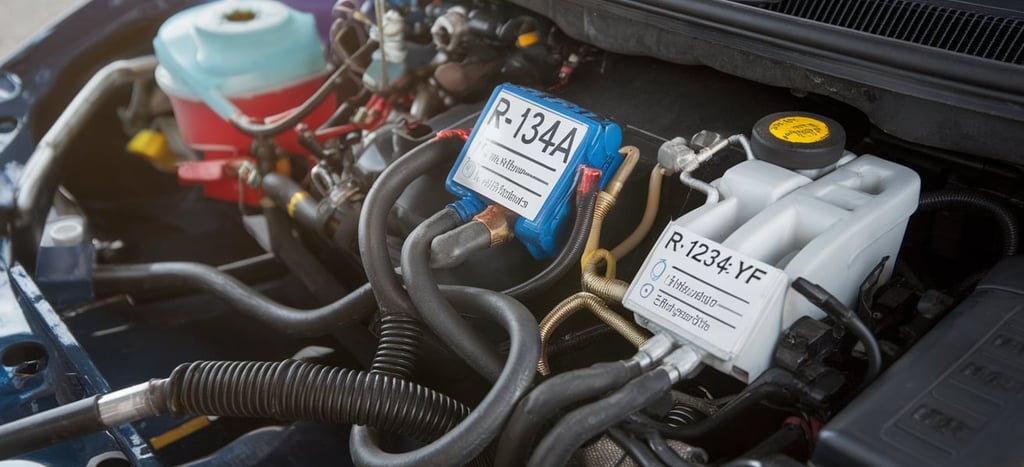
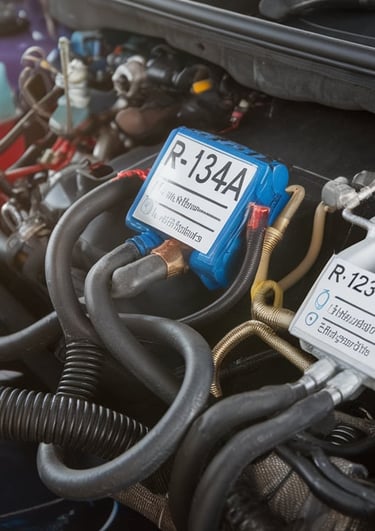
Check the label under the hood. Most manufacturers stick a white label near the radiator support or on the AC compressor. It will say either R-134A or R-1234yf, no guesswork needed.
Flip through the owner's manual. Boring? Yes. Accurate? Always.
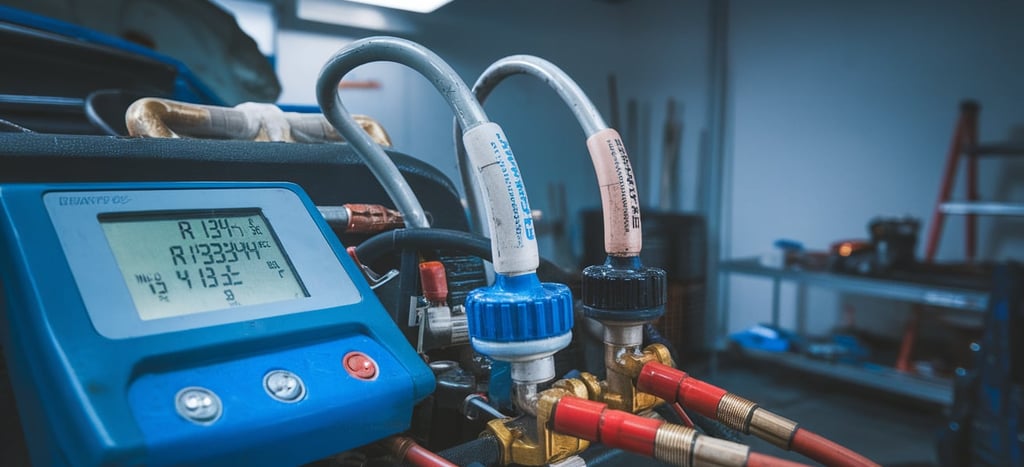
Ask your technician to test it. A quick pressure reading or refrigerant ID test tells the story without opening the system.
If you are driving a car made before 2014, chances are it runs on R-134A. If it is newer, especially EU or American models, then it likely uses R-1234yf.
Still not sure? Never top up without confirming first. Mixing gases will destroy your AC system and void your warranty and our car AC repair in Dubai team makes sure every recharge and repair is done the right way, protecting both your cooling and your car.
Some garages might offer a cheaper refill using whatever gas they have on hand. Walk away. Fast. That shortcut leads to burnt compressors, sensor errors, and in some cases, dashboard dismantling just to fix a leak caused by using the wrong refrigerant.
Choosing between R-134A and R-1234yf is not just about picking a gas, it is about understanding what your car was built for, how it handles Dubai’s extreme heat, and what kind of repair bills you are willing to deal with later. One is older, reliable, and cost-effective. The other is cleaner, regulated, and future-facing. But neither works if it is forced into the wrong system. So before you recharge, retrofit, or take advice from just anyone, pause. Let a technician who understands your system take a look. It will save you money, cool your cabin faster, and keep you out of AC trouble when the temperature hits 48.
Performance Face-Off R-134A vs. R-1234yf in Dubai Conditions
Dubai heat is not forgiving. You are not dealing with mild weather; you are battling 45°C traffic jams, sun-baked dashboards, and parked cars that feel like ovens. So when it comes to car AC refrigerants, performance is not a luxury; it is survival. Let’s talk about real results.
Cooling Efficiency
R-134A has been tested in Dubai's climate for decades. It cools fast, even under load.
R-1234yf? It works, but the cooling cycle is slower, especially during peak noon hours.
Newer systems using R-1234yf are designed to make up for that. Better insulation, tighter compressors, and smarter fans. But if you swapped it into an older system? It would struggle. That is just physics.
Pressure & Flow Dynamics
R-134A operates at higher pressure. That translates to faster heat exchange, hence quicker cooling.
R-1234yf runs cooler internally but needs more precise system tuning to hit the same performance level.
In a side-by-side test in two identical sedans, one with each refrigerant, R-134A dropped cabin temps 2–3°C faster.
Real-World Drive Test
In stop-and-go Sheikh Zayed Road traffic, R-134A keeps blowing cold air within a minute. R-1234yf might take a bit longer unless the car is moving and airflow improves.
If your car was built for R-134A, it will outperform in Dubai’s brutal heat. But if your car was designed for R-1234yf, you will still stay cool, as long as the system is in top shape. No refrigerant is perfect. But the right gas in the right system is what makes the difference. Trying to force one into the other? That is asking for trouble and in many cases, it is the AC Condenser that pays the price. High pressures, wrong gas, or cross-contamination can strain the condenser fins and coils, leading to weak cooling or even leaks. Our AC Condenser service in Dubai makes sure your system can handle the right refrigerant flow without compromise.
Experts
Get your car air conditioner repair done by reliable experts in Al Quoz.
Dubai
Contact
Car AC Heroes
0506087150
© 2024. All rights reserved.