
Van and Truck AC Repair Dubai
A van or light truck can cool differently at idle, in traffic, after loading or across a long shift. Diagnosis must account for condenser airflow, larger cabin heat gain, auxiliary fans, long lines, electrical demand and vehicle-specific access rather than treating the vehicle as an oversized sedan.
Why commercial cab AC faults hide in operating conditions
Commercial vehicles accumulate heat through large glass areas, dark dashboards, frequent door opening and long idle periods. A bulkhead, partition, added seats or modified interior can change air distribution. Drivers may also use maximum blower for hours, exposing a weak motor, controller or connector that survives a short workshop test. The intake therefore records the working pattern before measurements begin.
Condenser heat rejection is critical at low road speed. Fans, shrouds, stacked coolers, dirt and body modifications affect airflow. On a truck, access and radiator package layout may differ considerably from a passenger car. Engine-cooling warnings require the broader cooling system to be addressed rather than continuing an AC load test.
When the request involves multiple working vehicles, connect the repair with the fleet service framework. For a bus or minibus with several passenger zones, use the multi-zone commercial AC page instead of assuming the same diagnostic map.
Eight commercial-vehicle details that change the diagnosis
The component list is familiar, but size, access and duty alter how failures appear.
Traffic cooling depends on forced airflow
At road speed, natural airflow can mask a weak condenser fan, missing shroud or restricted heat exchanger. During idle, the system relies on fans and clean air passages.
The technician compares stationary and moving behaviour, fan command, engine temperature and pressure response. Gas should not be added to compensate for a heat-rejection fault.
Cabin heat gain changes with the route
Open doors, cargo partitions, added glazing and multiple occupants can overwhelm air distribution even when refrigerant performance is acceptable. The complaint may be slow pull-down rather than total failure.
The test records door condition, blower mode and cabin configuration. Any comparison with another vehicle needs a similar body and duty, not only the same badge.
Blower strength must reach the driver
A blocked filter, damaged wheel, weak motor, hot controller, collapsed duct or added interior trim can reduce useful airflow. High fan noise does not prove high air volume.
Vent distribution and motor current may be checked alongside temperature. If airflow is the primary fault, refrigerant work will not restore the missing volume.
Stacked cooling packs trap debris
Commercial front ends can collect sand, insects and packaging debris between condenser, charge-air cooler and radiator. Cleaning only the visible face may leave the restriction.
Inspection looks for access, fin damage, contamination between layers and fan coverage. Cleaning method must avoid bending fins or forcing debris deeper.
Long refrigerant routes create more inspection points
Hoses and pipes may cross a long chassis path, pass near vibration sources or serve an additional unit. Supports, crimps and abrasion points deserve attention.
A leak test follows the full route that belongs to the AC system. Cargo refrigeration circuits are kept separate unless the workshop has an approved scope for them.
Long shifts expose heat-sensitive connections
Blower controllers, fan relays, fuse boxes and connectors can heat under sustained current. A short cool-morning test may miss the complaint that appears after hours.
The technician checks the failure timing and relevant voltage drop or current rather than fitting a bigger fuse. Melted or discoloured connectors require the load cause to be investigated.
Drive system and control strategy vary
Some vehicles use belt-driven compressors with clutches, others use variable displacement or electrically controlled units. Engine speed and control data affect interpretation.
Noise, command, pressure change and belt condition are considered together. A compressor should not be condemned because the pulley area is noisy without locating the source.
Vehicle size changes workshop planning
Height, length, weight and underbody access determine the suitable bay and lifting equipment. Roof units or high cabs may need additional clearance.
The booking confirms dimensions before arrival. Unsafe improvisation around a vehicle that exceeds equipment capacity is not accepted as commercial-service flexibility.
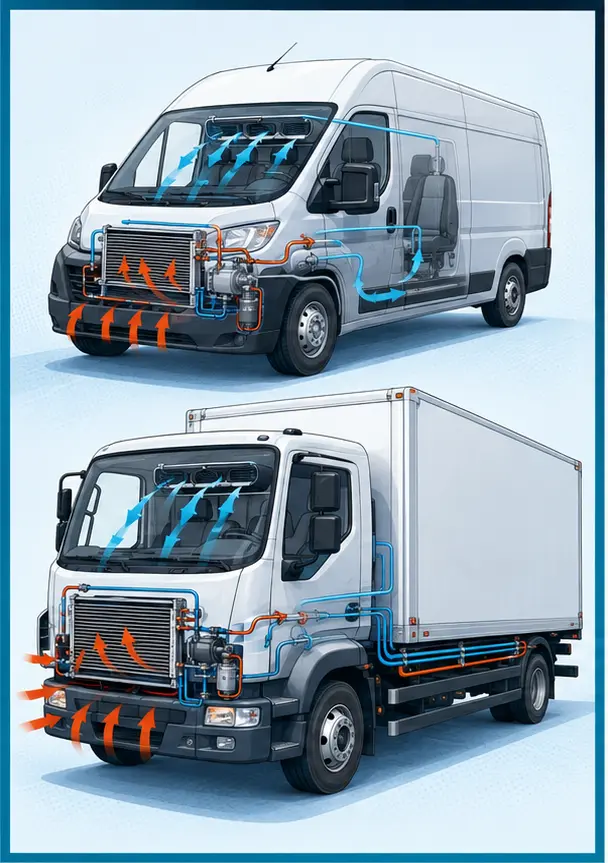
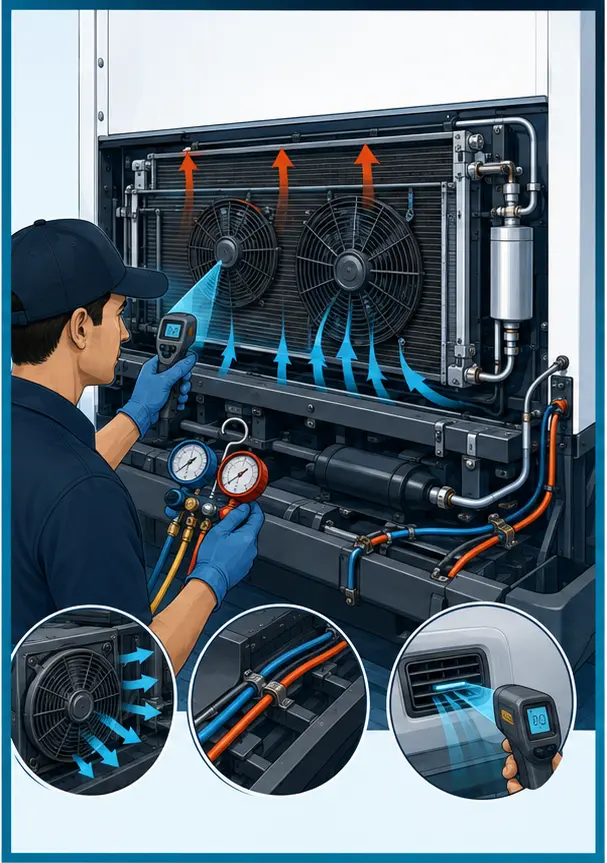
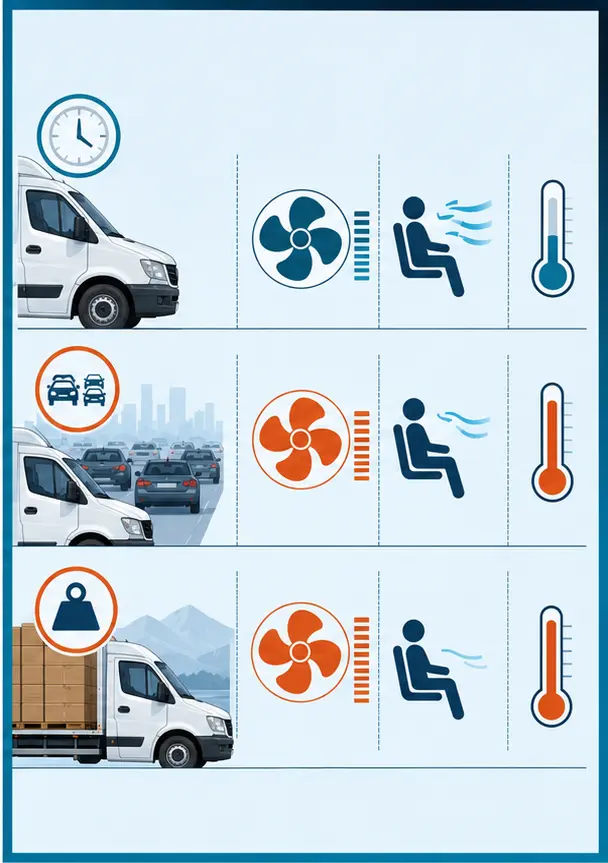
Cab airflow, heat rejection and duty-cycle testing explain the repair
The illustrations show generic van and light-truck layouts. Actual component position and capacity vary by manufacturer and body conversion.
Commercial size and downtime shape the quotation
The estimate can include diagnosis, bay or lift needs, refrigerant handling, parts, access labour and final testing. Vehicle dimensions and conversion work can change access substantially. A light van and a large truck should not receive the same starting assumption.
Any public price is provisional until the commercial vehicle is inspected. A commercial repair quotation follows confirmation of, exact chassis and body specification, fault severity, refrigerant, parts choice, required work, supplier timing and current workshop capacity.
Downtime is an operational estimate, not a warranty. A repair that exposes contamination, damaged lines or a second circuit can expand after access. The workshop should pause, document and request approval rather than hiding added work inside a commercial urgency charge.
Symptoms that become clearer when duty is included
Share the operating condition so the workshop can choose the correct repeat test.
| Operating pattern | Commercial AC test | Workshop implication |
|---|---|---|
| Cold on highway, warm in traffic | Condenser airflow, fan command, stacked cooler restriction | Engine temperature and pressure behaviour determine urgency |
| Strong fan noise, little air at vents | Filter, blower wheel, ducts, mode doors and controller | Added trim or bulkheads can change distribution |
| Cooling fades late in the shift | Heat-sensitive electrical points, compressor control and icing pattern | A short morning test may need extended reproduction |
| One cabin zone weak | Duct routing, rear blower, valve or separate evaporator path | Confirm whether the body conversion added a second unit |
| Oil or dye along a long hose | Full line route, support and abrasion inspection | Evidence must show an active refrigerant source before repair |
| Engine warning appears with AC | Stop the AC load test and inspect engine cooling | Do not treat this as a comfort-only appointment |
Cargo refrigeration, heavy-truck sleeper systems and specialized conversions may need a separate technical scope. Confirm the system before booking.
A repair path built around the working vehicle
The process begins before bay allocation because dimensions and duty affect the test.
Vehicle and body identification
Record chassis, body conversion, cabin zones, refrigerant label, dimensions and any cargo cooling system. Separate circuits are not assumed to share parts or service methods.
Driver pattern interview
Capture idle time, route, load, door opening, start time and when performance changes. A repeatable duty symptom is more useful than a guessed component.
Baseline in the bay
Measure airflow, temperatures, controls, fans and relevant pressures under stated ambient conditions. Engine-cooling behaviour is observed where it affects safe testing.
Targeted circuit checks
Inspect condenser pack, electrical loads, compressor control, line route, filter and ducts according to the pattern. Refrigerant work follows identification and leak awareness.
Scope and operational decision
The estimate identifies parts, access, downtime and whether the vehicle can continue limited use. Commercial urgency does not erase safety or approval requirements.
Loaded-condition verification
Where practical and safe, final testing reflects idle, blower range and the failure condition. The handover records any limit that could reappear under a route condition not reproduced.
Testing idle performance without overheating the vehicle
A complaint that appears during long idle needs careful reproduction because the same condition also loads engine cooling, charging and under-bonnet heat rejection. The technician watches fan command, engine temperature, electrical voltage and refrigerant response while the cab is operated. If engine temperature rises abnormally, the AC test stops and the engine-cooling issue takes priority. It would be unsafe and technically misleading to continue until the AC produces a dramatic pressure reading. The aim is to capture the transition toward failure without creating additional damage.
Commercial modifications deserve their own record. A body builder may add rear evaporators, long hoses, auxiliary relays or controls that do not appear in the chassis manufacturer’s basic diagram. Those additions are traced and labelled before parts are selected. When information is missing, the quotation may include access or circuit mapping rather than pretending the conversion is factory standard. The handover should identify which unit was repaired and which separate system, including any cargo equipment, remained outside scope.
After the repair, the workshop can compare outlet temperature and airflow at idle and at a controlled higher engine speed, while watching fan and charging behaviour. If the complaint required a loaded route that cannot be recreated, the driver receives a short observation list rather than a claim that every duty condition passed. Recording the test protects the next decision if the vehicle returns after a long shift.
Van and truck AC questions
Commercial operation creates questions that a passenger-car page cannot answer.
Can you test the vehicle while it is loaded?
Sometimes, if access, weight, bay capacity and safety allow, but loading can restrict inspection. Explain the cargo and operating need before arrival. Temperature-sensitive goods require a separate protection plan.
Why does the AC fail only in traffic?
Low road speed removes natural airflow, so condenser fans, shrouds and restrictions become more important. Pressure and engine-cooling behaviour must be measured before assuming low gas.
Do you repair cargo refrigeration?
Not automatically. Cargo systems may use separate equipment, refrigerants and regulations. Identify the unit and request a distinct scope. Cab AC service should not be advertised as universal transport-refrigeration repair.
Can you service several vans together?
Yes, through the fleet service process, subject to scheduling and bay capacity. Shared reporting is useful, while each vehicle keeps its own diagnosis and approval.
How long will a commercial AC repair take?
It depends on fault reproduction, access, vehicle size, parts and the final test. A filter or relay differs from a long-line leak, condenser pack, compressor or added rear unit. The written estimate states the current target and limitations.
Send the route pattern with the vehicle details
Tell us the chassis, body type, dimensions, cabin zones, usual load and when the cooling changes. We will plan the correct bay and diagnostic route.