
Full Car AC System Diagnostic Dubai
Get a clear explanation of why your car AC is not working and what to do next. Budget AED 100–350 for workshop diagnosis as an indicative Dubai range. Our mobile inspection is AED 199 including VAT for the agreed visit and accessible checks. We confirm the right scope and your total before booking. If you only need an initial no-dismantling baseline screen, see exactly what our free car AC check includes before choosing the paid diagnostic route.
Car AC diagnostic prices in Dubai
The right check depends on the problem, the access needed and whether you want a workshop or mobile visit.
Initial workshop screen
Free
A starting point for an accessible, no-dismantling AC screen. It can help decide whether paid fault finding is worthwhile.
This is not a complete diagnostic or a pre-purchase AC report. Check the free AC check inclusions before arranging your visit.
Workshop diagnosis
AED 100–350
Indicative Dubai budget, quoted for your car. The range comes from our AC repair cost guide and calculator. It is not a fixed workshop tariff.
Tell us the symptoms so we can confirm the required test depth. VAT treatment for the planning range is not specified; request the VAT-inclusive total. Complex electrical tracing, dismantling or extended intermittent-fault checks can cost more.
Mobile AC inspection
AED 199
Including VAT. Van attendance at your confirmed Dubai location and the agreed cooling, airflow and accessible component checks.
Parts, refrigerant, repairs and further workshop testing are separate. Confirm your vehicle, parking access and the mobile inspection scope before the van travels.
A mobile inspection and an in-depth workshop diagnostic are different scopes. We help you choose the useful first visit. Any further testing, repair or fee credit is agreed in writing before you proceed.
What a full AC diagnostic is designed to resolve
If your car AC is blowing hot air, the cause can be low refrigerant, condenser airflow, compressor control, a metering restriction, evaporator icing, weak blower output or a blend-door problem. Intermittent faults can involve power, grounds, networks, sensors or temperature-dependent electronics. The full diagnostic chooses a sequence from the symptom instead of opening every component without purpose. If you are still working out which pattern best matches your car, use the free online AC symptom checker before booking.
The agreed fee covers the defined diagnostic process, time and report. It is not an unlimited promise to dismantle a dashboard, recover contaminated refrigerant, program every module or operate the vehicle for days. If deeper access becomes necessary, the technician explains what new evidence is sought and requests approval before expanding scope.
Once we establish what is causing the problem, we can quote for leak repair, compressor repair, blower service, electrical climate-control diagnosis or the specific repair your car needs. If the part names are unfamiliar, the car air conditioning components guide maps the complete system before the repair decision.
Six diagnostic layers that prevent parts guessing
Each layer answers a different question and can redirect the next measurement.
The failure pattern selects the test
The intake records onset, idle or speed effect, fan setting, side-to-side difference, noise, smell, water, warnings and recent work.
A repeatable pattern can prioritize heat rejection, airflow, charge loss or electrical control before the system is connected to equipment.
If the system still produces cool air but cannot control the cabin heat, see why a car AC can be cool but not cold enough for the specific partial-cooling path.
Cabin delivery is measured separately
Filter, blower, outlets, doors, evaporator temperature and cabin zones determine how cooling reaches passengers.
Cold refrigerant lines do not prove useful cabin performance. Weak air and warm air remain separate measurements.
Pressure is interpreted with temperature and command
Refrigerant identity, charge history, pressure response, line temperatures and leak evidence are considered together.
A pressure reading without ambient condition, airflow and compressor state can support the wrong conclusion. For the interpretation logic behind low-side, high-side, static and running readings, see our car AC pressure chart and gauge readings guide.
Condenser and fan operation protect the circuit
Restricted fins, weak fans, missing shrouds or stacked-cooler debris can raise pressure and reduce cooling at idle.
Adding refrigerant cannot correct poor heat rejection and may increase stress when charge is already correct.
Command and physical response are both required
Fuses, supplies, grounds, sensors, network data, relays, actuators and compressor requests are tested according to the symptom.
A scan command does not prove a fan turned or a compressor moved refrigerant. The test closes the loop at the component response.
The original complaint closes the job
After diagnosis or repair, the system is operated under recorded conditions and relevant codes or warnings are reviewed.
If the intermittent failure does not return, the report states that limit and preserves a monitoring plan rather than declaring certainty.
Agree the testing before work starts
Fixed means the agreed included diagnostic does not change because the first theory was wrong. It does not mean unlimited dismantling, specialist programming, contaminated-refrigerant disposal or repeated visits. Those potential extras are identified before work begins.
The repair estimate remains indicative until exact access and parts are confirmed. Vehicle specification, fault severity, component choice, refrigerant, required work, programming and current availability determine the final written quotation.
Sometimes the most accurate result is that the intermittent fault was not reproduced. The report should still list tests, observations, stored evidence and the repeat condition. Honest uncertainty is more useful than an unsupported part recommendation.
What happens under the agreed diagnostic fee
The booking makes the boundary visible before testing begins.
Scope and fee confirmation
State the complaint, fixed diagnostic fee, included test depth and exclusions in writing. Repair is not pre-approved.
Baseline reproduction
Operate the vehicle under the closest safe condition to the complaint and record ambient, controls, airflow and temperature.
System-path testing
Follow evidence through cabin airflow, condenser, compressor, refrigerant, electrical and control layers. Avoid unrelated dismantling.
Fault confirmation
Use measurements and repeat behaviour to identify the failed component, circuit or condition as far as the scope allows.
Repair options and estimate
Explain repair, replacement, further access or monitoring, with price factors, parts and downtime. Customer approval remains separate.
Final report
Provide completed tests, confirmed findings, unresolved limits, driveability guidance and the next action whether repair is accepted or declined.
Included diagnostic value versus possible extra scope
The exact written booking controls; this table explains the distinction.
| Diagnostic element | Agreed-fee value | Possible extra scope |
|---|---|---|
| Complaint history and operating baseline | Normally part of the agreed diagnostic | Extended heat-soak or multi-day monitoring may need approval |
| Accessible visual, airflow and control checks | Normally part of the agreed diagnostic | Dashboard or sealed-unit dismantling is separate |
| Relevant scan and electrical tests | Included to the defined access depth | Programming, network-wide tracing or module bench repair is separate |
| Refrigerant performance assessment | Included as stated in the booking | Recovery, contamination handling, refill and leak repair are separate unless listed |
| Finding and repair estimate | Part of the diagnostic result | Parts and labour require customer authorization |
| Post-repair verification | Included with approved repair as quoted | A diagnostic-only visit does not include future repair testing |
Use AED 100–350 as a workshop diagnostic planning range. Your written quote confirms the exact fee, VAT-inclusive total and included tests. Additional access or specialist testing is quoted before it starts.
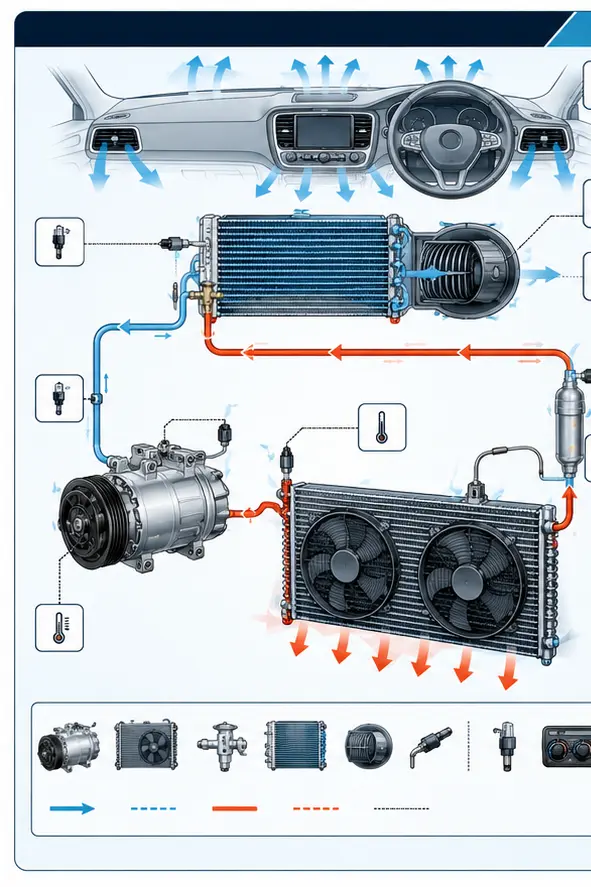
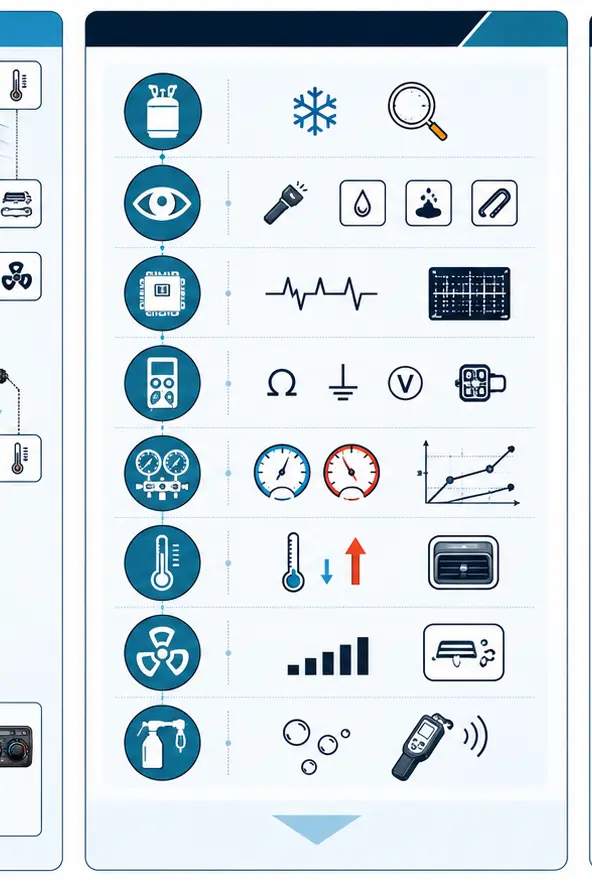
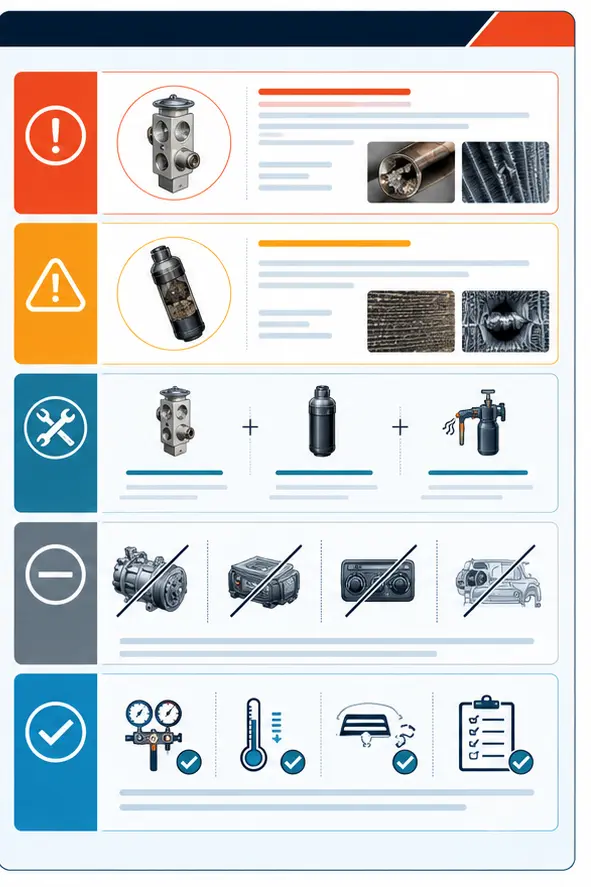
System map, test order and report structure make the diagnosis visible
Follow the system layout, testing sequence and findings that help explain the repair decision.
What a customer should be able to understand from the final report
The report should show the reproduced complaint, evidence level, repair order and safe next step without forcing the customer to decode workshop shorthand.
Complaint and proof
The report begins with the complaint in the customer’s language and the condition that reproduced it. It then lists the measurements that matter, such as selected vent temperatures, airflow observation, fan response, pressure behaviour, relevant codes and electrical results. It does not dump every scan value or gauge reading without interpretation. Each item is tied to the decision it supports, including what was ruled out. That makes the result useful to the customer and to any technician who continues the work later.
A confirmed fault is separated from a contributing condition. For example, a failed condenser fan may explain high idle pressure, while a dirty filter separately reduces cabin airflow. Repairing one can improve cooling without resolving the other. The estimate can present a required repair, an optional maintenance item and a monitoring item instead of bundling everything as one emergency package. If access is needed to prove a hidden evaporator leak or actuator failure, the report states the reason and the next diagnostic fee or labour authorization.
Safety and supporting evidence
Driveability guidance remains careful. The report can advise leaving the AC switched off because a compressor or belt noise may worsen, or recommend recovery because overheating, smoke, high-voltage damage or another risk appeared. It should not declare a vehicle safe solely from an AC inspection. When the issue is comfort-only and no wider risk was found in the completed scope, the wording still reflects that limited observation. Accurate boundaries protect the customer from false reassurance and protect the workshop from claims outside its test.
Photographs can support the report when they show a damaged connector, oil trace, blocked condenser, incorrect filter or measured display. They should be cropped to the technical subject and should not expose number plates, documents or unrelated personal items. A photograph is evidence of appearance at one time, not proof of an active leak or internal failure unless the related test connects it to the complaint.
Options without guesswork
If the customer seeks a second opinion, the report should make that easier. Vehicle identifiers, test condition, readings, fault codes, circuit conclusions and unresolved steps remain legible without requiring the next technician to accept a hidden assumption. A strong diagnostic can therefore retain value even when repair is completed elsewhere. The fixed fee pays for this structured decision record, not only for the minutes a scanner or gauge was connected.
A diagnostic also prevents several weak repairs from being stacked on the same car. Replacing a filter, adding refrigerant and fitting a relay can each change one symptom while leaving the main failure unresolved. By recording the system baseline before intervention, the technician can see which evidence points to the primary cause and which maintenance item is merely adjacent. The customer can approve work in a logical order and judge the result against the complaint that started the visit.
Repair order and continuity
When multiple faults are confirmed, the report can show dependencies. A condenser fan may need repair before charge performance can be judged reliably. A melted blower connector may require motor-current testing before a new connector is protected. A refrigerant leak may need sealing before compressor capability is evaluated under the specified mass. Ordering work this way prevents one abnormal condition from distorting the next test and gives the customer a defensible sequence for approval.
That ordered sequence is retained even when the customer delays repair, so the next visit resumes from the evidence rather than repeating the entire intake.
Full diagnostic questions
The fee is easier to judge when the result and boundary are explicit.
How much does car AC diagnosis cost in Dubai?
Workshop diagnosis typically falls within the indicative AED 100–350 Dubai planning range. This is not a fixed Car AC Heroes tariff or a maximum for complex faults. We confirm your testing scope and VAT-inclusive total before booking. Our mobile inspection is AED 199 including VAT for the agreed visit and accessible checks.
Does the fee include repair?
No, unless the written booking explicitly lists a small included action. Diagnosis produces the finding and estimate. Refrigerant, parts, labour, programming and extended access require separate approval.
Will you find every intermittent fault in one visit?
Not always. A heat, vibration, charging or road condition may not repeat. The report should preserve evidence, list what was ruled out and define a monitoring or repeat-test plan.
Why not just read the fault codes?
Codes identify what a controller observed, not always the failed part. Supplies, grounds, sensor plausibility, commands and physical response must be checked. Mechanical and refrigerant faults may store no code.
Can the diagnostic fee be credited toward repair?
Any diagnostic-fee credit toward an approved repair must be stated in your written quote. A credit is not automatic. Your diagnostic findings remain useful if you choose to delay or decline the repair.
Book the right AC diagnostic for your car
Send your vehicle, symptoms and preferred workshop or mobile visit. We will confirm the included checks, VAT-inclusive price and available appointment. For a car you are considering buying, read our used-car AC inspection guide and mention that the check is before purchase.