
Fleet and Commercial Vehicle AC Service
Fleet AC service is not a row of unrelated retail jobs. It needs vehicle-level evidence, common inspection fields, authorization limits, downtime priorities and a clear way to separate urgent failures from planned maintenance.
Why fleet AC decisions need a common language
A driver may report “not cold,” while another reports weak airflow, slow pull-down after loading or failure only at idle. If every vehicle is assessed differently, the fleet manager cannot compare urgency or spend. A repeatable intake records ambient condition, vent result, fan behaviour, refrigerant history, warning data and operating context. The aim is consistency of evidence, not identical repair recommendations.
Service timing must match operations. Delivery windows, school or staff transport, refrigerated cargo, night shifts and standby vehicles create different priorities. A failed sedan can sometimes be exchanged; a specialist van may stop a route. The workshop needs the planned downtime window and a named approval path before dismantling or ordering parts.
Commercial vehicles also divide into distinct technical intents. Use the van and truck AC page for cab cooling, larger condensers and loaded operation, and the bus and minibus page for multiple cabin zones, long ducts and roof or rear units.
A practical status matrix for AC fleet work
Shared labels allow fast scanning while the report underneath preserves technical detail.
| Fleet status | Recorded evidence | Management action |
|---|---|---|
| Monitor | Cooling and airflow meet the agreed test; a non-critical observation remains | Record the condition and next review trigger |
| Service planned | Filter, cleaning, fan or other maintenance item is due | Book within the operational window and confirm parts |
| Diagnosis required | Complaint exists but the cause is not yet confirmed | Approve the next test rather than a guessed replacement |
| Repair approved | Fault, scope and estimate are accepted | Track parts, bay time and target release |
| Awaiting decision | Evidence and quotation were sent | Vehicle use and holding conditions must be clear |
| Returned with limitation | Vehicle was released but a conditional or deferred issue remains | State the restriction, warning signs and follow-up date |
Fleet pricing, credit, response targets, pickup coverage, warranties and service-level commitments require a written manager-approved agreement.
Eight controls that turn repairs into fleet management
The controls are designed for traceability, not paperwork for its own sake.
Every unit keeps a stable identity
Fleet number, registration, VIN where securely required, make, model, year, engine or powertrain and refrigerant are matched to the work order. Driver nicknames are not reliable identifiers.
A stable record prevents history from moving to the wrong vehicle and makes repeat failure visible. Private information remains limited to the operational need.
Measurements use comparable conditions
Ambient temperature, operating mode, doors, blower setting, engine speed and vent location affect results. The technician records enough context to compare vehicles and later verify the same unit.
A single temperature number without test conditions can make a healthy large cabin look worse than a small sedan. Comparability protects repair priorities and supplier conversations.
Driver language is translated into patterns
The intake asks when cooling fades, which zone is affected, whether idle or load changes it and whether noise, smell or water appears. The driver’s observation remains attached to the record.
The technician then separates symptom from cause. A useful fleet report does not convert every “warm” complaint into a gas top-up or every “no air” complaint into a blower.
Spending limits are explicit
The fleet agreement identifies who can approve diagnosis, routine items, major parts, transport and work above a threshold. It also states how uncontactable approvers are handled.
No workshop should infer authorization from a previous vehicle or an urgent route. Clear limits reduce delay while preserving financial control.
Downtime risk is ranked visibly
A vehicle that carries passengers, operates long daytime shifts or has no spare may receive earlier attention than a unit due for planned replacement. Safety-related symptoms remain separate from productivity.
The rank and reason are recorded so workshop order can be defended. False emergency labels across every vehicle would destroy the usefulness of priority.
Common stock follows real history
Filters, relays, fan controllers or other repeat items may justify planned stock only after the fleet’s exact applications and failure pattern are verified. Guessing from badge similarity creates unused inventory.
Major compressors, modules and heat exchangers stay vehicle-specific. The estimate identifies availability and choice rather than assuming a bulk part fits the roster.
Return-to-service has defined checks
The final record can include vent performance, blower speeds, fan operation, relevant warning status, leak or electrical verification and the driver complaint outcome. The field set changes with the repair.
A tick marked “cold” is not enough for a repeated or zone-specific fault. The test should show what condition was recreated and what remains conditional.
Recurring faults are investigated across units
Multiple vehicles with dirty filters may reflect route dust or schedule. Repeated fan failures may involve operating pattern or a shared component. One repeat on one vehicle may instead be an unresolved individual fault.
Periodic review separates systemic opportunities from random events. It should not be used to invent savings, claim guaranteed uptime or replace vehicle-specific diagnosis.
How a fleet batch moves without losing exceptions
Each vehicle travels through the same status language, while technical depth follows its own fault.
Roster and operating brief
The manager supplies vehicle identities, duty patterns, depot access, priority rules and approval contacts. Existing service history is mapped where available.
Scheduled intake
Vehicles arrive or are collected in agreed groups that fit bay capacity and operations. Condition and driver complaints are attached to the correct unit.
Repeatable screening
Technicians use common baseline fields for airflow, cooling and controls. Units with safety or hard-failure symptoms leave the preventive queue for diagnosis.
Vehicle-level diagnosis
The suspected circuit is tested according to that model and complaint. Findings, parts and quotation remain linked to the individual work order.
Controlled authorization
Routine and exception approvals follow the named limits. Waiting status, supplier timing and revised return expectations are communicated.
Release and review
Final checks close each vehicle separately. Batch reporting then highlights overdue work, repeat complaints and planning opportunities without hiding unresolved units.
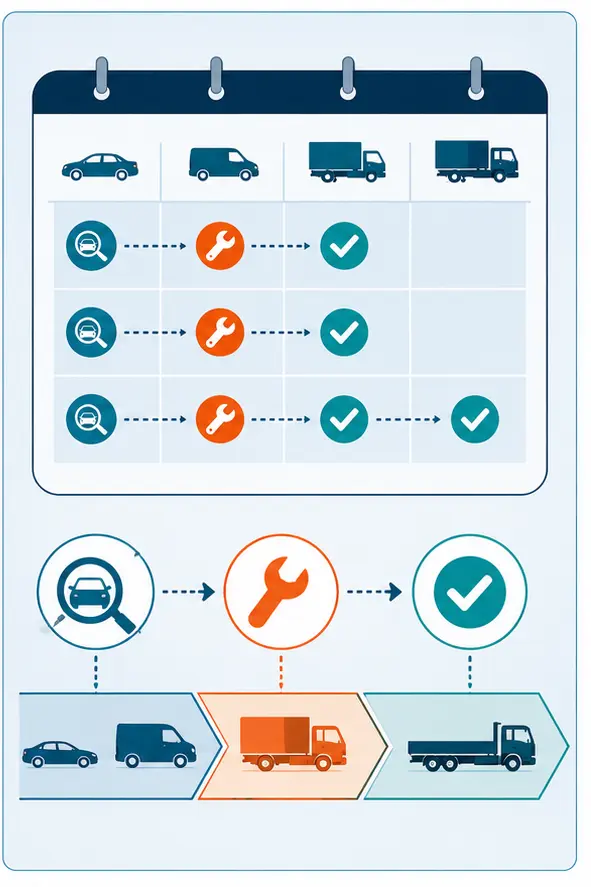
A mixed fleet needs common checkpoints and vehicle-specific decisions
The visual set represents process design, not an actual customer fleet or performance result.


Commercial pricing should expose the unit behind the total
A batch price can still show diagnostic, routine-service, parts, labour, transport and tax lines by vehicle. Without that detail, the manager cannot see whether one major repair or many small items moved the total. Transparent unit records also help warranty and repeat-fault review.
Volume does not guarantee identical cost. Access, refrigerant, vehicle size, cabin zones, parts and fault severity vary. Each unit estimate is built from recorded findings about, exact specifications, required work, choices, supplier availability and current conditions.
Preventive packages must define the checks and exclusions. A visual inspection is not a leak guarantee, and a successful temperature test does not prove future uptime. Claims about savings or reduced downtime need the fleet’s real baseline and manager-approved measurement method.
Use failure history without turning it into automatic replacement
A fleet history can show that several filters loaded quickly on one route, that fan connectors overheated on a particular vehicle group or that complaints rise after a certain operating interval. Those patterns help set inspection triggers and stock decisions, but they do not prove the next vehicle has the same failure. The technician still records the individual complaint and measurement. Trend data guides the test order; it does not replace diagnosis or authorize the part. This distinction protects the fleet from bulk replacement that looks efficient but does not resolve unit-level causes.
Review meetings should separate completed repairs, repeat complaints, deferred work, waiting approvals and unavailable parts. A vehicle returned with a limitation remains visible until the condition is closed. Cost reporting should distinguish planned maintenance from breakdown response and identify transport or downtime assumptions. If the business wants to claim reduced downtime or lower spend, the baseline, time window and excluded events must be agreed before measurement. Otherwise the figures become marketing rather than operational evidence.
Driver feedback needs a controlled route into the record. A driver can report the time, vent group, load, idle condition and warning without choosing the failed part. The fleet contact then decides whether the unit enters planned screening or priority diagnosis. This preserves useful frontline observation while preventing duplicate calls, unauthorized requests and contradictory descriptions. When the vehicle returns, the same driver complaint is checked again so the closure reflects the original operating problem. The completion note also records the driver who confirmed the original symptom was rechecked.
Fleet AC planning questions
A proposal becomes accurate when operational and technical terms are separated.
Can you service cars, vans and trucks in one fleet?
Yes, subject to vehicle size, bay capacity and agreed scope, but they should not receive an identical checklist by default. Baseline fields can be shared while access, cooling load, components and final tests remain vehicle-specific.
Do you offer fleet discounts or credit?
No unapproved commercial term is stated here. Volume pricing, payment terms, credit, pickup, warranty and response targets require manager review and a written agreement based on the fleet and expected work.
How do you prevent unauthorized repair?
The account identifies approvers and spending limits. Each vehicle retains its own finding and estimate. Work above the agreed routine scope waits for authorization, and previous approvals are not assumed to apply to another unit.
Can you guarantee reduced downtime?
No. A structured program can improve visibility and planning, but uptime depends on vehicle condition, parts, operations and many factors outside AC service. Any improvement claim should be measured against the fleet’s actual baseline.
What should a fleet report include?
At minimum, stable vehicle identity, driver complaint, test context, confirmed finding, approval status, work completed, parts, final checks and unresolved actions. Summary fields should link back to the vehicle record rather than replacing it.
Build the fleet AC workflow around your operation
Send the vehicle mix, operating pattern, depot or collection needs and approval process. We can define a practical inspection and reporting scope before the first batch arrives.