
Mobile Car AC Repair Dubai
A mobile visit can confirm many electrical, airflow and operating symptoms where the car is parked, but it is not a promise that every refrigerant or mechanical repair can be completed safely on-site. The booking starts with the vehicle, location, access and symptom so the right equipment and next step can be planned.
What mobile car AC repair can realistically cover
A car that still drives normally but has weak cooling, intermittent airflow, unusual fan behaviour or a control complaint may be suitable for an initial visit at home, work or another permitted location. The technician can review the symptom history, inspect accessible components, read relevant control data, check electrical supplies, compare vent temperatures and observe how the system behaves at idle. Those checks can separate a cabin airflow problem from a refrigerant-circuit or command problem without asking the driver to guess the failed part.
The location matters as much as the fault. Safe access, ventilation, lighting, ground condition and permission to work all affect what can be performed. Underground parking may restrict a service vehicle, communication or exhaust ventilation. A busy roadside, soft sand, steep ramp or prohibited building area can make even a basic inspection unsuitable. When the setting is wrong, moving the car to AMF Auto Services at 39 Al Quoz 4 is part of safe planning rather than a service failure.
Mobile diagnosis should connect with the wider full AC diagnostic service when pressures, leak testing, refrigerant recovery, extended electrical tracing or dismantling are required. The driver receives a clearer decision: continue at the location, schedule workshop work, or arrange transport because the vehicle should not be driven.
On-site assessment, measurement and workshop referral are different stages
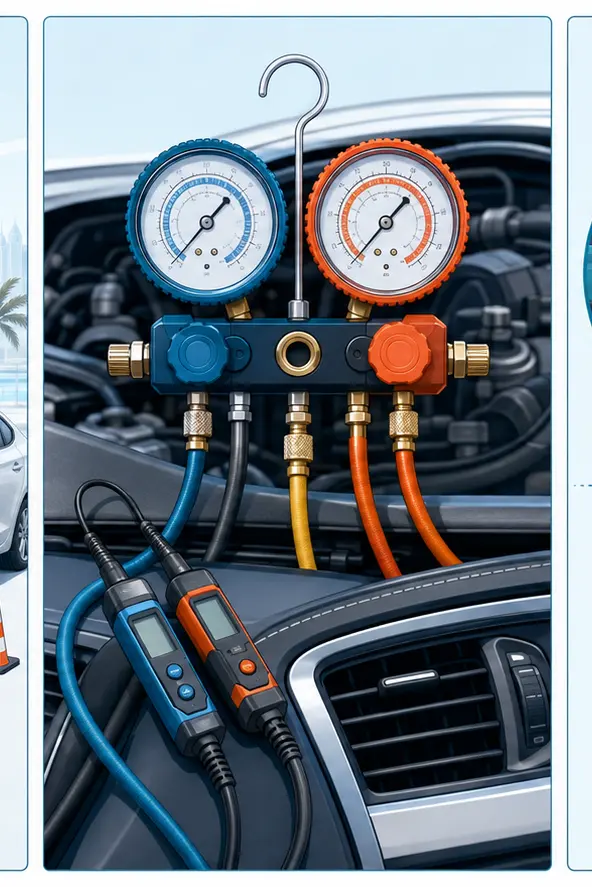
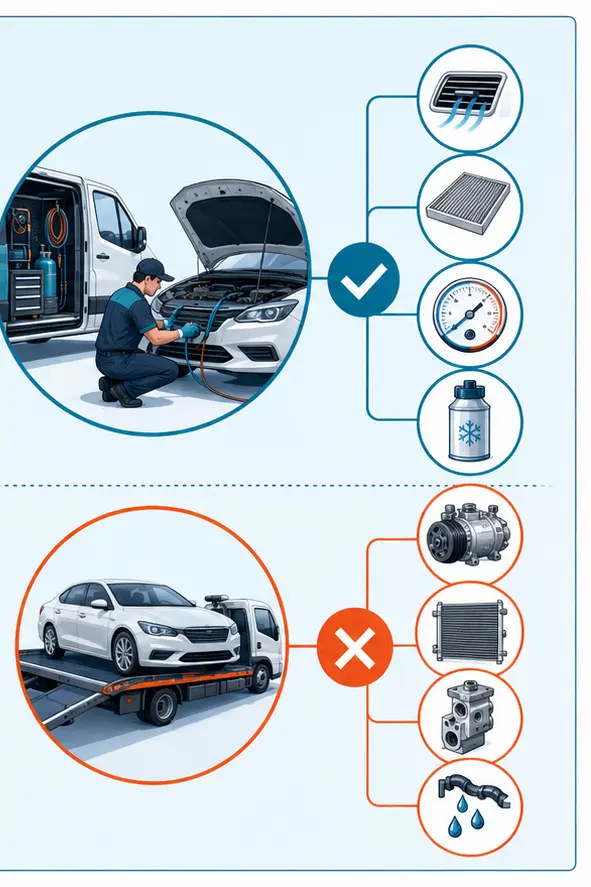
These educational illustrations show the service relationship. They are not photographs of AMF Auto Services work and do not claim that every pictured tool is carried to every booking.

Eight boundaries that protect the vehicle and the diagnosis
The following distinctions prevent a mobile booking from being sold as a universal repair solution. They also help the driver send the information that determines whether a visit is useful.
The working area must support the task
A flat, legal and well-ventilated space is needed around the vehicle. The technician must be able to open doors and the bonnet without blocking traffic, fire routes or neighbouring vehicles.
If the property prohibits mechanical work, the visit can still be converted into collection or workshop intake. Permission should be settled before arrival so paid time is not lost at a security gate.
Weak cooling is not a diagnosis
Warm air can result from low refrigerant, condenser airflow loss, a compressor command problem, an electrical fault, an air-mixing door or weak blower output. Temperature alone cannot identify which part needs attention.
The mobile check records when the cooling changes, whether engine speed affects it, how it behaves in traffic and which vents differ. Those patterns choose the first measurement instead of choosing a component.
Gas work needs controlled equipment
Refrigerant should be identified, recovered where required, measured and charged to the vehicle specification. Venting, topping up an unknown mixture or using a can without leak awareness is not a responsible mobile shortcut.
If the service location cannot support compliant recovery, vacuum or charging equipment, the circuit remains closed and the vehicle is referred to the workshop. The limitation is stated before any chargeable gas service is approved.
Many command faults can be narrowed on-site
A scan, fuse and supply review, live-data check and accessible connector inspection can reveal whether the climate panel, blower controller, pressure sensor or compressor request is behaving plausibly.
Deeper wiring access, module programming or high-current repairs may need workshop control. For intermittent panel or network symptoms, use the dedicated climate-control electrical page to understand the evidence that should be preserved.
A visible stain is only one clue
Oil residue, damaged condenser fins or dye evidence may help, but not every leak is exposed and not every stain is active. The system condition determines which test is appropriate.
A mobile visit can document likely sources and accessible joints. Nitrogen pressure testing, recovery or hidden evaporator investigation may move to the leak-detection service where the system can be controlled safely.
The first visit may not include the exact component
Vehicle year, engine, trim and refrigerant type affect compressor, sensor, valve, blower and control-part selection. A registration description alone may not resolve every option.
The technician confirms the relevant identifiers before promising supply. If a matched part is not already available, the visit can still establish the fault and provide a quotation rather than fitting a near match.
Comfort faults and safety faults are different
Loss of cooling alone may leave the car mechanically driveable, but burning smells, smoke, overheating, belt damage, damaged high-voltage equipment or severe electrical faults require a safer response.
No remote conversation can declare a vehicle safe. Describe all warning lights and non-AC symptoms. When risk is uncertain, stop use and arrange inspection or recovery instead of waiting with the AC running.
A confirmed referral is a valid result
Some faults only appear under workshop load, require underbody access or need the refrigerant removed before a component can be opened. Forcing the work into a parking bay can create contamination, damage or an incomplete test.
The handover should state what was observed, what was ruled out, which evidence remains missing and why the next step needs workshop equipment. That record prevents the second visit from starting again at zero.
How a mobile AC booking moves from message to decision
The sequence protects travel time and sets an honest expectation before the vehicle is opened.
Send the vehicle and location
Provide make, model, year, parking type, access restrictions and a short symptom timeline. Clear photos of warning messages or visible damage can prevent the wrong service vehicle from being dispatched.
Confirm suitability
The booking team checks whether the area permits work and whether the complaint sounds compatible with on-site assessment. Safety symptoms are redirected before a routine appointment is accepted.
Establish a baseline
At arrival, the technician confirms the complaint, records ambient conditions, checks control operation and notes any non-AC warning. The baseline becomes the comparison for each following test.
Test the likely path
Airflow, temperatures, accessible electrical points, control data and visible components are checked in an order chosen from the symptom. A gas connection is not the automatic first action.
Set the service boundary
If the fault and location support minor repair, that scope is quoted. If recovery, lifting, extended dismantling or model-specific equipment is needed, the workshop plan is explained.
Document the next action
The customer receives the finding, unresolved item, quotation basis and booking route. Where transport is needed, the reason and vehicle condition are recorded before handover.
Which mobile outcomes are realistic
This guide is not a promise for a specific vehicle. Exact scope depends on the fault, access, refrigerant and equipment required.
| Parking situation | Useful mobile check | Reason to change route |
|---|---|---|
| Weak airflow from every vent | Filter access, blower command, fan sound and basic electrical checks | Hidden blower removal, controller overheating or duct obstruction may need workshop access |
| Cooling weak mainly in traffic | Cooling-fan operation, visible condenser condition and performance comparison | Fan repair, deeper pressure testing or condenser work may require workshop equipment |
| AC panel or fan works intermittently | Scan data, accessible supplies, connectors and repeat conditions | Programming, harness disassembly or module repair moves to a controlled bay |
| Cooling faded after a previous refill | History, accessible leak clues and system operating observations | Recovery, pressure testing and measured recharge are completed only where the setup is suitable |
| Noise when AC starts | Noise location, belt-area observation and command timing | Do not continue running a severe mechanical noise; lifting or compressor work belongs in the workshop |
| Vehicle will not start or shows major warnings | Routine mobile AC service is not the correct first response | Arrange the appropriate mechanical, electrical, high-voltage or recovery assessment |
Mobile attendance and any workshop repair are separate scopes unless the written quotation says otherwise. Availability and area coverage must be confirmed at booking.
Price depends on the visit, evidence and repair path
A mobile fee should explain what attendance includes: travel within the confirmed area, an agreed diagnostic scope and a written outcome. It should not be presented as the final repair price before the vehicle has been tested. Additional refrigerant, parts, transport, extended tracing or workshop labour need separate approval.
Vehicle accessibility can change time. Removing a difficult cabin filter or reaching an under-dash blower is different from reading live data. Luxury, hybrid, electric, commercial and modified vehicles may require model-specific procedures or equipment. The quotation should describe the task rather than relying on a broad mobile-service label.
Any public figure is a planning guide rather than a binding quote. The written quotation is shaped after direct assessment of, exact vehicle specification, fault severity, parts choice, required work and current availability. If the visit cannot safely provide the planned test, the customer should know what was completed and how the unused scope is handled.
Mobile service questions answered before dispatch
The answers focus on scope and safety because the service location creates constraints that do not exist in a workshop bay.
Can you refill AC gas at my location?
Only when the refrigerant is identified, the location permits the work and suitable recovery, vacuum, leak-aware and charging equipment can be used. An unknown or contaminated system should not be topped up. The booking team confirms whether gas service is available for the vehicle and location.
Can every AC fault be repaired in one visit?
No. Accessible electrical issues, a filter or a minor connection may be resolved, but major leaks, compressor replacement, dashboard work, lifting, programming or parts that require identification often need another stage. The first visit should reduce uncertainty rather than hide it.
Do you attend underground parking?
Possibly, depending on clearance, ventilation, security permission, network access and space around the car. Send the parking level and height limit. If safe work is not allowed, collection or a workshop appointment is a better route.
What happens if the car should not be driven?
The technician or booking team explains why normal driving is not advisable and helps move the request toward suitable transport or recovery. A routine AC visit should not encourage driving through overheating, smoke, belt failure, high-voltage warnings or severe electrical symptoms.
Is mobile diagnosis the same as a full system diagnostic?
It can cover a useful first layer, but a full diagnostic may require longer operating tests, refrigerant recovery, pressure control, lifting, dismantling or dedicated facilities. The report should state which checks were completed so workshop diagnosis continues from the evidence already gathered.
Book the right first step for the parked vehicle
Send the car, symptom, location pin and access details. We will confirm whether mobile assessment is suitable or whether direct workshop intake at AMF Auto Services in Al Quoz 4 will save time.