
R1234yf Gas Refill Service Dubai
R1234yf service is not interchangeable with an R134a top-up. The vehicle label, service ports and machine setup are confirmed before connection. Refrigerant is recovered where required, the reason for low charge is considered, and the specified mass is measured before performance is checked.
What the R1234yf service should include
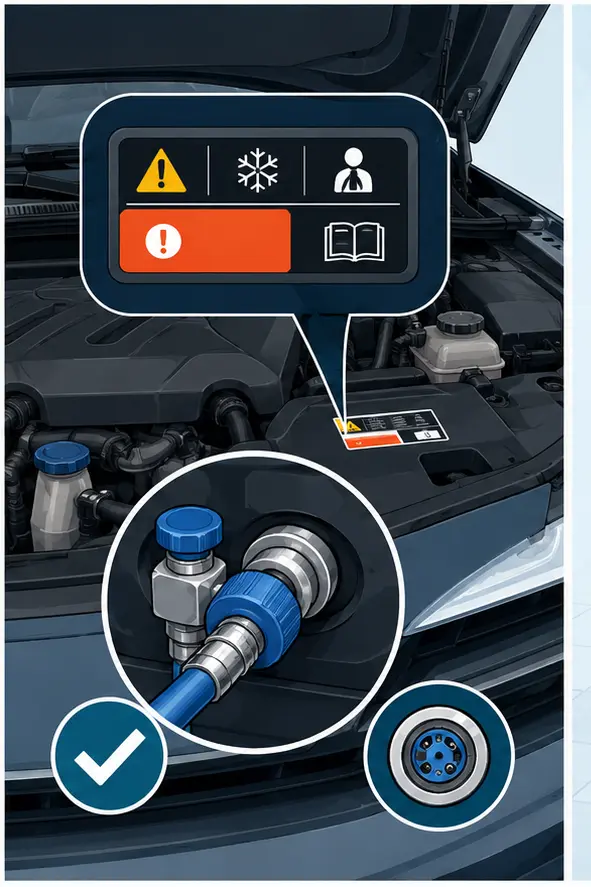
The label and fittings help identify the intended refrigerant, but the gas inside may still be mixed after previous work. A refrigerant identifier can be appropriate before recovery. Dedicated or correctly controlled equipment prevents oil and gas cross-contamination. The workshop should never use an adapter simply to make an R134a machine connect.
A sealed AC circuit does not consume refrigerant as fuel. If charge is low, leakage or previous incomplete service is possible. The technician reviews visible components, operating history and suitable leak evidence before or during the service. A small loss may require a different test from an empty system or a vehicle with collision damage.
Charging follows the specified mass, not a pressure guess. The general regas page explains charge and leak decisions across refrigerants, while the leak-repair page compares methods when cooling fades again. R1234yf handling remains specific to the label and service equipment.
What the recovered condition can mean
The result guides the next test but does not prove the failed part by itself.
| Recovered condition | Technical interpretation | Service decision |
|---|---|---|
| Near-specified amount recovered, cooling still weak | Investigate airflow, heat rejection, compressor control, sensors and air mixing | Do not add more refrigerant |
| Low amount recovered after gradual cooling loss | Search for leak evidence and review previous service | Repair scope depends on the source |
| System nearly empty | Treat as a significant leak or prior open-circuit condition | Avoid repeated refill without locating the loss |
| Identifier shows mixed refrigerant | Stop normal recycling and follow contamination procedure | Equipment and disposal route determine next steps |
| High pressure with poor cooling | Check charge, condenser airflow and system restriction | Pressure alone does not identify overcharge |
| Correct charge, one zone warm | Check blend doors, actuators and distribution | The refrigerant circuit may be operating normally |
Honeywell’s official R1234yf handling material is used as a technical safety reference. UAE legal and waste requirements must be confirmed through the applicable local authority and workshop procedures.
Identification, dedicated equipment and final verification are separate checkpoints
The illustrations show a generic service sequence. Actual machine design and port position vary.
Six controls that separate measured service from a top-up
Every control protects charge accuracy or refrigerant purity.
The intended refrigerant is checked
Manufacturer label information, service data and port design identify the system specification. Model year alone is not enough because markets and production changes can overlap.
If the label is missing or inconsistent, service information and identification take priority. Guessing from the connector risks mixing gas and choosing the wrong oil.
The recovered gas may need identification
Contaminated or mixed refrigerant can damage recycling equipment and produce unreliable performance. An unknown previous refill raises the need for caution.
The workshop separates contaminated material according to its equipment and disposal arrangements. It should not return an unidentified blend to the vehicle.
Existing refrigerant is controlled rather than vented
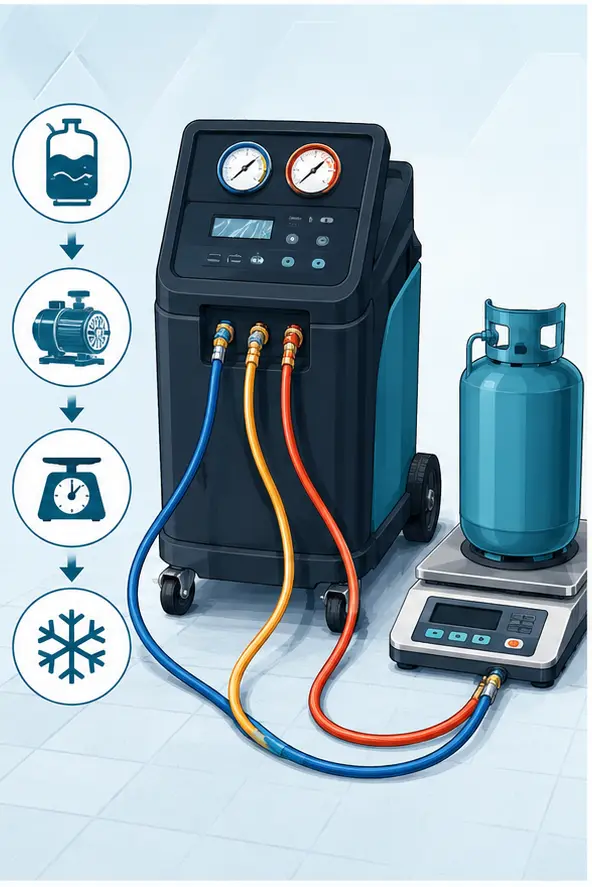
Opening the circuit or replacing a component requires recovery with suitable equipment. Controlled recovery also lets the technician compare removed mass with the expected charge.
The amount recovered is one clue, not the only diagnosis. Oil retention, machine process and a leak can affect interpretation.
Evacuation removes air and moisture after the system is sealed
A stable vacuum can support service quality, but it is not a universal leak test and may not reveal every pressure-dependent fault.
The technician chooses additional leak testing from the system condition. Repeated vacuum and recharge without finding a known loss is not a repair plan.
Mass controls the final refrigerant quantity
R1234yf systems can use precise charges. Too little can reduce evaporator performance, while too much can raise pressure and impair heat transfer.
The specified mass and approved equipment are used. Pressure is observed as performance evidence, not as a substitute for weighing.
A2L handling controls ignition and ventilation
Honeywell’s R1234yf handling guidance describes the refrigerant as mildly flammable under standard classification. Service areas and equipment must account for that property.
No open flame, smoking, improvised transfer or uncontrolled release belongs near the job. The public page does not provide DIY charging instructions.
How R1234yf is serviced without guessing
The sequence connects safety, purity and performance.
Specification check
Confirm vehicle, refrigerant label, charge mass, oil requirement and service information. Investigate missing or conflicting identification.
Purity and history
Review previous work and identify refrigerant where contamination is possible. Keep questionable gas away from recycling equipment.
Recovery and inspection
Recover with suitable equipment and inspect accessible components, ports and condenser for leak or damage clues.
Leak-aware preparation
Perform the method suited to the system condition, repair approved faults, renew specified seals and prepare the closed circuit.
Evacuation and measured charge
Evacuate according to procedure and charge the exact specified mass. Avoid pressure-only charging and improvised adapters.
Operating verification
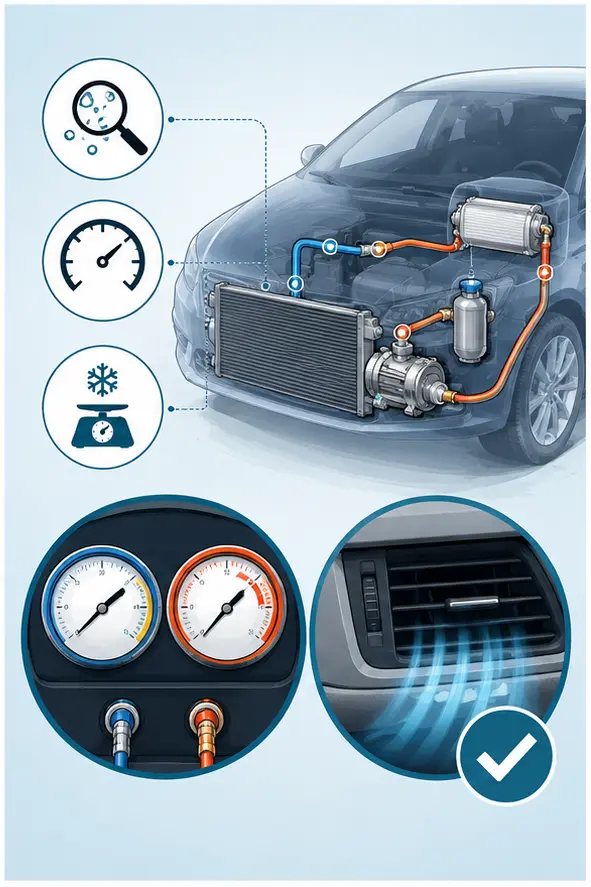
Check fan operation, pressures, vent temperature, airflow, noise and relevant codes. Document limitations and return signs.
R1234yf cost reflects gas, purity and fault condition
A quotation should distinguish identification, recovery, leak checks, seals, refrigerant mass, oil, labour and any component repair. A low advertised top-up price may exclude the very work needed to protect an expensive R1234yf system.
Any figure is a guide until refrigerant purity and charge state are known. The final written estimate depends on vehicle charge specification, amount and purity recovered, leak severity, parts, oil requirement, required work and current refrigerant availability.
A successful refill restores the specified charge at the test point. It cannot guarantee that an undetected intermittent leak will never return. The handover states the evidence, final condition and the symptom that should trigger reinspection.
Why leak evidence and charge mass belong in the same report
A useful R1234yf record connects recovered condition, oil control, final charge and operating proof.
Recovered condition
The amount recovered gives a useful comparison with the specified charge, but it must be interpreted carefully. Refrigerant can remain in service hoses, the machine has a defined process and previous work may already have altered the quantity. A low recovered mass supports further leak investigation when the history also shows cooling loss, but it does not identify the leaking component. The report links mass, vehicle label, operating condition and visual or detector evidence rather than treating one number as a complete diagnosis.
Oil management matters because recovery and component replacement can move oil within the circuit. The workshop follows equipment and manufacturer guidance instead of adding a generic amount at every refill. Too much oil can reduce heat transfer, while incompatible lubricant can create a more serious issue, particularly with electric compressors. Any added oil and relevant component change should be recorded. A customer comparing quotations can then see whether one service includes controlled oil handling and another only lists refrigerant.
Charge and operation
The final operating test needs a stable condenser fan, clean enough heat exchanger, suitable cabin airflow and the correct control command. If pressures remain abnormal with the specified charge, the technician looks for airflow, restriction, sensor or compressor causes rather than changing the mass to force a familiar gauge reading. The handover states vent temperature and test conditions, plus what to observe if cooling fades again. This makes the service traceable even when a very small intermittent leak cannot be reproduced immediately.
Service-port caps and seals are part of the closed system. Damaged cores, loose caps or oil residue around a port are inspected before the final handover. Replacing a cap does not prove that every leak is resolved, but ignoring a confirmed port fault can waste the measured charge. The report can identify whether a seal, core, cap or another component was replaced and which leak-check method supported the decision.
Traceable handover
The customer should keep the invoice with the vehicle because it records refrigerant type, specified charge, amount recovered where provided, refrigerant added and any oil or dye. That history helps the next technician avoid repeating identification work and can expose a recurring loss. It also protects against a later generic top-up that cannot explain what was already inside the circuit.
A leak that appears only with vibration, temperature or pressure may not reveal itself during every short inspection. The workshop can use the most suitable available method and document the result without claiming that one negative test proves permanent tightness. If the system was extremely low, the customer may be advised to return for a scheduled recheck. If cooling fades quickly, continued refilling is stopped and the leak decision is reopened.
When a component has been replaced, the recharge record should identify new seals, drier or related items only when the vehicle and repair require them. Automatic packages can add cost without technical reason, while omitting a specified item can shorten component life. The estimate explains each related part and leaves optional maintenance separate from the confirmed repair.
R1234yf refill questions
The refrigerant name answers only the first part of the job.
Can R1234yf be replaced with R134a?
Do not substitute refrigerant outside the manufacturer-approved system and applicable rules. Fittings, oil, calibration, safety and component design can differ. The specified refrigerant is confirmed before service.
Why is R1234yf service often more expensive?
Refrigerant cost, dedicated equipment, identification, precise charge and contamination control can affect the total. The estimate should show what is included rather than hiding the difference behind a generic gas price.
Is R1234yf dangerous?
It has an A2L mild-flammability classification and requires appropriate equipment, ventilation and ignition control. Intended automotive use follows engineered systems and procedures. This page is not a DIY handling guide.
Can you top it up without recovery?
A blind top-up cannot confirm existing mass or purity and may leave the wrong charge. The appropriate process depends on equipment and system condition, with identification and leak awareness before a measured final charge.
How do I know which gas my car uses?
Check the under-bonnet refrigerant label and vehicle service information. Production date and market can matter. If the label is missing or prior work is uncertain, the workshop resolves identification before connection.
Send the refrigerant label before the R1234yf booking
Share the vehicle, year, label photo and refill history. We will confirm the correct equipment and explain the leak-aware service scope.