
EV and Hybrid Car AC Service Dubai
Electric and hybrid vehicles may use high-voltage electric compressors, model-specific oils, heat pumps and cooling strategies linked to battery temperature. Service begins with vehicle identification and manufacturer procedure, not with a generic compressor test or universal refrigerant top-up.
What makes an EV or hybrid AC system different
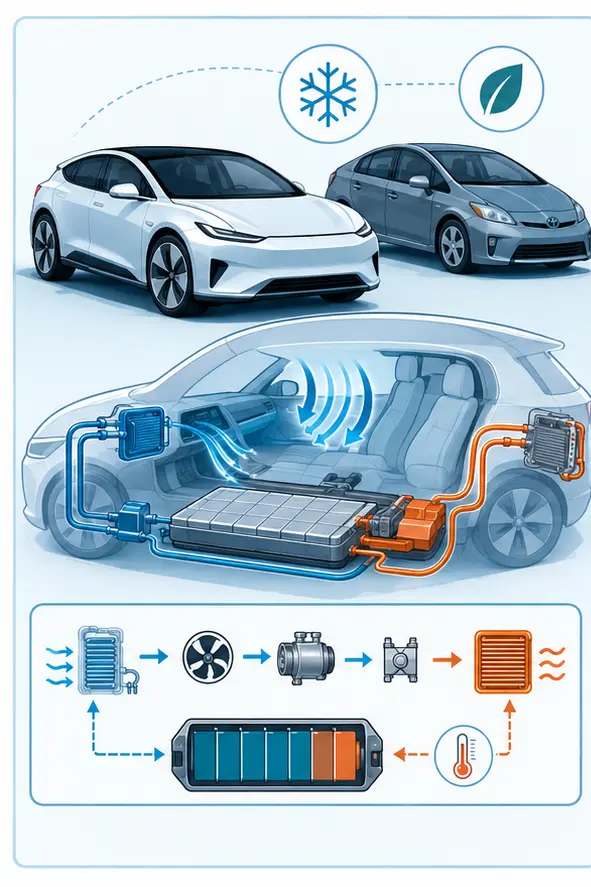
A conventional belt-driven compressor depends on the engine. An electric compressor can operate with the engine stopped and may be supplied by the high-voltage system. The climate controller can request cooling for passengers, battery temperature or both. A customer may therefore notice reduced cabin performance during charging, rapid driving, very hot weather or a battery thermal-management event.
Heat-pump vehicles can reverse or redirect refrigerant through additional valves and heat exchangers. Diagnosis may involve cabin heating as well as cooling, and one valve or sensor can affect several modes. Pressure and temperature readings must be interpreted against the commanded mode rather than against a simple passenger-car diagram.
Refrigerant and oil compatibility are critical. The label and service information are checked before connection. Where the vehicle uses R1234yf, the dedicated R1234yf service page explains identification, recovery and measured charging. A generic gas refill should never override the EV manufacturer procedure.
Six points that change the safe diagnostic route
Each point links a comfort complaint with electrical safety or thermal-management logic.
Electric drive removes the belt clue
An electric compressor can run independently of engine speed. No clutch click does not prove failure, and a scan command does not prove the compressor produced the expected refrigerant movement.
Diagnosis connects command, current or operating data, pressure response, noise and temperature. Access to the inverter or high-voltage supply follows the exact vehicle safety procedure.
Insulation properties can matter
Some electric compressor designs require a specified lubricant with suitable electrical characteristics. Introducing incompatible oil from shared equipment can reduce insulation performance or contaminate the circuit.
The service machine, hoses and oil procedure are matched to the vehicle requirement. A universal oil injection should not be accepted because the quantity appears small.
Cabin comfort may be intentionally limited
Vehicle software can prioritize battery protection, charging temperature or power demand. Reduced cabin cooling may be a strategy response rather than a failed compressor.
The technician reviews relevant thermal and climate data, warnings and operating conditions. Clearing a code or forcing output without understanding the reason can erase evidence or bypass protection.
Cooling and heating share more components
Reversing valves, chillers, multiple heat exchangers and sensors create fault paths that do not exist in a simple cooling-only system. A complaint in one mode can help diagnose another.
Testing follows the commanded flow state and manufacturer diagrams. Blindly comparing two pipes or charging by pressure can misread normal operation.
Power-down is a controlled procedure
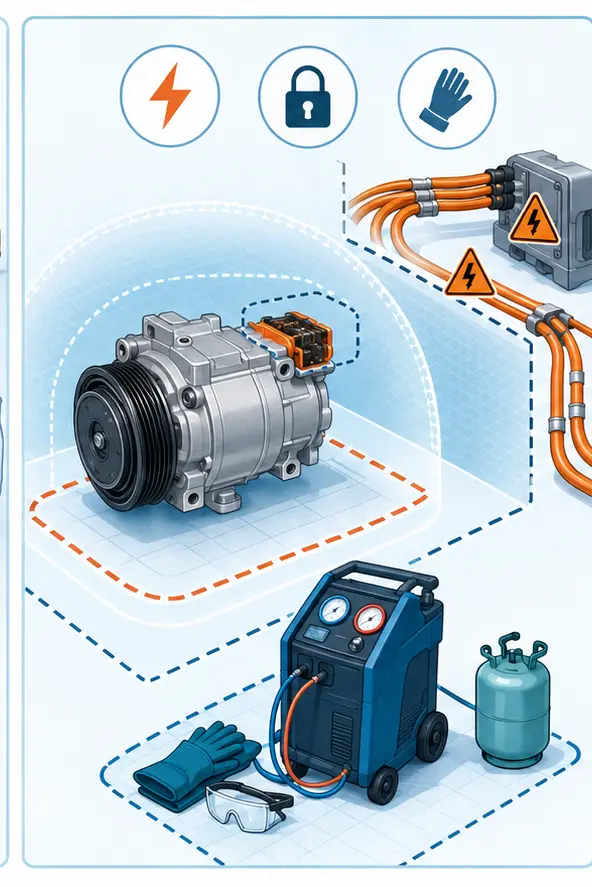
Switching the ignition off is not the same as proving a high-voltage system safe. Stored energy, automatic wake-up and model-specific disconnect steps require appropriate training and tools.
Customers should not attempt isolation. The work order states when high-voltage access is required and whether the workshop is proceeding under the necessary qualified scope.
The final test may include charging and battery conditions
A repaired cabin system can behave differently with low state of charge, active fast charging or high battery temperature. The test context must be recorded.
The handover separates what was verified from conditions not reproduced. It should not promise range, battery life or thermal performance beyond the completed AC checks.
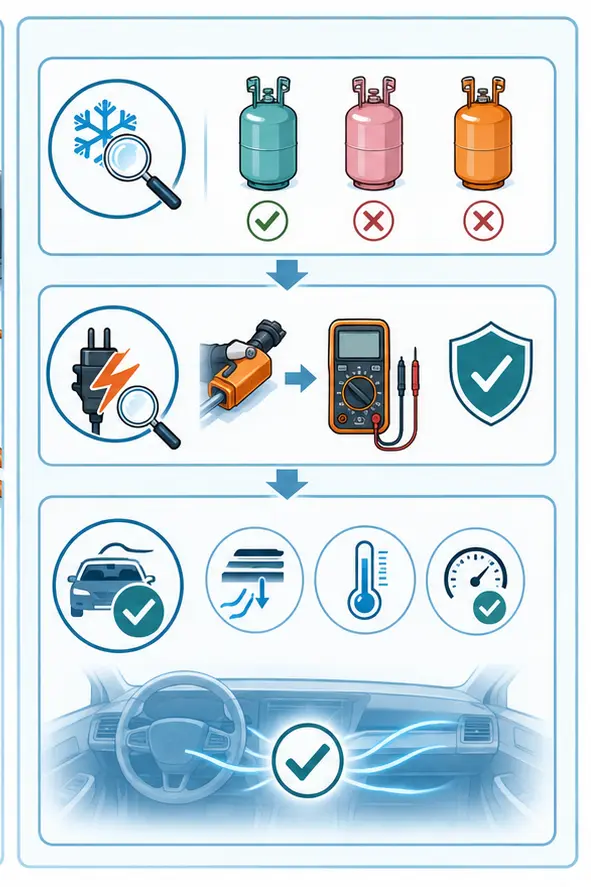
A cautious EV and hybrid AC workflow
The sequence keeps refrigerant work and electrical authority aligned.
Vehicle configuration
Confirm model, year, powertrain, refrigerant label, heat-pump option, warnings and service information. Visual similarity to another trim is not enough.
Safety and data baseline
Record state of charge, thermal warnings, climate commands and applicable scan information before resetting anything. Establish whether high-voltage access is required.
Mode-specific performance
Test cabin and thermal behaviour in the commanded mode with temperatures, airflow and refrigerant response interpreted together.
Targeted repair decision
Separate refrigerant loss, valve or sensor control, electric compressor, fan, blower and software paths. High-voltage work remains within qualified authority.
Contamination-controlled service
Use correct refrigerant, equipment and lubricant procedure. Recover rather than vent, and avoid mixing unknown gas or oil.
Post-service verification
Operate relevant modes, review warnings and document the tested charge and thermal condition. State any battery or charging scenario not reproduced.
EV quotations depend on configuration and authority
A quotation should state whether it covers cabin diagnosis only, refrigerant service, heat-pump testing, electrical diagnosis or high-voltage component work. These are not interchangeable. Programming, special tools and contamination control can add separate tasks.
Any price is provisional until the electrified configuration is verified until inspection. The EV service quotation depends on the verified configuration and exact vehicle configuration, refrigerant, fault severity, safety procedure, parts choice, required work, software needs and current availability.
Battery range, health and future thermal performance are not guaranteed by an AC repair. The final report documents climate results and warnings observed under the tested conditions, plus any scenario that needs dealer or battery-specialist support.
Cabin cooling, electric compression and controlled verification belong together
These generic illustrations are not model-specific wiring diagrams. Always follow the vehicle’s approved service information.
Symptoms that need EV-aware interpretation
The same driver complaint can have a different cause when the vehicle manages battery heat.
| EV operating state | Model-specific check | Safety boundary |
|---|---|---|
| Cabin cools while driving but weakens during charging | Review charging thermal demand, software commands and heat-rejection capacity | Do not assume low refrigerant from the operating pattern alone |
| No compressor sound with ignition on | Check commanded state and vehicle architecture | An electric compressor may be quiet or intentionally inactive |
| Warning about electric system or battery temperature | Stop routine AC testing and follow vehicle safety information | High-voltage or thermal protection takes priority |
| Heating and cooling both behave incorrectly | Investigate heat-pump valves, sensors and shared heat exchangers | One mode can provide evidence for the other |
| Cooling failed after service at another shop | Verify refrigerant, charge, oil, equipment contamination and codes | Wrong lubricant or mixed refrigerant can change the repair scope |
| Compressor insulation or electrical fault stored | Use manufacturer test procedure and qualified high-voltage scope | Do not energize or megger components with generic methods |
Manufacturer documentation and qualified high-voltage procedures control the work. Educational content on this page is not a DIY isolation guide.
How thermal strategy can imitate an AC hardware fault
Interpret each change against vehicle state before opening the refrigerant circuit or approaching high-voltage components.
Software limitation or component fault
An electrified vehicle can change climate output because the battery, power electronics or charging system needs thermal capacity. The controller may reduce compressor speed, change coolant-valve position or limit cabin demand without a failed refrigerant component. State of charge, rapid charging, battery temperature, drive mode and pre-conditioning settings become part of the evidence. The technician records those conditions and looks for commanded limitation before opening the circuit. A refill cannot correct software that is deliberately protecting another system.
Electric compressor noise also needs careful interpretation. A high-frequency operating sound can be normal, while rough mechanical noise, insulation faults or a lack of pressure response can indicate a problem. The test follows manufacturer thresholds and electrical safety instructions. It does not use a stethoscope or generic resistance method near energized high-voltage parts. When the diagnosis requires isolation, the work order should show the qualified scope, proof of safe state and the step that justified access.
Operating condition and safe access
Post-service verification should include the functions connected to the original complaint. A vehicle with a heat pump may need heating and cooling modes checked. A charging-related complaint may need confirmation with an appropriate state of charge and thermal demand. The report separates cabin performance from battery diagnosis and states when dealer-level software, battery service or another specialist is needed. That boundary prevents an AC service page from claiming authority over the entire high-voltage vehicle.
Cooling fans and pumps can continue operating after the driver believes the vehicle is off. Technicians follow wake-up, sleep and key-control instructions before approaching moving parts or connectors. Remote climate applications and scheduled pre-conditioning are also considered. The customer should disable only the functions requested by the service procedure and keep keys or devices where instructed. A generic battery disconnect can lose data without proving the high-voltage side safe.
Compatible parts and verified handover
Parts selection must include voltage class, compressor design, connector, refrigerant, lubricant and software compatibility. A physically similar electric compressor may not be electrically or electronically interchangeable. The quotation identifies the exact option and any programming or initialization. Used components, where even considered, require an honest statement about provenance, configuration and warranty rather than an unsupported claim that they are plug-and-play.
Before handover, the workshop checks that charging, pre-conditioning and climate settings disturbed during diagnosis are restored or explained. Relevant warnings are rescanned after the operating test. The customer receives any instruction about leaving the AC off, returning under a particular charge condition or monitoring a thermal message. The report avoids promising battery health from climate results alone.
EV and hybrid AC questions
The answers avoid treating every electrified vehicle as the same system.
Can a normal AC machine service an EV?
Only if the machine, refrigerant, hoses, oil procedure and contamination controls meet the vehicle specification. Electric compressors can be sensitive to lubricant compatibility. The workshop checks the model requirement before connection.
Does the AC cool the high-voltage battery?
On some vehicles the refrigerant or coolant thermal-management system supports battery temperature, directly or through a chiller. Architecture varies. A cabin complaint may therefore need thermal data, not only vent temperature.
Can I disconnect the battery myself?
Do not use this page as an isolation guide. High-voltage systems can retain energy and wake automatically. Isolation and proof of safe state require model-specific procedures, appropriate equipment and qualified personnel.
Why does cooling change while charging?
Battery and power-electronics cooling demand, fan operation, state of charge and software strategy can affect available cabin performance. The condition should be reproduced with scan and temperature data before a part is blamed.
Do you refill R1234yf in electric cars?
Where vehicle procedure, equipment and workshop scope allow, yes. The refrigerant must be identified and measured. See the R1234yf page for the service sequence and safety limits.
Send the exact EV or hybrid configuration
Share the model, year, heat-pump option if known, warnings, state of charge and the operating condition that changes cabin cooling. We will confirm the suitable diagnostic scope.