
Workshop support for Downtown drivers
Car AC Repair Downtown Dubai
Cooling can feel acceptable on a short trip from covered parking and then weaken in slow traffic, after heat soak or during a restart. Car AC Heroes uses that timing to plan diagnosis at its Al Quoz 4 workshop rather than guessing from the words “not cold.”
The fault timeline
Use one journey to capture the moment cooling changes
Keep the vent, temperature and fan setting consistent where practical. The sequence is more useful than a single temperature impression because it shows how the system responds as conditions change.
Initial start
How long does cold air take to arrive? Note any delay, odour, noise or weak fan response.
Stationary load
Observe whether cooling fades at a queue or traffic light while the selected settings remain the same.
Road movement
Does cooling recover with speed? That contrast can guide heat-rejection and fan checks.
Hot restart
After a short stop, record whether performance, sound or airflow differs from the first start.
Pattern before part
Warm at traffic lights is not the same complaint as weak at every speed
These patterns suggest different first checks. They do not confirm a failed component, and several faults can occur together.
Parking context
Covered parking can hide a fault that returns after heat soak
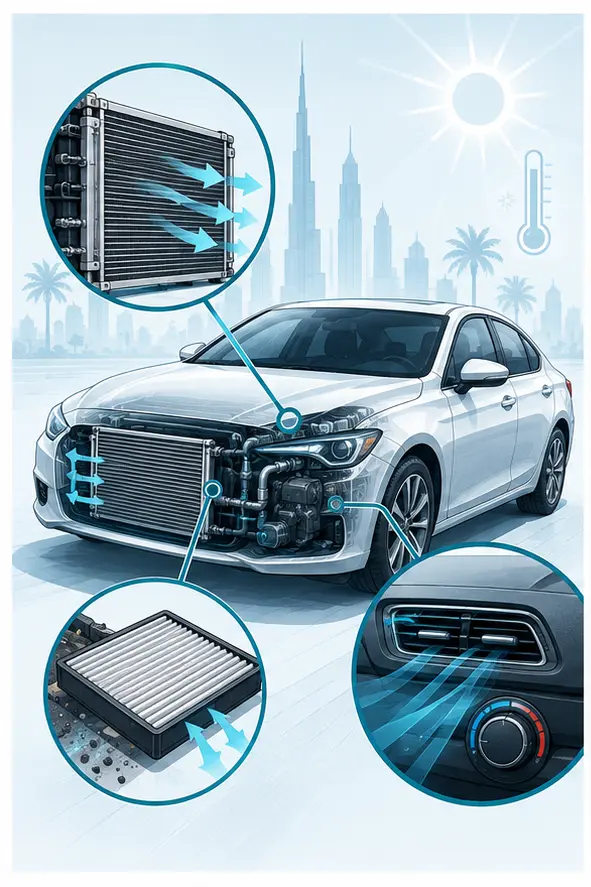
A cooler starting environment reduces the initial load on the cabin and condenser. A system with limited capacity may seem acceptable at first and then struggle after the vehicle sits outdoors, idles or restarts with a hot cabin.
The opposite can also happen. A blocked filter or weak blower may feel more obvious after the car has been parked because the cabin needs high airflow, even though the refrigerant circuit still produces cold air.
Share the parking condition as context, not as a diagnosis. The workshop should still measure the relevant system. If the complaint is broad or intermittent, a full car AC diagnostic can preserve the baseline and test order.
Open the relevant test path
What gets checked at the Al Quoz workshop
The page does not decide the repair. These expandable notes show why the same cabin complaint can require different evidence.
When refrigerant quantity may be involved
Pressures, temperatures, refrigerant identification and leak evidence should support the decision. Refrigerant is not normally consumed like fuel. If charge is low, review how leak detection is selected before approving another unexplained refill.
When the compressor is suspected
Noise alone is not enough. Electrical command, control method, pressure response, system contamination and supporting components affect the repair-versus-replacement decision.
When airflow is the main complaint
Filter condition, blower speed, controller output, evaporator restriction, flap movement and duct delivery can reduce comfort even if the air at the evaporator is cold. Temperature and air volume are measured separately.
When the fault appears electrical or intermittent
Power, ground, wiring, sensor plausibility, control-panel input, network communication and actuator response may need testing under the condition that triggers the fault. Stored codes support the process but do not automatically name the failed part.
From Downtown to a repair plan
Use live navigation and a confirmed handover window
Dubai traffic makes a fixed travel-time promise unreliable. Confirm workshop intake, then use the current map route to 39 Al Quoz 4.
Send the symptom timeline
Include the vehicle, parking condition, fault moment and any warning or recent AC work.
Ask the team to reproduce it
Describe the setting and operating condition that made cooling change. Avoid clearing useful warning information first.
Review the written scope
Approve parts, labour, refrigerant and additional access only after the finding and exclusions are explained.
Quotation clarity
The estimate should explain what changes the final AED amount
There is no honest single price for every car AC fix in Downtown Dubai. The same symptom can end with a filter, wiring repair, leak repair, sensor, fan, compressor or another confirmed action.
What should be specific
Exact vehicle configuration, confirmed fault, parts option, refrigerant type, access labour, included testing and any known exclusions.
If further dismantling may expose hidden work, the approval point should be agreed before it happens.
What should remain separate
Diagnosis, recovery or collection, repair, optional cleaning and unrelated maintenance should not be blended into one unexplained number.
The final written estimate depends on inspection, fault severity, required work, parts choice and current availability.
A 30-second message
Send the exact moment cooling changes
The most useful Downtown enquiry contains a timeline, not a guessed part. Send it before requesting a workshop date so the first appointment can be planned around the likely testing needs.
- Vehicle: model, build year and petrol, hybrid or electric powertrain.
- Start: covered, shaded or exposed parking.
- Change: idle, movement, time, side or fan speed.
- Recovery: restart, road speed or no recovery.
- History: recent refill, repair, battery or warning.
Make the Downtown fault repeatable
Call with the timeline if you are unsure which booking fits. The workshop can advise the next practical step, while the repair decision remains subject to inspection.