
Car AC Electrical and Climate Control Diagnostics Dubai
A climate panel that lights up does not prove the compressor, blower, sensors or air doors are receiving the right commands. We compare the driver’s request with module data, circuit behaviour and the actual mechanical response before replacing electronics.
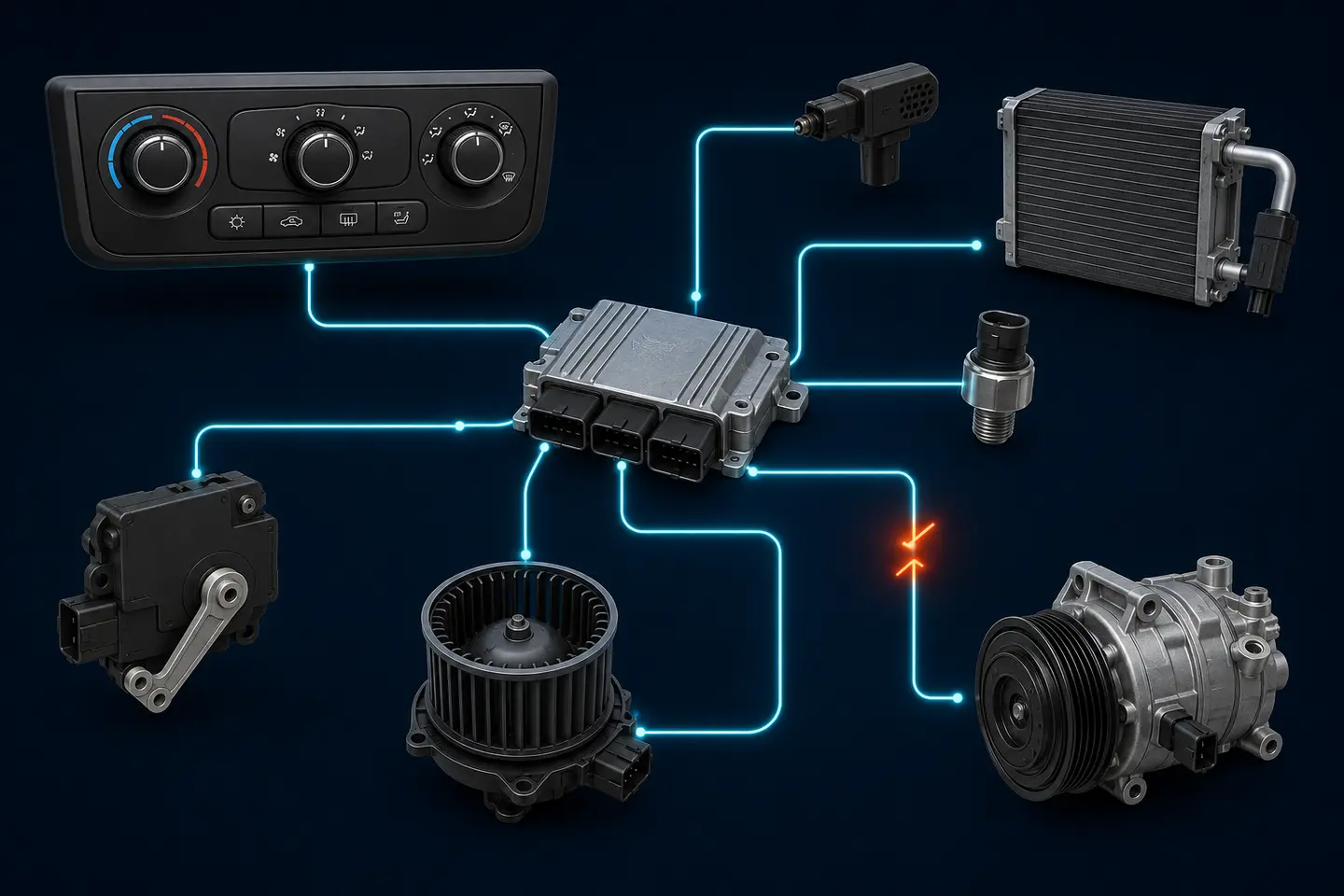
Climate control is a conversation between systems
The illustration simplifies a modern control path. Some vehicles use a dedicated HVAC module, while others distribute functions across body, engine, gateway, compressor and local actuator electronics.
Why electrical AC complaints are easy to misdiagnose
The driver may press the AC button and see its indicator, but another module can inhibit compressor operation because of pressure, temperature, engine load, battery voltage or a stored protection condition. A conventional clutch can be controlled by a relay, while a variable compressor may use a control valve or electronic interface. Hybrid and electric vehicles add high-voltage compressor and thermal-management considerations, so those faults follow the EV and hybrid AC service route.
Air temperature also depends on doors and actuators inside the HVAC case. A healthy refrigerant circuit can produce cold air that becomes warm when a blend door remains in the wrong position. A sensor can report an implausible temperature without being the only problem if its reference voltage, ground or signal wire is damaged.
Replacing a climate panel because the screen is dark can miss a fuse, power feed, network wake-up or ground fault. Replacing a pressure sensor because a code names its circuit can miss refrigerant loss, a damaged connector or an out-of-range supply. The diagnostic goal is to prove where the expected signal stops.
Different symptoms point to different signal paths
Blank, rebooting or unresponsive controls
Check battery condition, relevant fuses, loaded power and ground, connector fit, network communication and whether another module controls panel wake-up. Screen illumination alone does not prove button messages are reaching the HVAC controller.
Recent battery replacement, jump-starting, water entry or accessory installation is useful history.
AC indicator on but compressor not operating
Compare the AC request, permission and output command. Pressure plausibility, evaporator temperature, outside temperature, engine conditions, relay or control-valve circuit and compressor response must agree.
A low-charge protection decision belongs with leak diagnosis, not an electrical bypass.
One side hot or temperature stuck
Command the affected actuator, review feedback position where available and listen for movement. Linkage damage, a jammed door, lost calibration and wiring faults can look similar from the driver’s seat.
Dual-zone complaints require left and right vent-temperature comparison.
Fan speed wrong or air from the wrong outlet
Review requested blower output, controller signal, motor current and mode-door position. A working motor can receive the wrong command, while a working actuator can move a broken or obstructed door.
The filter and duct path still require mechanical inspection.
Seven checkpoints before a module is condemned
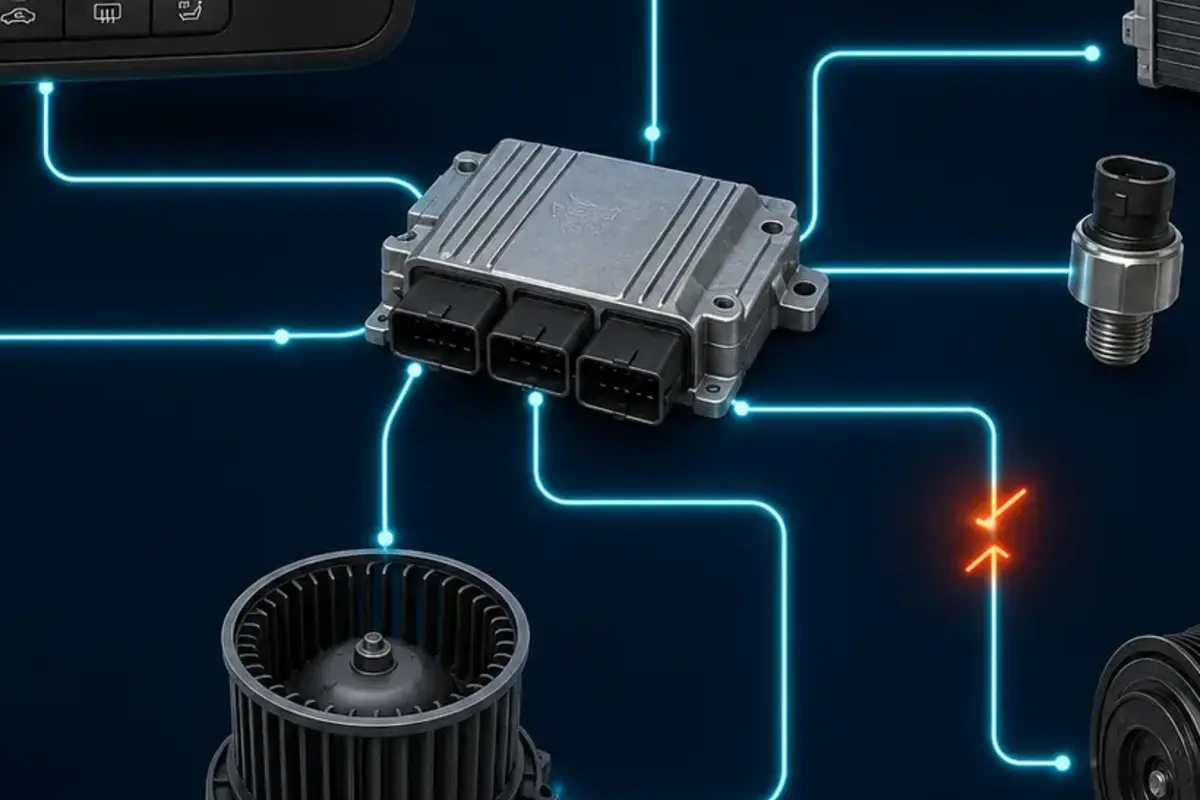
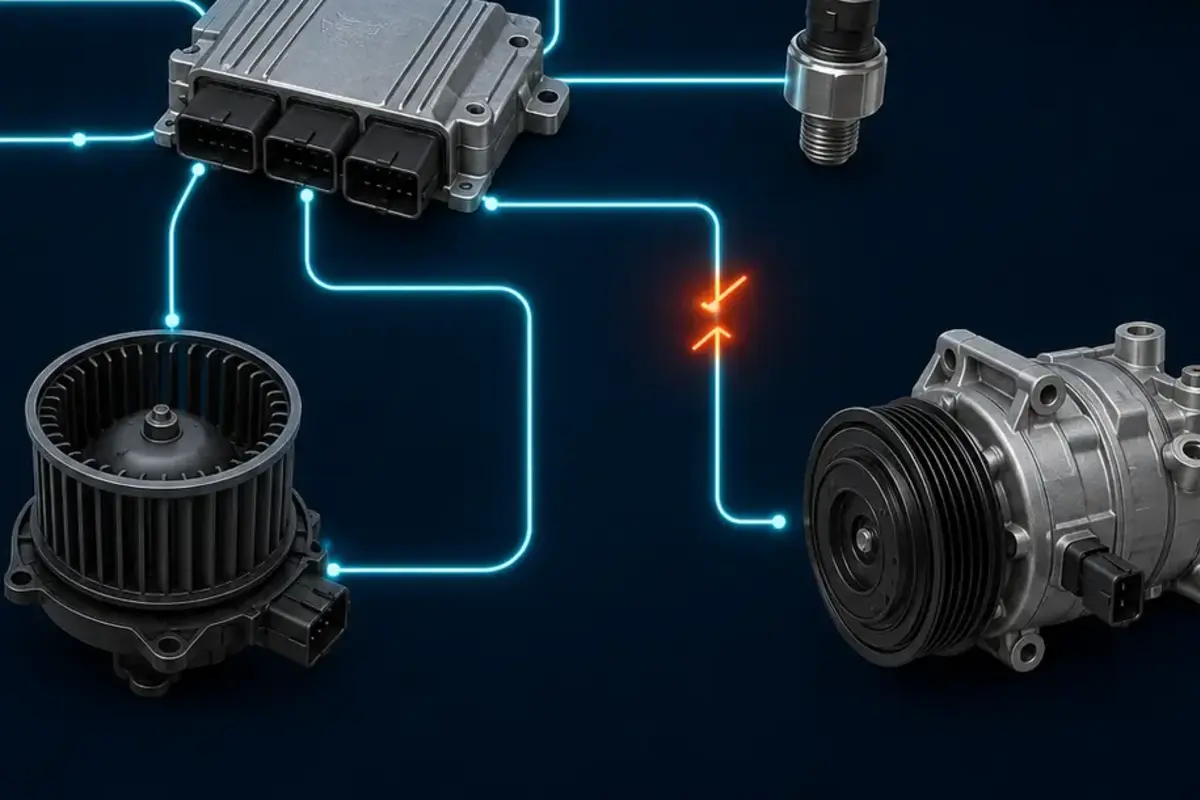
A broken signal and a non-responsive load are not the same fault
Repair, replace, program or leave the controller alone
A control module should be replaced only when its inputs, supplies, grounds, communication and outputs have been tested far enough to support that decision. Internal failure is possible, but external circuit faults, water entry, overcurrent loads and incorrect programming can damage a replacement or reproduce the complaint.
Electronic repair may be considered when a competent specialist can identify the failed internal area, the unit is serviceable and post-repair validation is available. Not every sealed, security-linked or safety-relevant controller is a suitable repair candidate. A used unit may carry vehicle identity, immobiliser, component-protection or configuration data that prevents straightforward installation.
A new or remanufactured module may require coding, calibration and actuator relearn. The estimate should say whether programming is included and whether online manufacturer access is required. A climate panel and an HVAC control module are not always the same component, so part names must match the wiring and vehicle catalogue.
If another fault caused the electronic failure, that cause belongs in the repair scope. A blower motor drawing excessive current can damage a speed controller. Water from a blocked drain or body leak can corrode connectors. A shorted actuator can overload an output. Correcting only the visible electronic damage can lead to a repeat failure.
What a useful electrical result should explain
Complaint
State the exact failed function and the conditions that reproduce it.
Evidence
Record codes, live data, circuit readings and observed component response.
Cause
Separate the wire, connector, input, output, load or controller failure.
Repair
Define wiring work, part choice, coding and related root-cause correction.
Proof
Repeat the operating test and confirm no relevant faults return.
Diagnostic time depends on access and intermittency
Accessible, repeatable fault
A failed fuse feed, visible connector or consistent actuator fault may be narrowed down efficiently when the vehicle information and wiring route are available.
Intermittent or network fault
A condition that appears only after heat soak, vibration or extended operation can require monitoring and repeated testing. A stored code may not reproduce the live failure.
Programming and deep access
Dashboard removal, harness tracing, online coding, security matching or multiple module involvement changes the scope. These steps should be authorised separately when not part of the initial diagnosis.
Any diagnostic or repair amount is indicative and non-binding until the exact vehicle, complaint and required access are confirmed. A written estimate should separate testing from approved repairs and state whether coding or calibration is included.
Before parts are ordered
Does a fault code prove the sensor is bad?
No. A code can describe high, low, implausible or missing signal behaviour caused by the sensor, wiring, connector, supply, ground, module or the physical condition being measured.
Can disconnecting the battery reset the AC?
It may clear temporary states on some vehicles, but it can also erase useful evidence and create relearn or security issues. A reset that hides the symptom does not repair the cause.
Why does the AC work after the car restarts?
A module may reset an intermittent communication, voltage, sensor or protection condition. Heat-related electronics, connectors and compressor control can also recover temporarily. Scan the vehicle before clearing evidence where possible.
Can a used climate module be installed?
Sometimes, but compatibility, coding, vehicle identity, security and calibration must be checked. A matching connector does not prove the software and option configuration are correct.
Why is one side hot and the other cold?
Blend-door position, actuator calibration, sensor input, physical door damage, airflow and refrigerant distribution can all be relevant. Vent temperatures and actuator response should be compared before replacement.
Capture the failure before clearing the evidence
Electrical complaints that disappear after a restart often need a different plan from a permanent open circuit. Time, heat, vibration and network state become part of the test.
Cold start versus heat soak
Record whether the panel, blower or compressor fails after the car sits in the sun, after a long drive or only on the first morning start. Electronics and connectors can change behaviour as temperature expands materials or raises internal resistance.
A controlled repeat can include monitoring voltage, communication and the affected output as the vehicle warms. Replacing a module that works throughout the test without capturing the fault leaves too much uncertainty.
Road movement versus stationary test
A harness can move with engine torque, road vibration, steering or dashboard flex. A fault that appears on bumps may involve connector tension or a partially broken conductor.
Testing must remain safe. Harness movement is performed only at accessible, stationary points with correct precautions. Randomly pulling wiring near airbags, belts, fans or high-voltage components is not an acceptable method.
Module history before reset
Freeze-frame information, event counters, undervoltage records and communication faults can show what the system saw when operation stopped. Clearing codes or disconnecting the battery too early can remove that evidence.
The report should distinguish current, stored and historic faults. A historic code unrelated to the complaint should not become a sales reason for a module.
When mechanical and electrical diagnosis meet
A valid actuator command does not prove the air door moved. A valid compressor command does not prove the compressor produced the expected pressure change. Electrical diagnosis therefore finishes at the physical response, not at the scan tool. This is why the page links closely with compressor testing, blower diagnosis and the wider refrigerant circuit.
A pressure sensor reading also needs physical plausibility. If the refrigerant circuit is empty, a low reading may be correct. If the system is off and the reading is impossible for the measured ambient condition, the sensor circuit or data interpretation deserves attention. A sensor should not be bypassed to force compressor operation.
What belongs in the handover
The customer should receive the reproduced complaint, relevant codes, confirmed circuit or component, completed repair and final test. When the fault could not be reproduced, the report should say so and list the observations rather than presenting a guess as a diagnosis.
Programming records matter where a module was configured. Note the part number, software or calibration action where available, and any actuator relearn. If a used or repaired module was selected, its limitations and warranty source should be stated without implying manufacturer approval that does not exist.
After repair, operate the system through temperature, fan and mode ranges. Clear only relevant resolved faults, then rescan after the final operating test. Verify that unrelated warning lights or customer settings were not disturbed.
Preserve useful photos and fault timing
If the display goes blank again, photograph the screen and other warning lights before restarting where it is safe to do so. Record outside temperature, journey time and which AC functions remained available. That information can distinguish a complete module power loss from a single output or communication fault and can shorten an intermittent diagnosis.
Ask for the evidence chain, not only a code printout
A useful result states the driver complaint, the conditions that reproduced it, the relevant module information and the measurement that isolated the failed circuit or component. If the module itself was replaced, the report should confirm its supplies, grounds and external loads were checked so the new unit is not exposed to the same cause.
Verify every affected function after repair, including temperature selection, fan speed, outlet mode, recirculation and compressor request. Confirm whether coding, calibration or actuator relearn was completed. If the intermittent fault could not be reproduced, the honest handover is a monitoring plan with preserved evidence, not a confident part recommendation unsupported by a live failure.
Send the exact display, warning and failed function
Share the make, model, year, a short video and any recent battery, dashboard or AC work. We will arrange electrical climate-control diagnosis at AMF Auto Services, 39 Al Quoz 4, Dubai.