
Weak Airflow From Car AC Vents
Weak airflow is different from air that is not cold. If the fan sounds busy but very little air reaches the cabin, begin with restrictions, blower output and evaporator ice before assuming the car needs gas. The change over time is especially useful: steady weakness, one speed missing, or airflow that fades after 20 minutes each point to a different route.
Weak airflow is usually a path problem before it is a gas problem
Check the cabin filter, blower output and vent settings first. If airflow starts normal but falls after the AC has been running, evaporator icing or a control fault moves higher in the sequence. If cooling itself also cuts out with time, compare the AC stops working after a while pattern. Cooling can still feel cold at the vent while too little air is being delivered.
Start with the point where air is being lost
Air cannot enter
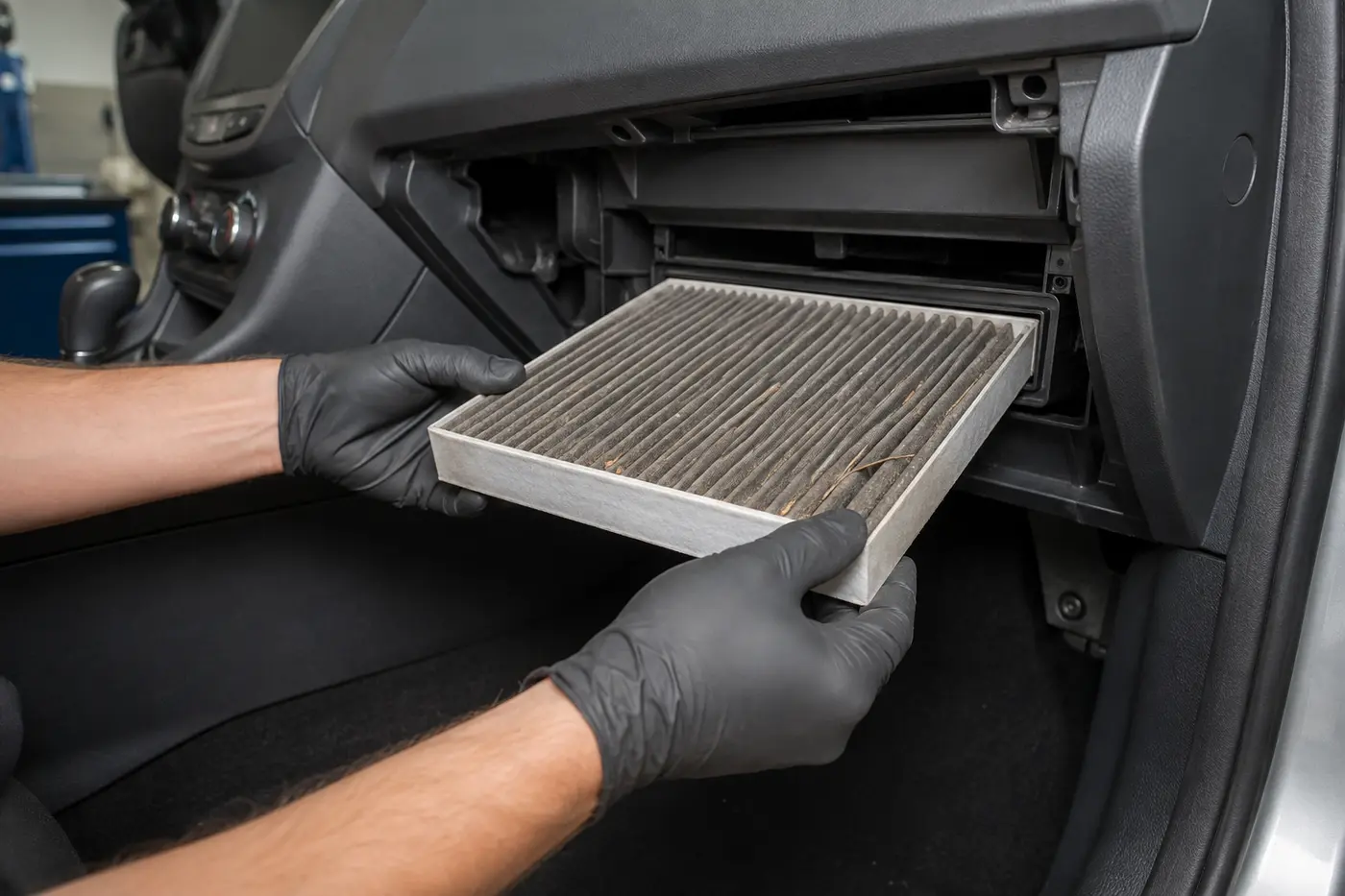
Blocked cowl intake, leaves, a saturated filter or a collapsed filter element restricts air before it reaches the blower. This can cause a constant weak flow at all speeds.
Air is not being pushed
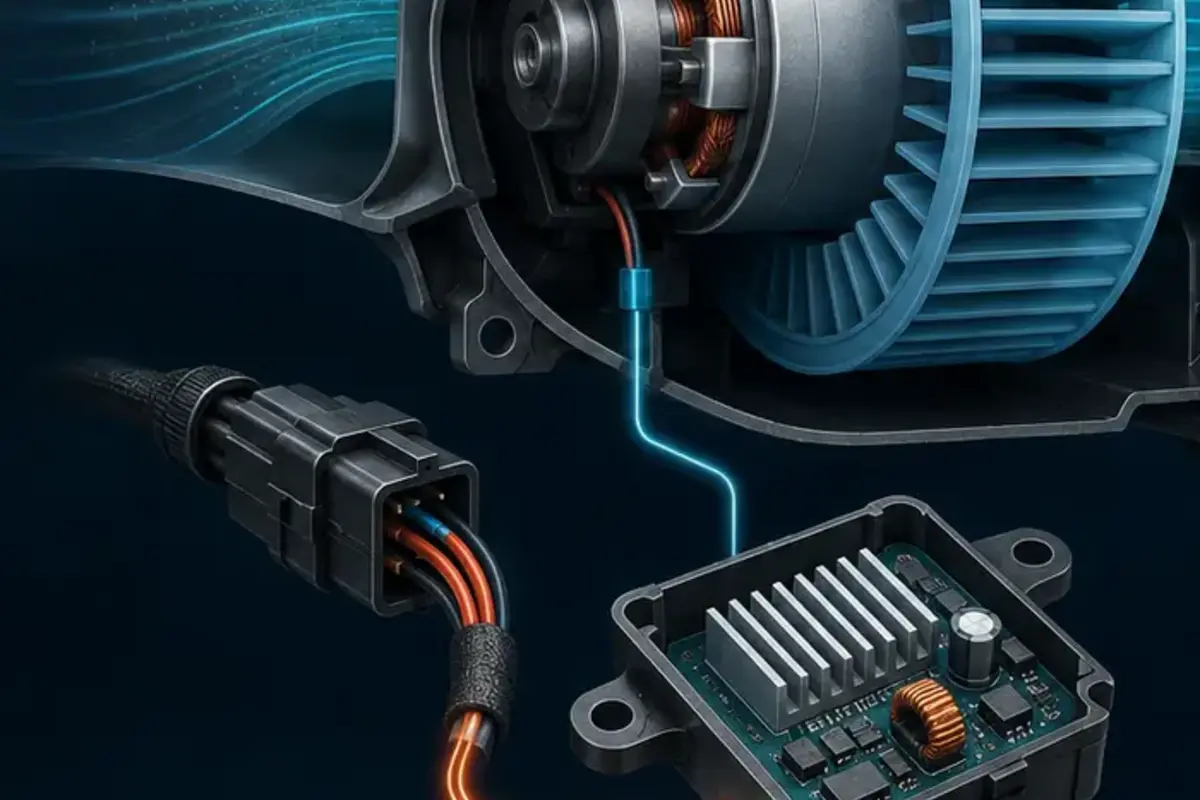
A worn blower motor, failed resistor or electronic controller may reduce speed, lose individual fan settings, work only when cool, or make noise. Electrical testing must follow the vehicle circuit, not a guess based on fan sound.
Air cannot pass through or reach the chosen vents
Evaporator ice, debris, a displaced duct or a blend door can restrict the path after the blower. The pattern at different vent modes helps separate these possibilities.
Use the time pattern before buying a filter
Weak from the first minute
If airflow is poor immediately at every fan speed, an intake restriction, cabin filter problem or low blower output moves higher on the list. A filter is worth inspecting, but it is not a universal answer.
Starts strong, then fades
If airflow begins normally and collapses after cooling has been running, evaporator ice or a heat-sensitive blower fault deserves attention. Record whether airflow returns after the AC is switched off or after the vehicle sits.
Fan sound matters
A loud blower with little air can indicate a restriction. A quiet blower despite a high-speed command points more toward the motor, controller, supply or ground. Test the circuit across its commanded range before choosing a part.
What we test before calling it an AC gas issue
| Possible cause | Typical clues | Confirming direction |
|---|---|---|
| Cabin filter or intake restriction | Weak from the start, dust or leaf history, recent sand exposure, unchanged by temperature selection. | Inspect intake and filter fit, loading, moisture and debris. Check that the replacement specification matches the housing. |
| Blower motor or controller fault | Some speeds missing, intermittent operation, fan noise, burning odour, or flow changes when the motor warms. | Check commanded speed, supply, ground, controller operation, current draw and connector condition using vehicle information. |
| Evaporator icing | Airflow begins normal then becomes very weak after cooling has been on, often returning after rest or after the AC is switched off. | Measure vent and evaporator-temperature behaviour, blower output, pressure and sensor plausibility. Do not recharge without evidence. |
| Blower wheel contamination or duct restriction | Noise, imbalance, debris history or a sudden reduction after rodents, leaves or repair work. | Inspect reachable wheel and housing, then confirm duct condition and mode-door travel where access permits. |
| Blend-door or mode-door fault | Air is strong at the windscreen but weak at face vents, or changes incorrectly between selected modes. | Command the doors, verify movement and diagnose actuator, linkage or HVAC-control faults. |
When weak airflow is actually evaporator ice
The classic freeze-up pattern
Air starts cold and strong, then gradually becomes weak as ice forms across the evaporator. Flow may return after the AC is switched off or the vehicle sits long enough for the ice to melt.
Why gas is not the only suspect
Low charge can contribute on some systems, but so can an implausible temperature sensor, a restriction, incorrect compressor control or poor airflow across the evaporator. The useful test captures the system while the fault is present.
A temporary improvement is not proof
If a top-up changes the symptom for a while, that still does not prove the root cause was simply low refrigerant. The pressure, temperature, airflow and control pattern must agree.
Three observations that change the next step
Weak at all speeds
Begin at the intake and cabin filter, then compare commanded fan speed with actual blower output. Constant restriction and low blower output become more likely than freeze-up.
Weak only after cooling runs
Look for the freeze-up pattern. Compare airflow, vent temperature, evaporator temperature information and system control while the fault is present.
Weak only from selected vents
Inspect air distribution rather than assuming a cooling-system fault. Mode doors, actuator calibration and duct movement may be the relevant path.
Where the airflow path becomes expensive to restore
Access usually controls the labour
A cabin filter or intake clean is very different from blower replacement, controller diagnosis, evaporator access or an HVAC-door repair behind the dashboard. Vehicle design and access determine how much dismantling is required.
Keep airflow work separate from cooling repairs
If testing finds a separate cooling fault that is causing evaporator ice, that repair should be scoped and priced independently from a filter or blower job. A simple airflow service should not be represented as a full AC-system repair.
Ask what the quote actually includes
Request the inspection result, confirmed fault, parts choice, labour scope and any required calibration. Make, model, year, trim and parts availability can all change the final amount.

Arrange prompt inspection instead of continuing the fan test if
There is a burning smell, smoke, melted-plastic smell, repeated fuse failure, fan operation that cuts in and out with electrical noise, wet carpet near connectors, or visibility is compromised in rain because demisting is inadequate. Do not reach into the blower or force debris through vents. A blocked air path can be inconvenient, but an electrical odour or unstable blower circuit deserves immediate attention.
Weak air from vents without guessing
Can a dirty cabin filter make the AC feel warm?
It can reduce the amount of cold air that reaches the cabin, making cooling feel poor even when the air itself is cold. Temperature and airflow should be assessed separately.
Why is airflow good again after I stop the AC?
That pattern can fit evaporator ice, but it needs confirmation. It can also reflect a heat-sensitive blower fault or another intermittent condition.
Does weak airflow mean the blower motor must be replaced?
No. The filter, intake, blower wheel, power supply, controller, evaporator and distribution doors all need to be considered. Testing avoids replacing a motor that was not the cause.
Should I remove the cabin filter and keep driving?
Removing it may change the symptom but can allow more debris into the HVAC case. Use the correct replacement and investigate why it became unusually blocked or damp.
Book the right airflow check
Tell us if the flow is weak from the start or fades after running, which vents are affected, the fan speed behaviour and any noise or smell. We will separate restriction, blower, evaporator and air-distribution tests instead of guessing from one symptom.
How to describe weak airflow accurately
“The AC is weak” can mean poor cooling or low air volume. Separate those two symptoms first, then use the pattern below to narrow the route.
1. Temperature or volume?
If plenty of air arrives but it is warm, the problem is cooling performance. If the air is cold but barely reaches the cabin, the problem is airflow. Compare equivalent face vents at one fixed fan speed before changing modes.
2. Does fan speed actually change?
Move from low to high and listen for a clear change in blower sound and air volume. High command with little fan noise points toward the motor, controller, supply or ground. Loud fan with weak flow points toward a restriction or duct path.
3. Is the filter the cause or just dirty?
Dubai dust can load a filter quickly, but a dirty filter is not automatically the root cause. A wet, collapsed or repeatedly blocked filter deserves inspection of the intake, housing and moisture source as well.
Why a restriction should not be ignored
Demisting gets slower
Low air volume reduces how quickly the system can clear the windscreen and cool a heat-soaked cabin.
The blower works harder
A motor pushing against a blocked filter or restricted path can become noisier, run hotter and still deliver poor cabin airflow.
Removing the filter is not a repair
Driving without the correct filter can send dust and debris deeper into the HVAC case. The proper fix is to restore the restricted or low-output part, then retest every vent mode.
Verification after the repair
Check more than one fan speed
The blower should respond normally from low through high without abnormal noise, smell, overheating or delayed operation.
Repeat the original failure pattern
If airflow used to fade after 20 to 40 minutes, the system needs to run long enough to prove that the fault no longer returns.
Confirm vent routing and clean assembly
Face, footwell and windscreen modes should route air correctly. Filter housings should be closed properly and loose debris should not be left near the blower wheel.