Chevrolet AC Repair Dubai
Tahoe, Suburban, Silverado, Traverse, Equinox, Camaro and other Chevrolet models can develop weak cooling, rear-zone problems, refrigerant leaks, compressor faults and blower issues. We separate front-cabin, rear-cabin and truck-use complaints before parts are approved so a large SUV or pickup gets a repair plan that matches how it actually fails in Dubai heat. For another major American make, see our Ford AC repair Dubai guide.
Front and rear cabin repair
If front and rear zones behave differently, we compare airflow and temperature by zone before a whole-system part is blamed.
Pickup idle and work-use repair
Long stationary use can expose fan, heat-rejection and electrical weaknesses that road airflow hides.
Family and urban cooling repair
Cabin pull-down, traffic performance and blower strength help decide whether airflow or refrigeration needs priority.
Heat-soak and intermittent repair
Compressor control, pressure protection and engine-bay temperature may need extended run time to reproduce the complaint.
Cabin size and vehicle duty change what counts as a successful AC repair
Rear passenger comfort is part of the repair result
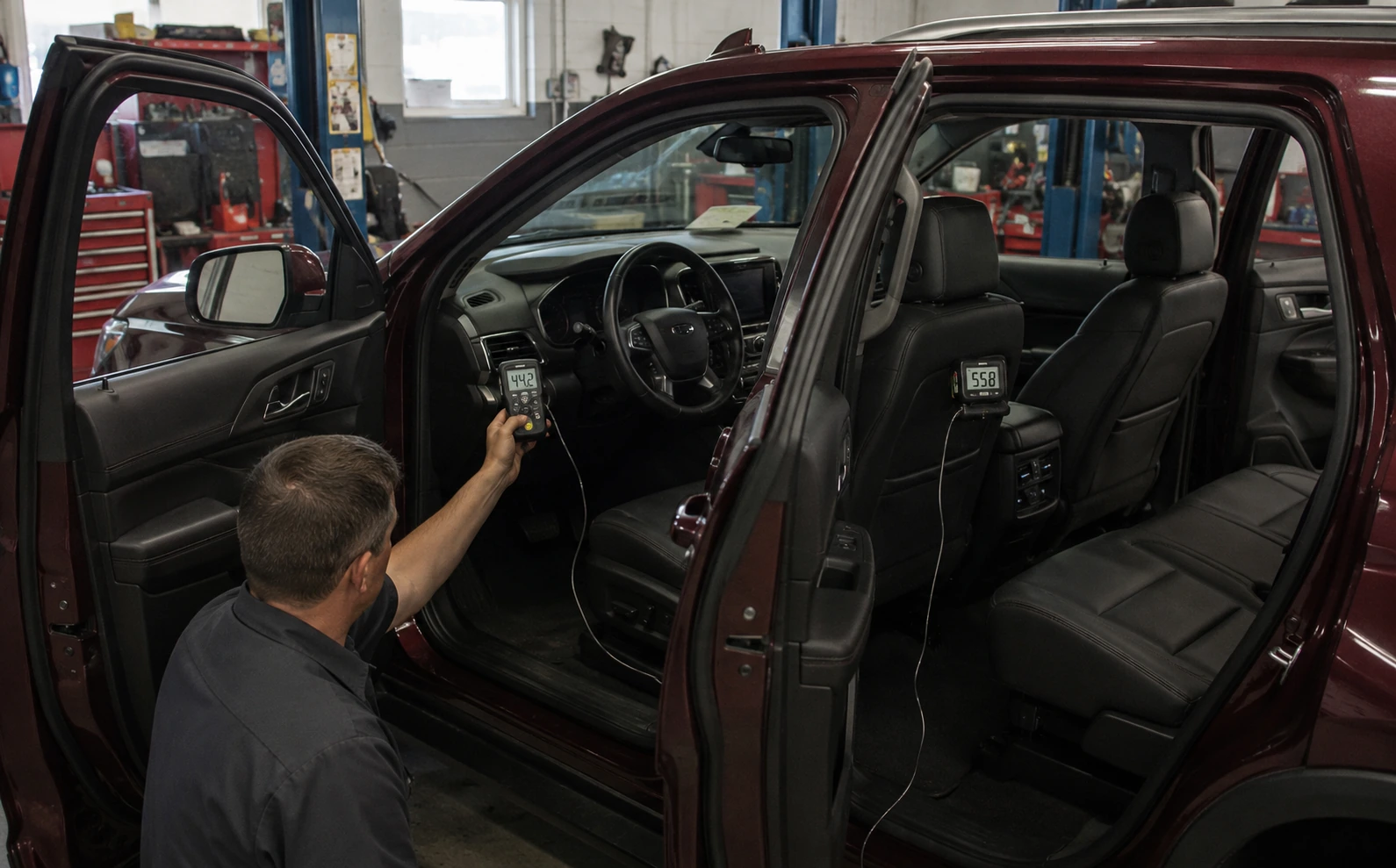
Front-centre vent temperature alone cannot prove a large SUV is fixed. Rear airflow, rear vent temperature and complete cabin pull-down should be verified where the complaint involves passengers behind the first row.
Stationary work and traffic load
Pickup use can involve long idle periods. Fan command, actual condenser airflow and electrical response need to be tested under the condition that causes the weakness.
Family-cabin cooling balance
Rear and front airflow, charge accuracy and heat rejection matter when a larger cabin takes too long to cool after hot parking.
Urban heat-soak complaints
Short trips and stop-go driving can make fan, blower and compressor-control weaknesses more visible than they are at steady road speed.
Performance heat and compact-cabin response
Cooling that changes after the engine bay is fully hot may require extended testing before pressure protection or compressor-control faults are clear.
What usually brings Chevrolet owners to the workshop
These patterns connect the owner complaint to a repair branch. They are not intended as a generic list where every possible AC component is treated as equally likely.
Rear vents are weak or warm
Especially relevant on Tahoe, Suburban and other large family vehicles. Front and rear performance should be compared before rear access is approved.
AC gets warm at idle
Fan command, actual condenser airflow, heat rejection and compressor output should be checked in stationary conditions. The idle cooling symptom page can help describe this.
Cooling fades after a refill
Repeated low charge supports AC leak detection and repair instead of another routine recharge.
Airflow is weak or inconsistent
Cabin filter, blower motor, controller, wiring and air distribution can reduce cabin cooling even when the refrigerant circuit is cold.
Cooling is intermittent or compressor output is weak
Command, pressure protection and physical response should agree before compressor repair or replacement is approved.
AC starts cold then changes with time
Heat-sensitive electrical behaviour, icing and pressure protection may need sufficient run time. The AC stops after a while page helps describe the timing.
Tahoe rear cooling Silverado idle load and newer electrified systems need different checks
Chevrolet covers very different cabin and duty patterns. Tahoe and Suburban complaints may belong to a rear HVAC branch, while Silverado cooling that weakens during stationary work use needs fan airflow and heat rejection tested under idle load. Those are different starting points even when both vehicles arrive with a warm-cabin complaint.
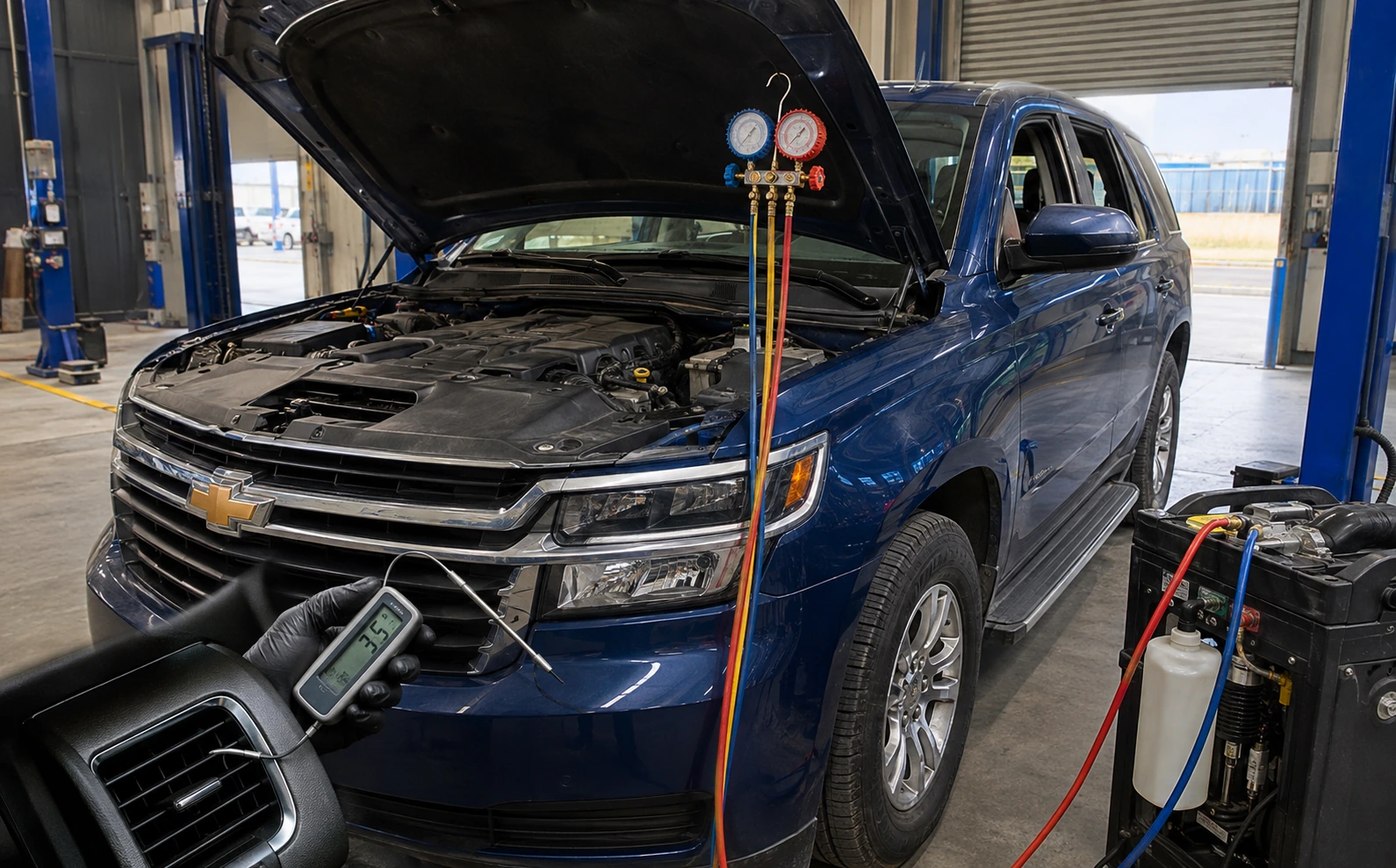
Refrigerant type is confirmed from the exact vehicle label before service. Depending on model year and market, a Chevrolet may use R134a or R1234yf. The correct route is then either the standard AC gas service or the dedicated R1234yf service, with the specified oil and measured charge.
Electrified Chevrolet models require another boundary. Electric compressors and vehicle thermal-management systems are routed through the EV and hybrid AC service when applicable rather than being treated as a conventional belt-driven compressor job.
Chevrolet repair planning
Front and rear cabin results are separated before rear trim or a whole-system component is approved.
Stationary cooling is tested without road airflow so fan, voltage and condenser weaknesses become measurable.
Accessible blower, sensor and electrical work may be completed sooner, while compressor, rear HVAC and evaporator work needs more access and verification time.
Where a Chevrolet repair qualifies and uses original parts, six months of warranty cover is included in the written scope before work starts.
Rear HVAC access and truck duty change what good value means
A Tahoe rear-cabin repair can involve trim and interior access, while a Silverado may need a part chosen with long idle time and work use in mind. Those jobs deserve a different decision from an external hose, relay or service item.
We match the component to the exact Chevrolet and the proven failure, then weigh durability, availability and the labour that would have to be repeated if the part does not hold up.
Rear-cabin and buried components
Evaporator-side, rear HVAC and difficult interior work usually justify a stronger focus on exact specification because the access is expensive to repeat.
Truck-duty components
For Silverado and other work-use vehicles, predictable availability and service life can be more valuable than the lowest initial component price.
Fan blower and control hardware
Electrical and airflow parts are selected only after the failed motor, controller, supply or command branch is identified on the vehicle.
Accessible service items
Selected filters, seals, hoses and external components can use a broader quality range when fit, material specification and warranty are clear.
Price the repair by cabin branch and vehicle use
Tahoe and Suburban owners may be dealing with a rear-cabin problem, while Silverado complaints often show up under long idle periods or work use. Those differences change which labour and parts belong in the quote.
These figures are Dubai planning bands only. The exact Chevrolet, failed branch, refrigerant system and access determine the written estimate after testing.
Front and rear comparison test
AED 200 to 500Useful when the owner needs to know whether the problem is local to one cabin area or affects the whole cooling system.
Leak-source repair
AED 350 to 1,700+An external seal or hose is far simpler than condenser, evaporator or rear-HVAC leakage that requires deeper access.
Rear blower and local control work
AED 450 to 2,000+Trim removal, blower assembly, wiring and rear-zone control can move this from a simple airflow fix to a larger cabin job.
Idle-cooling fan or condenser work
AED 650 to 2,500+Fan hardware, control modules, condenser condition and front-end access all influence the final amount.
Front-cabin blower repair
AED 250 to 1,800+Filter restriction, blower motor, controller and wiring are priced differently once the weak-airflow branch is proven.
Compressor-side repair
AED 1,100 to 4,000+The scope changes with control type, clutch arrangement where fitted, contamination and whether a complete compressor is actually required.
Evaporator or rear HVAC access
AED 1,600 to 5,000+Interior dismantling, seals and recharge procedure are major cost drivers on this route.
Electrical diagnosis and repair
AED 300 to 1,600+A relay or connector issue is not priced like an actuator, module or network fault, so the circuit is narrowed first.
For Tahoe and Suburban rear-cabin work, the estimate should clearly say whether the repair is rear-specific or part of a system-wide cooling problem.
Mark the affected cabin area
We begin by confirming whether the complaint belongs to the front row, rear cabin, both zones or only a long-idle condition.
Recreate the Chevrolet use case
Hot parking, third-row passenger use, long idling or highway running are used to reproduce the same weakness the driver reports.
Compare air delivery by zone
Front and rear vent volume and temperature are checked separately when the vehicle has a multi-row cabin complaint.
Load the heat-rejection system
Fan airflow and condenser performance are watched while road airflow is removed, which is especially important for Silverado idle complaints.
Read whole-system cooling capacity
Refrigerant condition and compressor response are judged only after the zone and airflow results show whether the problem is local or system-wide.
Trace electrical faults from the physical symptom
Rear controls, blower circuits, relays or fan commands are tested where the cabin result gives a reason to investigate them.
Define front rear or whole-system scope
The estimate states which branch is being repaired and what trim access, refrigerant work or supporting materials belong to it.
Verify the same seating and idle condition
A Tahoe rear-cabin job is checked from the rear, while a Silverado idle fault is given stationary run time before the vehicle leaves.
Questions that help us choose the right Tahoe Silverado or Suburban test
The useful starting detail is which cabin area is affected and whether traffic, idling or road speed changes the symptom.
My Tahoe is cold in front but warm in the rear. What does that point to?
That pattern supports a rear-cabin branch first. Rear airflow, local HVAC operation and total system capacity are compared before trim is removed or a compressor is blamed.
Why does my Silverado lose cooling while it sits idling?
With road airflow gone, the fan and condenser have to reject the heat on their own. Their actual performance is checked alongside refrigerant condition and compressor reserve.
The Chevrolet was recharged recently and is weak again. What next?
The next step should be locating where the charge is escaping. Another refill may cool the vehicle temporarily without correcting the reason it became low again.
Can a Suburban rear problem exist even when the front vents are cold?
Yes. A long multi-row cabin can have a rear-specific airflow or local HVAC issue while the front remains comfortable. The two areas should be measured separately.
Do you diagnose both blower and condenser-fan faults on Chevrolet models?
Yes. Cabin blower problems affect air delivery inside the vehicle, while condenser-fan faults affect heat rejection outside it. The symptom determines which circuit is tested first.
How do you choose parts for a rear-HVAC Chevrolet job?
Access cost matters heavily. If trim or interior work is substantial, exact specification and dependable service life usually carry more weight than a small component-price saving.
What changes the cost of Chevrolet compressor work?
Compressor design, control type, contamination findings, refrigerant procedure and model-specific access determine whether the quote stays near the lower end or becomes a larger replacement job.
What should I send before booking a Chevrolet AC visit?
Send the model, year, whether front, rear or both areas are affected, whether idling changes the cooling, and any recent recharge, blower, fan or compressor work.
Send the model and tell us which cabin area loses cooling
A Tahoe with rear-passenger discomfort and a Silverado that warms during long idling need different preparation. Send the year, affected area and operating pattern so the workshop can start with the correct front, rear or truck-duty branch.