
Car AC Stops at Idle or in Traffic
If the AC turns warm while you wait at a signal but becomes cold again once the car moves, the complaint is strongly tied to low-speed operating conditions. Condenser fan performance is high on the list, but refrigerant charge, compressor output, engine idle control and pressure protection can create the same traffic-only pattern.
If moving makes it cold again, airflow across the condenser deserves an early test
The front condenser has to reject heat from the refrigerant. At road speed, natural airflow helps. At idle, electric or engine-driven fans must do far more of the work. If fan speed is missing, weak or commanded incorrectly, pressure can rise and vent temperature can climb until the car starts moving again.
That pattern is common in heavy Dubai stop-go traffic because the AC is working against a very hot cabin, high ambient temperature and heat radiating from the road and engine bay. A system with slightly weak fan performance may feel acceptable at night and fail at a midday signal. A marginal refrigerant charge or compressor can show the same heat-load sensitivity. Pajero, L200 and Outlander owners can also use the Mitsubishi AC repair Dubai guide for model-specific heat-load and idle-cooling checks. Wrangler, Charger, Durango and Grand Cherokee owners can use the Dodge and Jeep AC repair in Dubai page for model-specific heat-soak, idle and rear-cabin context.
Do not approve a fan, compressor or gas refill based on the symptom alone. Run the free AC symptom checker and select “cold while driving, warm in traffic” to organise the clues before booking. The diagnostic still needs to reproduce the complaint stationary, observe fan command and actual fan behaviour, measure system response and then compare the same vehicle under raised engine speed or road airflow.
If the engine temperature also rises when the AC is used, the complaint becomes more urgent. AC condenser airflow and engine radiator cooling are physically linked in the front cooling stack on many vehicles. A fan problem can affect both systems.
Four versions of the idle complaint lead to different branches
Warm at lights, cold at speed
Condenser airflow moves high on the list. Fan operation, shroud condition and front-stack restriction should be checked before refrigerant is blamed.
Starts cold, fades in a jam
Heat soak can expose a marginal fan, weak compressor, pressure-control event or charge problem that is not obvious during a brief workshop idle test.
Cooling returns above idle RPM
Compressor output, drive speed, fan strategy and idle-load control become relevant. Raising RPM is a clue, not a safe permanent workaround.
AC weakness plus engine heat
Stop treating it as a cabin comfort issue. Cooling fan, radiator airflow, engine cooling and compressor load all need prompt assessment.
At zero road speed every link has to carry more load
This page is built around the operating chain that changes when the car stops moving. The chain helps explain why a vehicle can be cold on Sheikh Zayed Road and warm at the next traffic light without the refrigerant magically changing.
Compressor receives the cooling request
The control system decides whether compressor operation is allowed based on temperature, pressure, engine load and protection inputs.
Hot refrigerant reaches the condenser
The condenser has to release heat into already hot Dubai air. Any restriction or damage reduces its reserve capacity.
Road airflow falls to almost zero
Once the vehicle stops, the fan must pull or push sufficient air through the condenser and radiator stack.
Pressure and temperature respond
If heat rejection falls behind, refrigerant pressure can rise and cooling performance can drop. The control system may reduce or stop compressor operation for protection.
Movement restores airflow
When the car accelerates, natural airflow can mask the underlying fan or heat-rejection weakness. That is why a road test alone can miss the root cause.
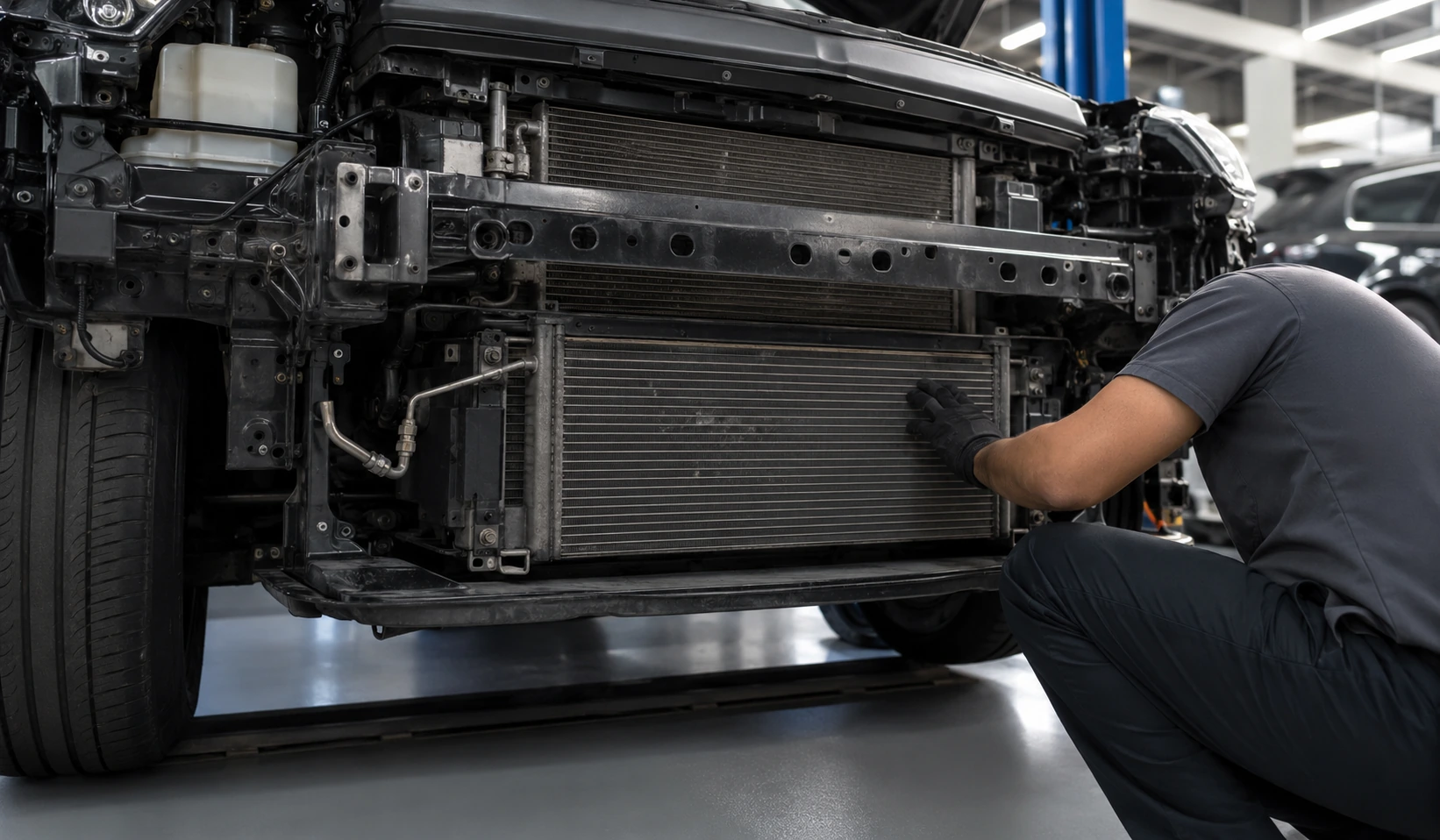
A good idle diagnostic observes the fan rather than merely listening for it. Some vehicles use variable-speed fans, multiple fan stages, shutters or networked fan modules. A fan that spins is not automatically delivering the commanded airflow. Actual speed, current draw or control signal may need to be compared with the request.
Condenser cleanliness matters too. Sand, debris, bent fins or tightly packed contamination can reduce heat transfer. Cleaning can help when restriction is confirmed, but aggressive pressure washing can damage fins and should not be treated as a universal fix.
Most likely faults for AC that stops cooling at idle
Condenser or radiator fan not moving enough air
This is the first branch to test when road speed reliably restores cooling. The fan may be completely dead, intermittently failing when hot, stuck at a low stage, suffering high resistance, receiving a weak supply or being commanded incorrectly by a module.
The fan circuit should be tested under the condition that causes the complaint. A cold workshop check can miss a motor or module that fails only after heat soak. If the front cooling stack also supports engine cooling, the same fault can raise engine temperature in traffic. Confirmed condenser or airflow issues can lead to the AC condenser repair route or the relevant electrical repair after testing.
Marginal refrigerant charge or leak
A low or incorrect charge can reduce cooling reserve. The system may still feel cold while moving but fail under idle heat load. If refrigerant is low, the next question is why. Repeated topping up is not the repair.
Use AC leak detection if loss is confirmed. The charge should be restored by specified quantity after the source has been addressed.
Compressor weak at low speed
A worn compressor, control valve or clutch-related problem may produce insufficient output at idle and improve as engine speed rises. That pattern needs pressure, temperature and command data. Do not condemn the compressor because raising RPM improves the vent temperature.
When compressor evidence is strong, the compressor repair and replacement service is the appropriate path.
Pressure sensor or protection strategy
Pressure information helps the control system protect the AC. An implausible sensor value, wiring issue or genuine high-pressure condition can cause compressor operation to be reduced or stopped. The technician should compare commanded behaviour with measured reality.
A confirmed sensor or switch fault can move to the AC pressure switch diagnostic route.
Idle control or excessive engine load
Some vehicles temporarily alter compressor operation when engine load, throttle request, coolant temperature or electrical demand is high. A rough idle, low charging voltage or engine-control issue can therefore influence the AC at a stop. The complaint should be reproduced with engine and electrical conditions recorded, not isolated from the rest of the car.
The same cold vent can be produced by two very different airflow sources
While the car is moving
Road speed pushes a large volume of outside air through the front cooling stack. This can hide a weak fan, damaged fan control or borderline condenser restriction. The driver experiences normal cooling and assumes the system is healthy.
- Natural airflow can compensate for low fan output.
- Engine RPM may also increase compressor output.
- Heat under the hood can be carried away more effectively.
- The symptom may disappear before the workshop sees it.
While the car is stationary
The vehicle has to manufacture its own airflow with the cooling fan. At the same time, the cabin and engine bay can be absorbing strong Dubai heat. This is the better condition for diagnosing a traffic-only complaint.
- Fan command and actual fan response become visible.
- High-side heat rejection can be evaluated.
- Idle voltage and compressor request can be observed.
- Engine temperature should be watched at the same time.
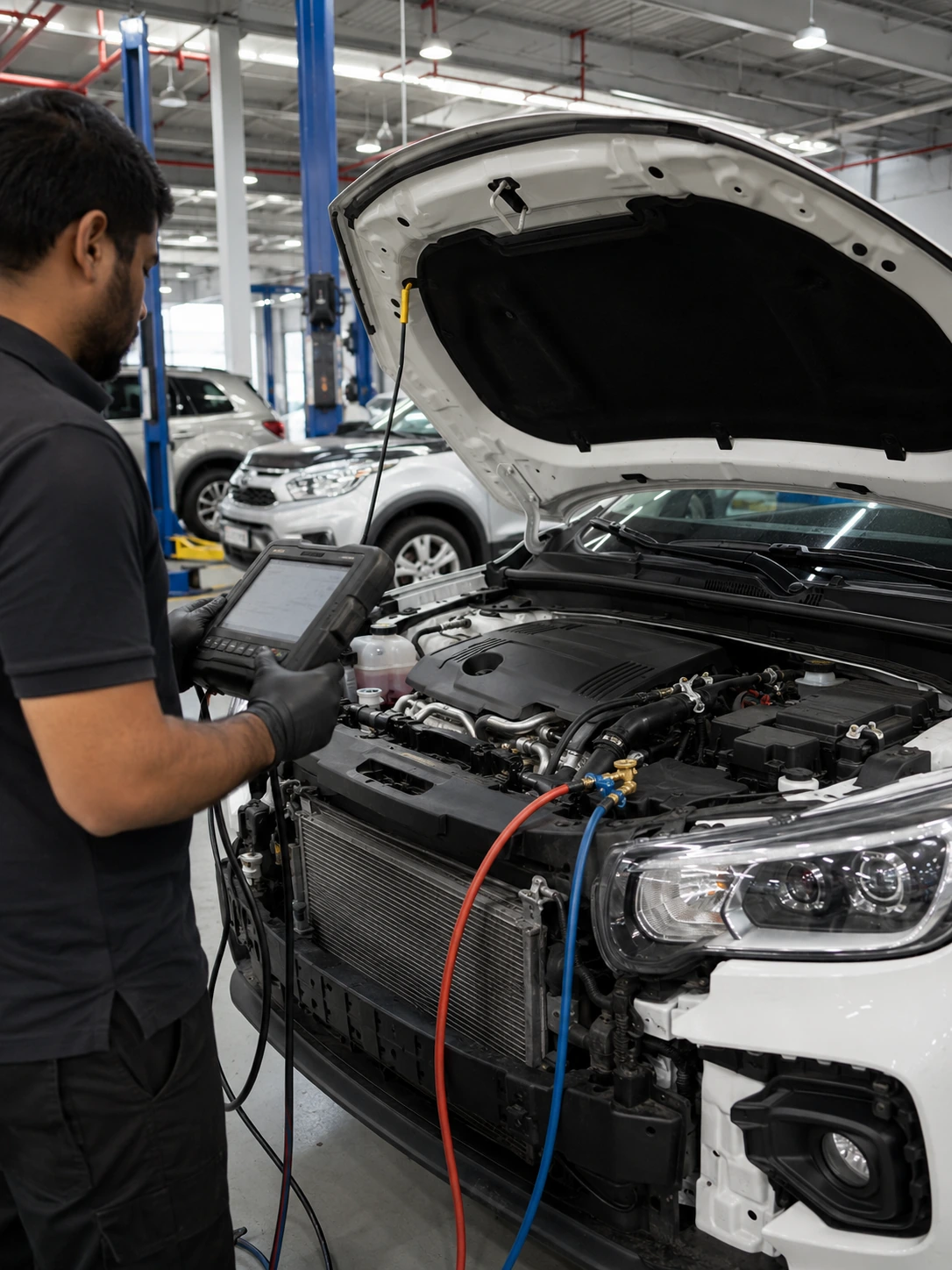
Use the scan image as part of the diagnosis, not a full-width break
At idle, live data is useful because the fault often depends on fan command, compressor request, pressure behaviour and engine temperature at the same moment. The image now sits beside the key measurements instead of dominating the section.
Do not fix a traffic-only symptom by forcing one component
The symptom is valuable because it happens under a specific operating condition. Preserve that information. A random refill, fan bypass or repeated high-RPM workaround can hide the original fault and create new problems.
Do not hard-wire the fan
A temporary bypass can defeat staged or variable fan control, overload wiring and hide the command fault that needs diagnosis.
Do not keep revving at signals
If extra RPM restores cooling, report it. Do not use it as a routine workaround in traffic, especially if engine temperature or belt noise is abnormal.
Do not add gas because traffic is hot
Dubai heat increases demand but does not prove refrigerant is low. Charge quantity should be checked through a proper diagnostic process.
Do not ignore an engine heat warning
If the engine temperature rises with the AC, switch the AC off and assess the vehicle safely. Continued overheating can cause major engine damage.
What repairs for AC that fails at idle may cost
These are broad planning ranges, not quotations. Exact price depends on the vehicle, confirmed fault, parts choice, electrical testing, fan configuration, refrigerant type and the work required to reproduce and verify the traffic condition.
Focused AC and fan diagnosis
AED 200 to 450Planning range for reproducing the complaint and separating airflow, charge, compressor and control branches.
Fan relay, resistor or wiring path
AED 250 to 900Depends on circuit design, connector damage, access and whether a module is involved.
Cooling fan or fan module
AED 650 to 2,200+Single fan, dual fan and integrated module assemblies vary widely between cars.
Condenser repair path
AED 700 to 1,900Relevant when restriction, impact damage or leakage is confirmed at the front cooling stack.
Refrigerant leak and recharge
AED 350 to 1,500+The leak location and required part determine the repair. Recharge is done after the source is addressed.
Pressure sensor or switch path
AED 350 to 1,100Includes variation in sensor cost, access, wiring diagnosis and refrigerant recovery where required.
Compressor control or repair
AED 800 to 3,500+Control valve, clutch and complete compressor work have very different scopes.
Engine cooling related repair
After diagnosisIf overheating is present, radiator, coolant, fan and engine-cooling work must be scoped separately.
These figures are budgeting guidance only. The workshop quote is prepared after the exact vehicle and fault have been tested.
Separate a comfort problem from a cooling-system warning
An AC that warms at idle can be frustrating without being immediately dangerous. The safety level changes if the engine, belt drive or electrical system is also affected.
Cabin cooling fades only at idle
If engine temperature, charging system and vehicle behaviour remain normal, turn the AC off if needed and arrange diagnosis. Avoid long stationary AC use until the cause is known.
Fan noise, rapid cycling or belt distress appears
Abnormal fan, clutch or belt behaviour deserves prompt attention. Continuing to request AC can increase load on a failing component.
Engine temperature rises or warning appears
Switch the AC off and stop in a safe place if the engine overheats, steam appears, coolant is lost, the charging warning comes on or another serious warning indicates the car is unsafe to continue.
Reproduce the traffic condition before replacing anything
Confirm the exact pattern
We record whether cooling fails only at a standstill, after several minutes of heat soak, with engine idle, with auto stop-start active or only at a certain outside temperature.
Check the front cooling stack
Fan blades, shrouds, condenser face, radiator obstruction and visible damage are inspected before the system is loaded.
Observe fan command and response
The requested fan state is compared with actual operation where the vehicle provides that data. Variable speed, staged fans and integrated modules are tested according to the design.
Measure AC performance at idle
Vent temperature, ambient condition, blower setting, refrigerant behaviour and compressor command are recorded while the symptom is present.
Compare with raised speed or road airflow
The diagnostic notes what changes when engine RPM or vehicle airflow changes. That comparison can separate heat-rejection weakness from other branches.
Check engine and electrical context
Coolant temperature, charging voltage, idle quality and relevant engine requests are considered so an AC symptom is not isolated from a wider vehicle problem.
Isolate the failing branch
Fan power and control, refrigerant charge, compressor output, pressure sensing and condenser condition are tested only as far as the evidence justifies.
Verify in the original condition
After approved repair, the vehicle is allowed to idle under comparable heat load. A cold vent while driving does not verify an idle complaint.
When the fault is not yet isolated, start with full AC system diagnostics. If high pressure, fan behaviour or front-stack restriction is confirmed, the next repair route can be defined precisely instead of replacing the most visible part.
Where the diagnosis can lead
Condenser airflow or damage
Use the AC condenser repair and replacement service when front-stack restriction, leakage or condenser damage is confirmed.
Unknown idle fault
The full AC diagnostic is the best starting route when fan, charge, compressor and control faults still need separation.
Pressure sensing problem
Implausible pressure data or a confirmed switch fault can move into the pressure switch repair route.
Compressor weak at low speed
Measured low-speed output or a control fault can lead to the compressor repair service after evidence is documented.
Confirmed refrigerant loss
A low charge caused by leakage belongs in the AC leak detection service before a final measured refill.
Engine temperature rises too
Review the related car overheats with AC on symptom route because the problem has moved beyond cabin cooling alone.
What Dubai drivers notice at idle
The timing of the symptom is often more useful than how warm the vent feels.
Why does my car AC get warm at traffic lights?
At a stop, road airflow through the condenser falls away and the cooling fan has to provide airflow. A weak fan, restricted condenser, marginal charge, compressor weakness or pressure-control issue can become obvious only at idle.
Why does the AC become cold again when I start driving?
Vehicle speed increases natural airflow across the condenser and usually raises engine RPM. Either change can temporarily compensate for a weak fan, heat-rejection problem or low-speed compressor issue.
Does warm AC at idle always mean the condenser fan is bad?
No. The fan is an important early test because the symptom is speed-dependent, but charge condition, compressor output, condenser restriction, pressure sensing and engine control can produce similar behaviour.
Can low refrigerant make the AC fail only in traffic?
Yes. A marginal charge can lose cooling reserve under severe heat load, but the leak or charge has to be confirmed. Do not add refrigerant simply because the symptom happens in Dubai traffic.
Is it normal for AC to be slightly warmer at idle in extreme heat?
Some difference can occur because airflow and compressor speed change, but the system should still provide useful cooling when healthy. A clear change from cold while moving to warm at every stop deserves diagnosis.
Why does revving the engine make the AC colder?
Higher RPM can increase compressor output and may change fan strategy or electrical output. Report that pattern to the workshop, but do not use repeated revving as the repair.
Can I drive if the AC stops cooling at idle?
If the engine temperature and all vehicle warnings remain normal, driving with the AC off until diagnosis is often possible. Stop if the engine overheats, smoke appears, severe belt noise starts or a critical warning comes on.
Can a dirty condenser cause traffic-only cooling problems?
Yes. Sand, debris and damaged fins can reduce heat transfer, especially when natural road airflow is absent. Cleaning is useful only when the restriction is confirmed and done without damaging the fins.
Does auto stop-start affect AC cooling at a signal?
Some vehicles reduce compressor operation when the engine stops and use control strategies to manage cabin comfort. For a deeper explanation of what the compressor and blower may do during an engine-off stop, see our auto start-stop and car AC guide. If the behaviour is new, excessive or accompanied by weak cooling even with the engine running, the system should be assessed rather than assumed normal.
Tell us what happens at the signal and what changes when you move
Send the make, model and year, whether cooling returns immediately with road speed, whether revving changes it, how long the car must idle before it turns warm, and whether the engine temperature changes.