
Car AC Cold at Night, Warm in Daytime
If your car AC is not cold during the day but feels normal after sunset, the system is usually losing capacity when heat load rises. That points the inspection toward condenser efficiency, fan operation, refrigerant charge and compressor output under real daytime conditions.
The time of day changes the test, not the basic fault logic
Daylight adds ambient heat, sun through the glass and a hotter cabin for the AC to pull down. A healthy system should still make a meaningful, stable improvement, even though it will not cool a parked car instantly. When cooling is acceptable at night but repeatedly weak in daytime, it is reasonable to investigate the system’s heat-rejection and capacity margins.
That differs from an AC that blows fully hot air at every time of day. It also differs from a normal pull-down period after parking. The deciding factor is a repeatable daytime weakness after the car has been running with sensible settings and the cabin heat has had time to reduce.
Why cooling fades when the sun is up
These are inspection priorities, not a parts list. The vehicle’s refrigerant type, configuration, prior repairs and the exact way the symptom appears can change the order.
Condenser airflow is not keeping up with the heat
The AC condenser sits at the front of the vehicle and needs enough airflow to release heat. Dirty or blocked condenser fins, weak fan speed, a damaged shroud, an electrical command issue or airflow blocked by other front-end components can make cooling deteriorate most sharply in high heat or traffic.
Low or incorrect refrigerant charge has reduced the reserve capacity
A system can still provide some cooling at a mild load while lacking enough charge or correct performance to manage a Dubai afternoon. A previous recharge that improved the AC briefly is history worth recording, not a diagnosis by itself. The next step depends on measured behaviour and leak evidence.
Compressor output or control falls short under demand
Variable compressors and electronically managed systems may be commanded to cool but deliver less than expected because of a control valve, sensor, electrical input, clutch issue or internal mechanical limitation. Pressure behaviour, line temperatures and relevant data must be read together rather than judged from a single number. If this branch is confirmed, the compressor repair and replacement route explains the component-level scope.
Cabin delivery makes a capable system feel weak
A restricted cabin filter, weak blower, incorrect recirculation, evaporator icing, air-distribution problem or blend-door fault can prevent cooled air from reaching passengers properly. This does not replace the heat-load diagnosis. It is checked alongside it because a cold component can coexist with poor cabin comfort.
Temperature inputs or a metering fault are changing the system decision
Climate-control inputs, evaporator temperature protection and refrigerant metering faults can alter compressor request or refrigerant flow as conditions change. These are less useful to guess at from a driver symptom alone, so they belong after the basic airflow, heat-rejection and system-performance checks.
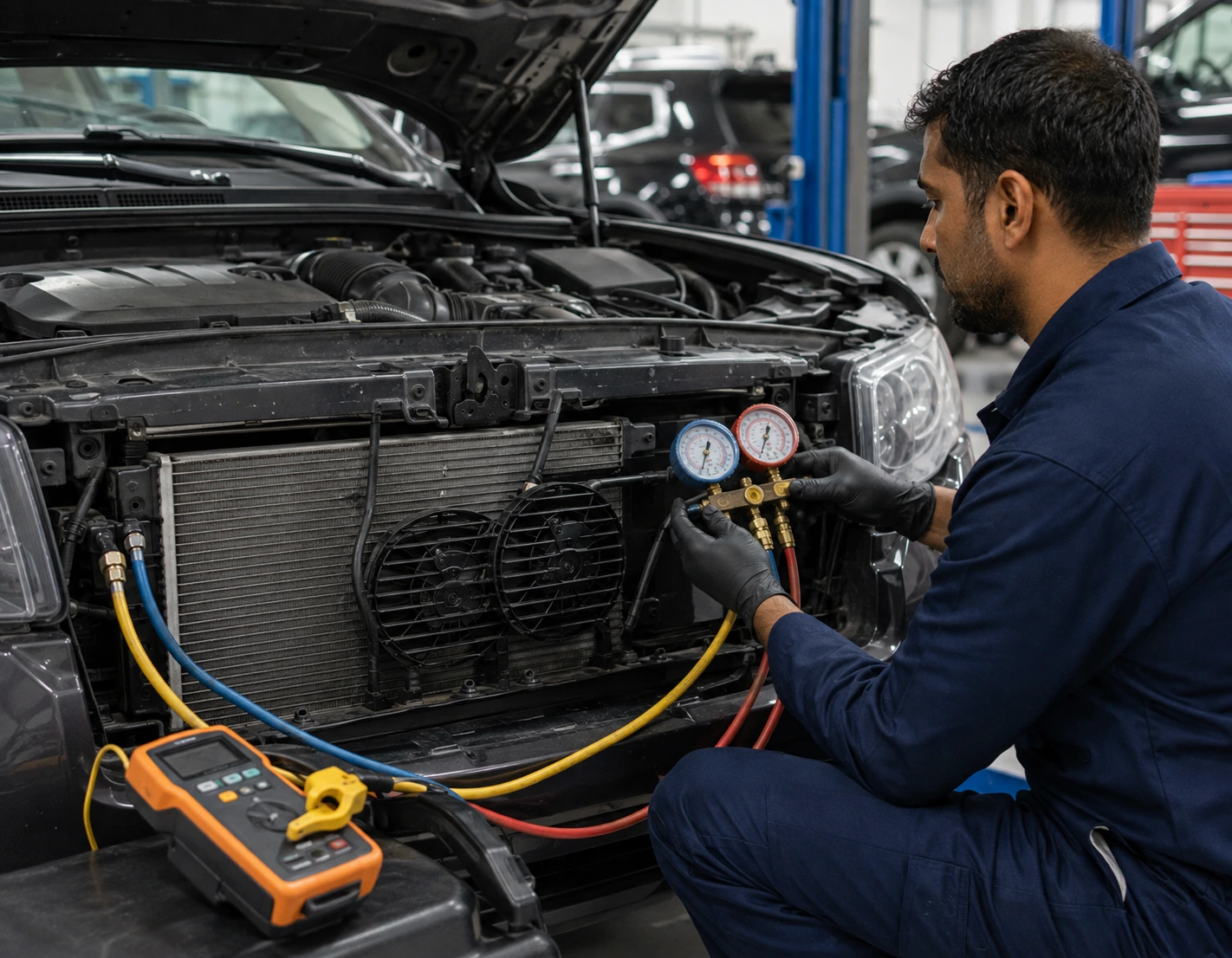
Two situations that look similar but need different action
The cabin was heat-soaked after parking
After a car has stood in direct sun, seats, glass, trim and the air inside are all storing heat. Even a healthy system may need a reasonable pull-down period. Ventilating briefly, then using recirculation once the hottest air has cleared, can help the cabin recover. The useful observation is whether the system settles into a stable, comfortable performance after that initial load has reduced.
The AC is consistently underperforming in daytime
If cooling stays weak on repeated daytime journeys, is noticeably better after sunset, or improves only at speed, the difference becomes a diagnostic clue. Record outside conditions, whether the car was moving, blower setting, recirculation state, the time since parking and whether the engine temperature remains normal. That gives the workshop a much stronger starting point than “the gas feels low”.
Daytime AC testing is about relationships, not one cold-vent number
Outside temperature, direct sun, cabin temperature and whether the car was parked determine how much heat the system must remove before the interior feels stable.
Blower strength, filter condition, recirculation and outlet distribution explain whether cooled air is actually reaching the cabin at a useful volume.
Condenser condition, fan operation and the difference between idle and road speed help identify whether the front of the vehicle can release heat effectively.
Vehicle-specified data, pressure behaviour, line temperatures, compressor request and the physical response are considered together before a charge or component is approved.
After any authorised work, the repair is judged against the original daytime pattern. A brief improvement in a different condition is not the same as confirming the fault has been resolved.
Start with the reason the capacity disappears
A daylight-only complaint may lead to a relatively contained airflow or measured refrigerant service, or to deeper component and electrical testing. A fixed diagnostic scope is the useful first purchase because it separates a performance complaint from the repair decision.
Where a refrigerant route is confirmed, see the separate measured gas-refill service. Where testing indicates a leak, the correct next path is AC leak repair, not repeated top-ups.
Measured refrigerant service after assessment
Correct refrigerant identification, specified charge quantity, recovery process and vehicle design all affect scope. A recharge is not evidence that a leak has been fixed.
Lower-scope leak detection and repair
Cost changes with the suspected location, test time, access, repairable versus replacement component and required refrigerant work.
Fan, condenser, compressor or control fault
These need a written estimate after the fault, access needs, vehicle specification, parts choice, electrical tracing and repair scope are known.
All ranges are indicative and non-binding, not a quotation. The final written estimate depends on inspection, exact vehicle specification, confirmed fault, parts choice, labour, refrigerant type, required work and current conditions.
How a daytime performance check should be approached
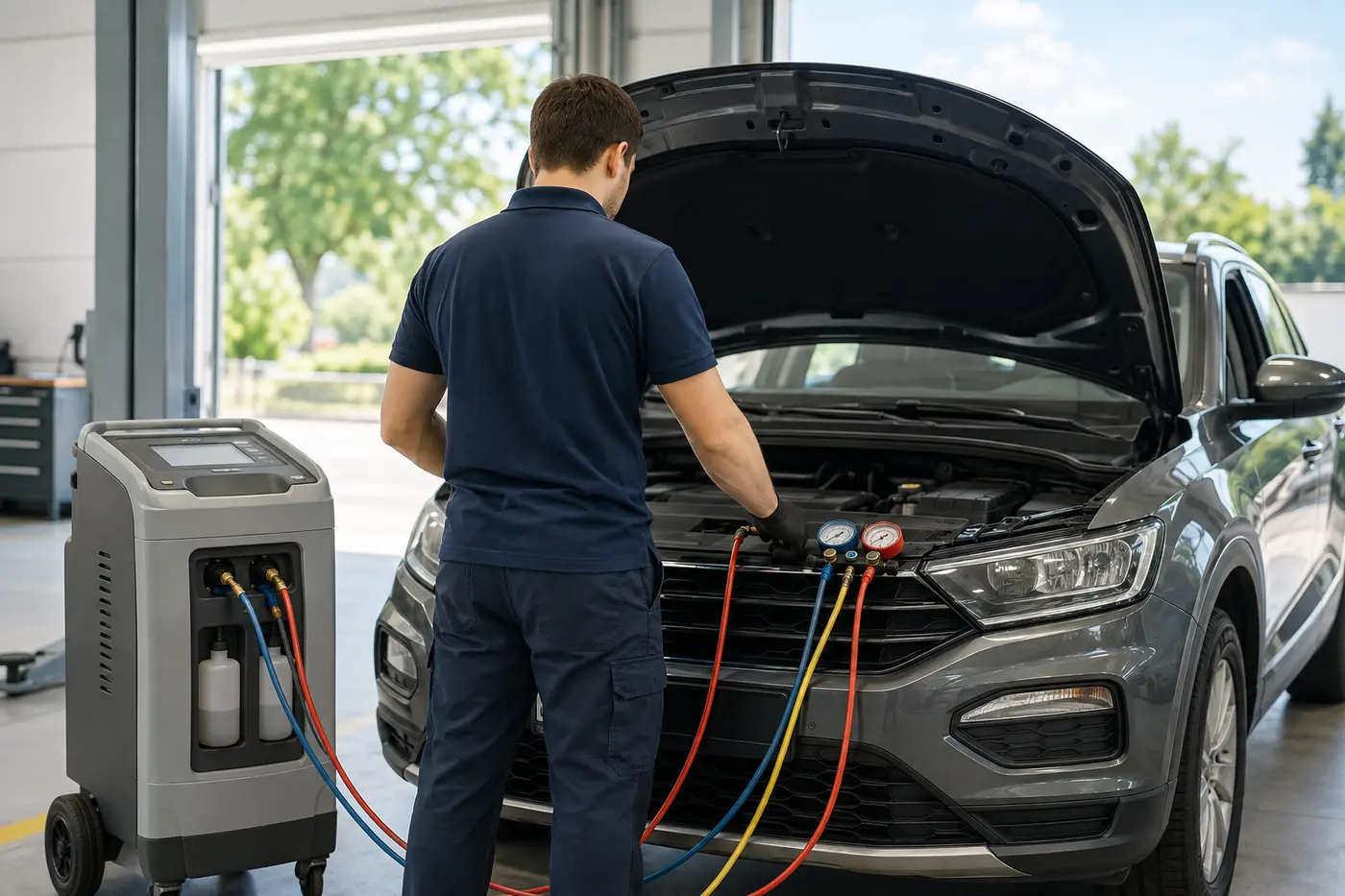
The parent full AC diagnostic is designed for a fault whose cause is not yet proven. The symptom dictates the order of testing, rather than a refill being treated as the default answer.
- Reproduce the complaint as safely as practical and record the ambient conditions, sun load, AC controls and whether the vehicle is stationary or moving.
- Check cabin air delivery separately from cooling output, including blower strength, filter condition, outlets, recirculation and zone behaviour.
- Inspect condenser condition and observe fan operation under the relevant daytime or idle condition.
- Interpret refrigerant behaviour, compressor command and physical response together against the vehicle specification.
- After approved repair, compare the result with the original daytime failure pattern rather than only checking a brief cold vent reading.
What Dubai drivers usually want to know next
The time pattern is valuable, but it cannot name a failed part without inspection.
Why is my car AC cold at night but warm in the day?
Outside temperature, sun load and a heat-soaked cabin increase the work the system must do. The pattern can expose limited condenser airflow, low charge, reduced compressor performance or poor cabin delivery that is less obvious at night.
Does daytime weak cooling always mean the AC gas is low?
No. A sealed system should not need routine top-ups. Low charge is one possibility, but fan performance, condenser restriction, compressor control and cabin airflow can produce a similar daytime complaint.
Is it normal for AC to take longer after parking in Dubai?
Yes, a heat-soaked cabin will take longer to cool. It becomes a fault pattern when cooling remains weak or unstable after a reasonable pull-down period, repeats across daytime journeys or improves markedly only after sunset or at road speed.
Can a dirty condenser cause AC to work better at night?
Restricted condenser airflow can matter more when ambient temperature and system heat load are high. Condenser condition and fan behaviour should be inspected rather than assuming that the visible dirt alone is the confirmed cause.
Tell us what changes between day and night
Send the vehicle make, model and year, plus whether the AC is worse after parking, in traffic, at idle, at road speed or only in the afternoon. The diagnostic scope and fee are confirmed before testing at AMF Auto Services in Al Quoz 4.