
Car AC Duct and Vent Cleaning Dubai
Dust at a vent, musty odour and weak airflow can begin at different points. Cleaning should follow the intake, filter, blower, evaporator, drain and duct path, then choose reachable physical removal and targeted treatment without soaking electronics or claiming permanent sterility.
Where contamination can sit inside the airflow path
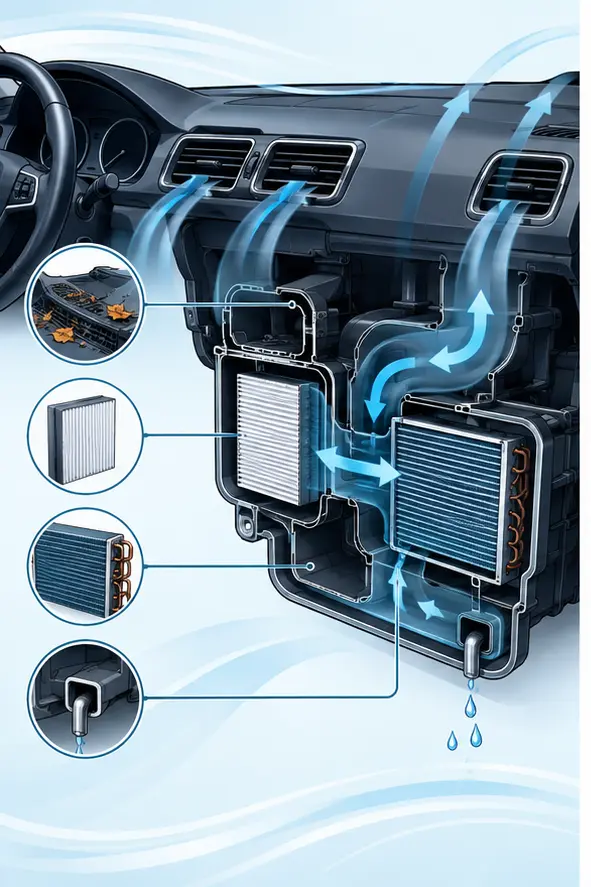
Outside or recirculated air first passes through an intake and often a cabin filter before reaching the blower and evaporator. Leaves, coarse dust and insects may collect upstream. Fine particles can coat the filter or blower. Moisture on the evaporator can hold debris, while a restricted drain keeps the housing damp. Ducts and outlets can carry residue without being the original source.
Cleaning depth should match access and evidence. A brush and vacuum can remove reachable dry debris. A specified filter can restore flow. Direct evaporator treatment may be possible through a service opening on some vehicles, while others require more disassembly. Fogging or fragrance alone cannot remove leaves, wet underlay or a blocked drain.
For a musty or biological-source complaint, the broader smell removal and disinfection page owns source assessment and product limits. For weak volume, check the blower motor and cabin filter rather than assuming the ducts are dirty.
Cleaning price follows source, access and method
A quotation should identify filter, intake, blower, evaporator, drain, duct and outlet scope. A low-price fog treatment is not equivalent to physical debris removal or repair of water entry. A deeper service is not automatically better when it adds unnecessary dismantling.
Any amount is indicative until inspection. Vehicle access, number of cabin zones, filter type, contamination, moisture, product, parts and required work determine the final written estimate.
Cleaning can remove a confirmed source at the verification point. It cannot guarantee permanent odour control when humidity, water entry, smoking, pets, outside air or neglected filters continue. Aftercare guidance should name the recurrence trigger.
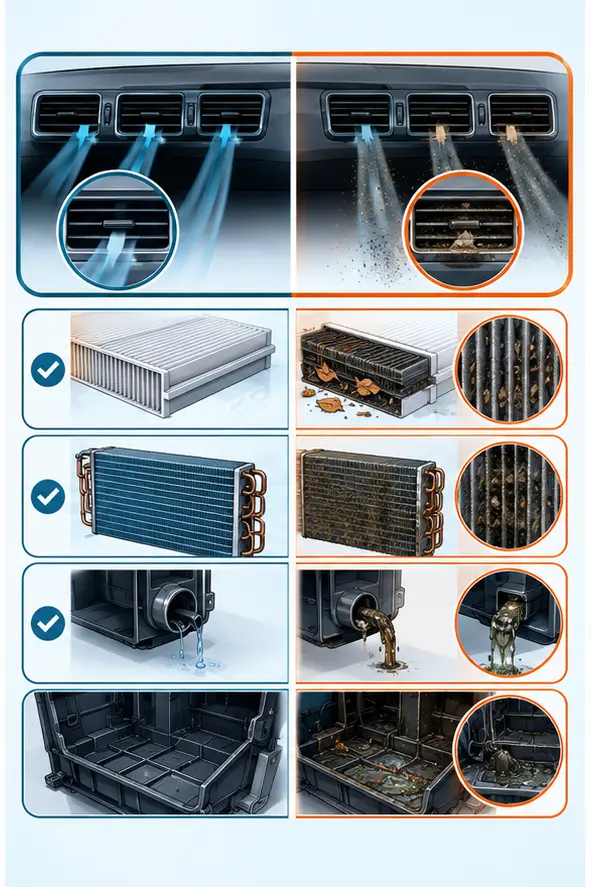
Six source locations with different cleaning methods
The decision is based on material, moisture, access and component sensitivity.
Leaves begin before the dashboard
Cowl and cabin intakes can trap leaves, sand and insects. Water-management paths in the same area must remain open.
Dry debris is removed without pushing it into the blower. Rain leakage or damaged seals require repair beyond cosmetic cleaning.
The filter can restrict or bypass
A loaded element reduces airflow, while a wrong or distorted filter can let dust travel around its edges. A damp filter can hold odour.
The housing and cover are inspected with the element. Replacement uses the correct size and airflow direction, not a universal pad.
The wheel can carry imbalance and noise
Debris inside the fan can create ticking, vibration or reduced output. Chemical spray can damage motors, controllers or electronics.
Reachable dry material is removed with power isolated as appropriate. Motor condition is diagnosed separately if noise or current remains abnormal.
A wet heat exchanger needs drainage
Normal condensation wets the fins during cooling. Dirt and persistent moisture can contribute to odour and reduced heat transfer.
Treatment follows product and vehicle access instructions, then the housing is dried and the drain is checked. No permanent sterilization promise is made.
Long passages are not equally reachable
Flexible and molded ducts can hide joints, foam, doors and sensors. Aggressive tools can disconnect or damage them.
Cleaning focuses on confirmed reachable deposits. Extensive dismantling requires evidence because removing a dashboard only for generic freshness may be disproportionate.
Not every smell comes from AC
Wet carpets, upholstery, food, smoke, coolant, electrical faults and outside fumes can enter the same vents or be mistaken for duct odour.
The source pattern is tested with fan, cooling, fresh-air and recirculation modes. Non-HVAC sources are routed to the correct repair.
The duct is one part of a larger intake, moisture and airflow system
These illustrations show generic component relationships and safe cleaning concepts, not actual contamination found in a customer vehicle.
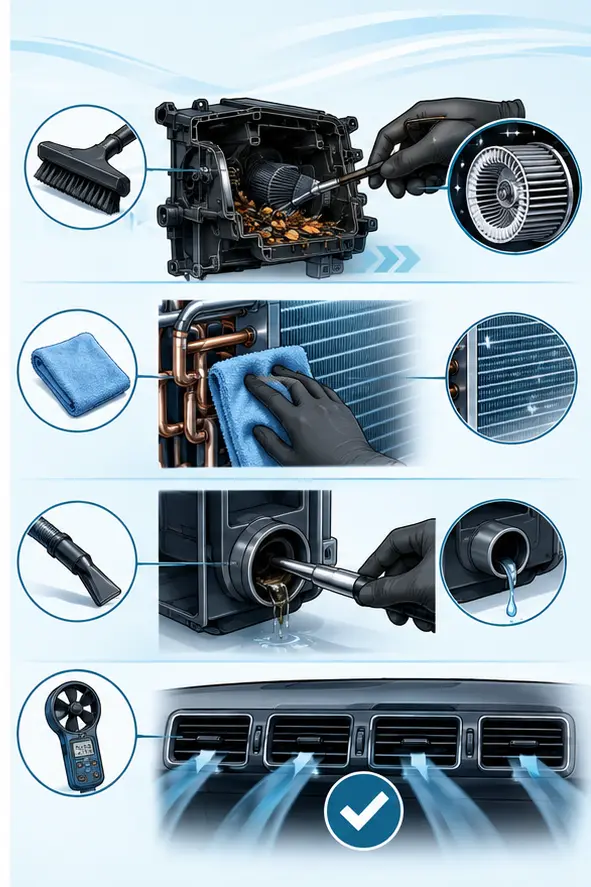
A cleaning sequence that preserves electronics and evidence
The system is observed before fragrance or chemical can mask the pattern.
Odour and dust pattern
Test fresh air, recirculation, fan-only and cooling modes. Record rain, parking and first-start timing.
Filter and intake access
Inspect element, housing, cover, upstream debris and water routes. Photograph useful evidence before removal.
Airflow and blower check
Compare fan stages, outlet distribution, noise and wheel condition. Separate restriction from a weak motor or controller.
Evaporator and drain decision
Check moisture and drainage clues, then choose reachable physical or approved surface treatment for the actual vehicle.
Duct and outlet cleaning
Remove confirmed reachable deposits with methods that protect foam, doors, sensors and electronics. Avoid uncontrolled liquid.
Drying and verification
Ventilate as required, confirm drain and airflow, and reassess the original odour after added scent fades.
Match the complaint to the first source check
A vent symptom becomes more useful when its timing is included.
| Air-path complaint | Source inspection | Cleaning limit |
|---|---|---|
| Dust puff when fan starts | Filter bypass, intake debris, blower housing and outlet residue | Repeated dust after cleaning suggests an upstream source |
| Musty smell after parking | Evaporator moisture, drain, wet filter and housing | Fragrance can hide the pattern temporarily |
| One vent smells or flows differently | Local duct, door, diffuser and foreign object | Compare adjacent outlets before broad treatment |
| Odour only on fresh air | Cowl intake, outside fumes and water entry | Cabin treatment may not address the source |
| Wet carpet with AC use | Evaporator drain, case seal and alternate water leaks | Coolant and rainwater must be separated |
| Burning or exhaust smell | Stop routine cleaning path | Electrical, engine-bay or sealing diagnosis is required |
Cleaning products, exposure instructions and any antimicrobial claim must be supported by the exact approved product and use. This page makes no universal germ-kill promise.
Choose physical removal, surface treatment and drying separately
Dry leaves and sand respond to careful vacuuming or brushing at a reachable intake or housing. Greasy film on an evaporator may need a compatible product and direct access. Standing water requires a drainage correction, while wet underlay can need interior drying outside the AC system. These are separate tasks. A single aerosol cannot remove every material and may carry debris deeper into the housing. The quotation should identify which task is included and what access supports it.
01 Physical removalProtect the blower, controls and outlets
The blower and its controller deserve protection during cleaning. Liquid introduced through vents can travel unpredictably, settle on a motor or electronic module and dissolve adhesive or foam. If the fan wheel is removed, its orientation, fasteners and surrounding seals must be restored. A new vibration after cleaning suggests debris, damage or incorrect reassembly and should be inspected rather than ignored under a stronger fragrance.
A clean outlet should also remain secure and easy to adjust. Broken louvers, loose trim or damaged clips discovered during access are reported separately instead of hidden by the cleaning charge.
02 Surface treatmentName the product, treated area and filter scope
Cabin filters with activated carbon or additional media can reduce certain odours or particles, but their performance depends on product specification, seal and condition. They do not justify claims that every pollutant or microorganism has been removed. The invoice should name the fitted filter type. If the housing shows bypass marks, the cover, tray and dimensions are corrected so the new element does not repeat the same failure.
Cleaning records should name the treated area and product rather than relying on a vague sanitation label. The customer can then avoid accidental repeat exposure and give useful information if an odour or irritation returns. If access prevented direct evaporator work, that limitation is written down. If physical debris was removed, the likely entry path is explained. This level of detail separates a real cleaning service from a temporary perfume application.
03 Drying and proofRetest the original smell and airflow pattern
Verification occurs after the added scent and surface moisture have reduced. The technician compares the original mode and timing, confirms airflow at selected outlets and checks that condensate leaves through the intended route. A persistent smell can redirect the work to water entry, heater coolant, electrical faults, upholstery or outside fumes. Repeating chemical treatment without revisiting the source increases exposure and can hide the clue that would have solved the problem.
Aftercare can reduce moisture without blaming the driver for design limitations. In some conditions, allowing a short fan-only period before parking may help surfaces dry, while other vehicles manage this automatically. The advice must suit the vehicle and product used. More important are clear drains, corrected water entry, a properly fitted filter and prompt investigation of a returning smell, especially when occupants experience irritation.
Airflow verification can include more than hand feel. The technician compares fan stages and selected outlets, listens for a wheel that remains unbalanced and checks whether mode doors send air to the intended locations. If cleaning exposes a weak motor, damaged door or disconnected duct, that fault receives its own diagnosis and estimate. The cleaning is not blamed for a pre-existing mechanical problem, and the customer can see why airflow still differs.
Duct and vent cleaning questions
The best answer often begins outside the visible outlet.
Will vent cleaning remove a musty smell?
It can help when residue is at reachable outlets, but a wet evaporator, filter, drain, water leak or cabin material may be the source. Diagnosis should follow the smell timing before treatment.
Do the dashboard and ducts need to be removed?
Usually not for routine cleaning. Extensive dismantling should be supported by evidence of an inaccessible source or damaged component. Access method varies by vehicle.
Is fogging enough?
Fogging may distribute an approved product but does not physically remove leaves, thick dust, wet underlay or a blocked drain. Its role and limitations should be stated clearly.
Can cleaning improve cooling?
Restoring airflow across a restricted filter or dirty evaporator can improve delivery, but cleaning does not correct low refrigerant, compressor control, condenser fan or blend-door faults.
How long should the car ventilate?
Follow the exact product and method instructions. The workshop should provide the ventilation period and safe re-entry guidance. Do not assume that a fading perfume proves the source was removed.
Describe the airflow and odour pattern before cleaning
Send when the problem appears, which mode changes it and whether there is dust, water or weak airflow. We will match the cleaning depth to the source.