
Classic and Vintage Car AC Repair and Retrofit
A classic AC repair may preserve an original system, update selected components or design a discreet retrofit. The right plan begins with vehicle history, originality goals, existing modifications, refrigerant condition, engine cooling, electrical capacity and the owner’s tolerance for visible change. For prestige vehicles where interior protection and major-access planning are especially important, see our Bentley and Rolls-Royce AC repair guide.
Three possible paths for a heritage vehicle
An original system in repairable condition may need seals, hoses, a compressor, condenser, valve, blower or control work while retaining its architecture. Parts availability and refrigerant compatibility determine whether the repair can remain close to factory specification. A cosmetic restoration of a non-working system is a different goal from reliable daily cooling.
A selective update can preserve cabin controls while improving heat rejection, hoses, compressor efficiency or electrical protection. The design must consider belt alignment, pulley ratio, engine temperature, alternator output, fuse and relay capacity, condenser airflow and hose movement. A component that fits physically can still overload another system.
A full retrofit can introduce a modern under-dash or integrated evaporator, new controls and refrigerant architecture. The plan should document cuts, brackets, wiring, drains, vents and retained original parts before work. The owner approves visibility, reversibility and performance expectations in Dubai heat.
Original components, selective updates and preservation checks form one design decision
The illustrations show generic heritage concepts and do not identify a particular customer car or factory specification.
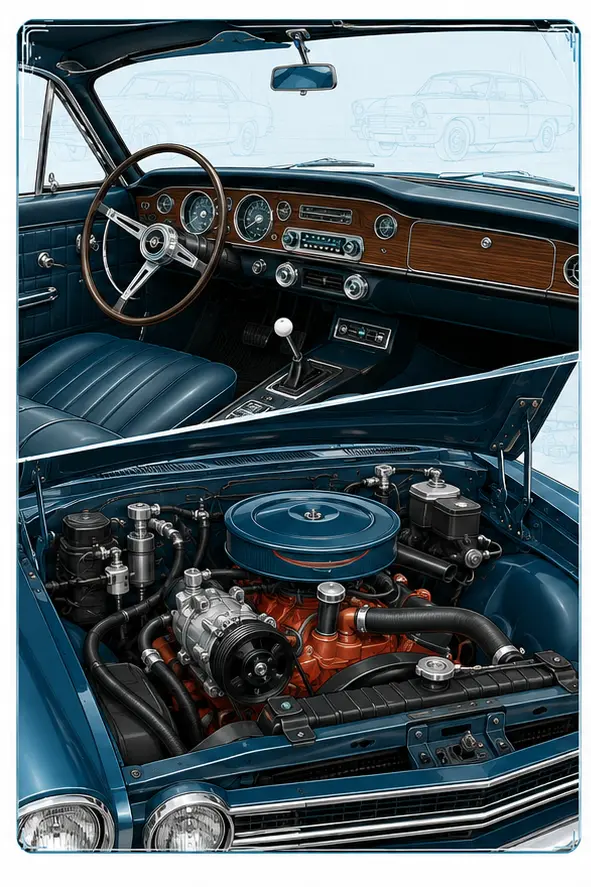
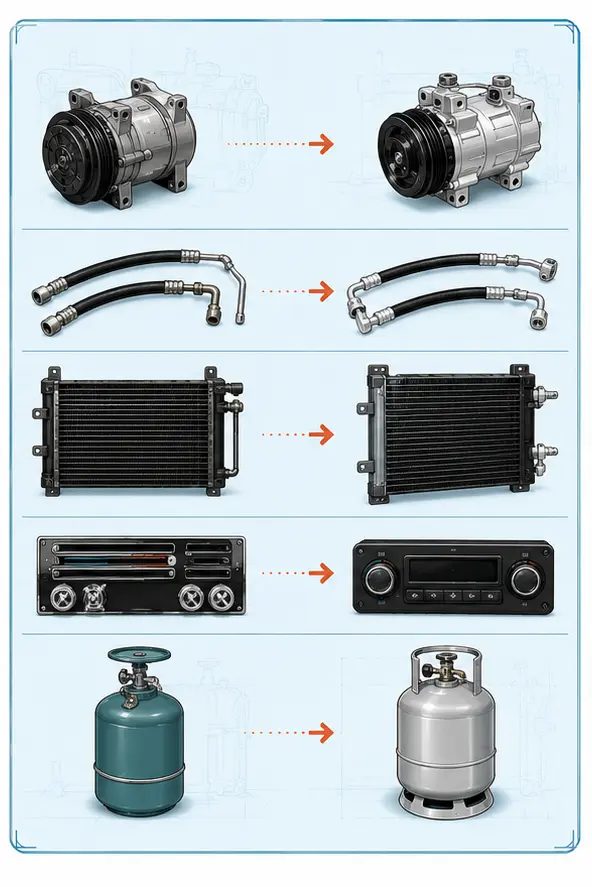
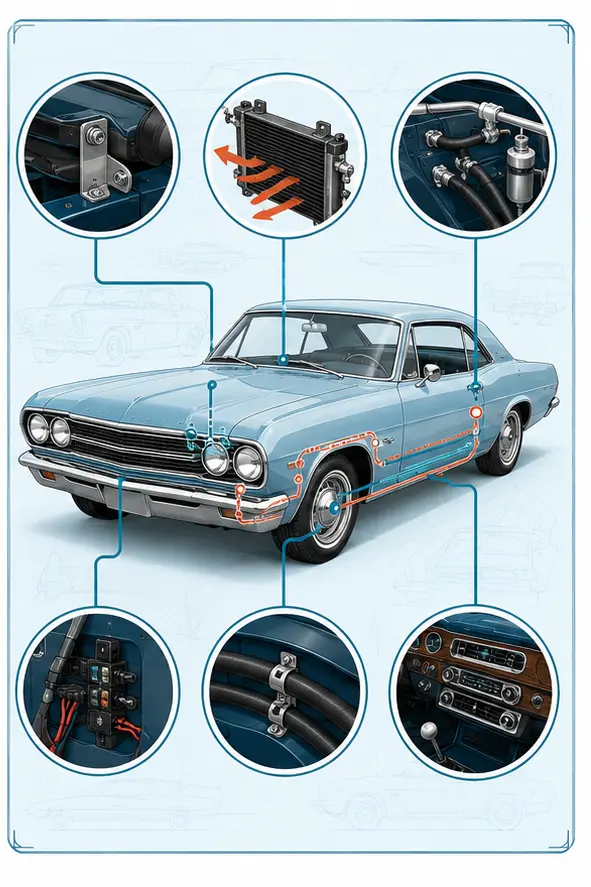
Repair, selective update or full retrofit
The correct choice balances evidence, use and preservation.
| Preservation goal | Suitable approach | Owner tradeoff |
|---|---|---|
| Original repair | Best when architecture is complete and serviceable | Parts and refrigerant strategy may limit outcome |
| Selective update | Targets weak heat rejection, hoses, compressor or electrical protection | Compatibility between old and new components must be engineered |
| Full retrofit | Useful when the original system is missing or unsuitable for the owner’s use | Visible changes and reversibility require explicit approval |
| Display-only restoration | Preserves appearance without promising modern cooling | Operational limitations must be honest |
| Daily-driver upgrade | Prioritizes serviceability and Dubai heat performance | May accept more non-original parts |
| Concours preservation | Prioritizes historical evidence and reversible work | Cooling target may be constrained by originality |
The vehicle owner approves the preservation brief. Claims about factory originality, value or concours acceptance require independent evidence and are not guaranteed by the workshop.
How a preservation-led AC project is planned
The sequence separates investigation, design approval and irreversible work.
History and originality record
Photograph the system, identify known parts, gather prior invoices and record the owner’s preservation goals.
Condition diagnosis
Test the existing compressor, leak condition, heat exchangers, blower, controls, engine cooling and electrical capacity.
Path comparison
Prepare repair, selective-update and retrofit options with visible changes, parts availability, limitations and expected performance.
Mock-up and approval
Confirm bracket, condenser, hose, control, vent and drain positions before cutting, drilling or final wiring.
Installation and documentation
Complete the approved route, label the refrigerant, protect wiring and retain original parts according to the agreement.
Heat and road verification
Test idle, road speed, engine temperature, cabin airflow, controls and condensate. Record expectations that remain conditional.
Six preservation decisions before a spanner turns
The brief protects both cooling performance and the vehicle’s story.
Document what is genuinely original
Factory, dealer-installed and later aftermarket systems can look similar decades later. Part numbers, period literature, photographs and prior invoices help establish what belongs to the car.
The workshop avoids claiming originality without proof. Removed components are labelled and returned according to the owner agreement.
A conversion needs engineering detail
Changing refrigerant can affect oil, seals, hoses, pressure switches, charge quantity and heat exchangers. A label should document the final specification.
A casual adapter-and-refill conversion is not a complete retrofit. The circuit is inspected, cleaned or rebuilt as required and charged to an evidence-based target.
Mounting and belt geometry protect more than cooling
Bracket stiffness, pulley alignment, belt wrap and engine vibration affect bearing load and reliability. A modern compressor can require a new mount without damaging the engine.
The plan avoids improvised brackets and checks adjacent steering, fan and bonnet clearance. Original hardware is preserved where agreed.
Dubai heat demands honest airflow planning
A larger condenser needs real air through it, not only more surface area. Grille opening, fan shroud, radiator stack and engine-cooling margin matter.
The final design should not hide engine overheating behind cold cabin air. Stationary and road-speed behaviour are tested together.
Old wiring may not support new loads
Additional fans, blower speeds and electronic controls can exceed original circuits or expose aged connectors. Voltage drop and alternator capacity require review.
Relays, fuses, wire size and grounds are designed for the load. New wiring is routed and protected without destroying original harness evidence.
Vents, drains and controls define visible quality
An under-dash unit can affect legroom and appearance. Integrated systems can require extensive trim or dashboard work. Condensate needs a safe route.
The owner approves mock-up position, control style and any hole before final installation. Reversible claims are limited when permanent body changes are accepted.
Heritage quotations need design and discovery allowances
A fixed parts list before inspection can miss hidden prior conversions, damaged threads, unavailable fittings, weak wiring or engine-cooling limits. The estimate should separate diagnosis, design, fabrication, parts, irreversible work and final testing.
Any public figure is a planning allowance before design and discovery. The final written estimate depends on vehicle condition, originality goal, parts availability, fabrication, refrigerant strategy, electrical and cooling upgrades, trim access and approved finish.
Performance expectations are also conditional. A large glass cabin, limited condenser opening and preserved original blower can restrict pull-down in Dubai heat. The owner should see that tradeoff before authorizing a historically sensitive project.
Balance cooling capacity with the systems that support it
A heritage AC upgrade succeeds only when load, routing, cabin condition and future serviceability remain compatible.
Mechanical and electrical load
A stronger compressor or larger condenser can increase the load carried by the belt, crank pulley, alternator, fans and engine-cooling package. Old mounts and rubber components may react differently under sustained Dubai idle conditions. The design review therefore looks beyond vent temperature. Belt alignment, fan current, idle quality, coolant temperature and available grille airflow are tested as one vehicle. An upgrade that makes the cabin cold while the engine overheats is not a successful retrofit.
Hose routing must allow engine movement, steering travel and service access without abrasion or visual clutter. Bulkhead passages and drains need grommets and protection. Electrical additions use relays, fuses, grounds and wire sized for the actual load. Where originality matters, new harnesses and brackets can be made removable and separated from original fabric. These decisions are photographed so future restoration work can distinguish factory material from the retrofit.
Cabin and comfort expectation
The owner’s comfort expectation should include the cabin itself. Uninsulated roofs, large glass, missing door seals and low original blower capacity can dominate performance. Improving seals or discreet insulation may provide more value than pushing refrigerant pressures higher. The final road and idle test records outside condition, engine temperature and cabin pull-down. It also states whether the preserved original vents or controls limit distribution, allowing the owner to decide if another visible change is acceptable.
Commissioning should include more than a cool vent in the workshop. The technician watches belt tracking, idle stability, alternator voltage, fan current, engine temperature, condensate and hose movement. A road test can reveal vibration or high-speed airflow effects that a stationary bay cannot. The owner receives the operating conditions and any tradeoff, such as limited idle pull-down with a preserved original condenser opening. These details define a successful heritage installation more honestly than a single temperature claim.
Parts and documentation
Sourcing needs a provenance record. New-old-stock rubber or seals may look authentic but have aged in storage. Rebuilt compressors can vary in specification and warranty. Reproduction controls and vents may differ in finish from surviving originals. The quotation identifies the proposed source and the owner chooses between originality, serviceability and availability. No supplier relationship or factory authorization is implied unless it is genuinely documented.
Future service is easier when the retrofit carries a wiring diagram, hose route, refrigerant label, charge record and part list. Hidden relays and fuses are marked without damaging visible trim. Original parts stay boxed with their fasteners and photographs. This documentation allows another workshop to diagnose the system without cutting into the vehicle again and gives a future owner evidence of what changed.
Maintenance and retained originality
Maintenance planning protects the conversion after the project. The service record names belt type and tension method, filter or receiver location, fuse and relay points, refrigerant, oil and charge. It also lists any period component that should not be exposed to modern test methods. When the vehicle is stored, the owner follows a sensible operating and inspection routine without assuming that running the AC alone can prevent every seal or corrosion problem. Future work begins from documentation, not rediscovery.
Before final delivery, every removed original item is carefully reconciled with the owner’s retention instructions. Small brackets, knobs and fasteners can matter as much as a compressor to a future restoration. The handover list prevents valuable heritage parts from being treated as workshop waste. Each retained item is matched to its labelled container before the vehicle and parts leave.
Classic AC repair and retrofit questions
The owner’s preservation goal changes the technical answer.
Can the original AC be repaired?
Often, but condition, completeness, refrigerant strategy and parts availability decide. Diagnosis should identify what is reusable and what creates reliability or safety limits before a conversion is assumed.
Will a retrofit reduce the car’s value?
Value depends on provenance, rarity, quality and buyer priorities. The workshop should not promise a financial outcome. Documented, tasteful and reversible work can protect options, but independent valuation belongs elsewhere.
Can you keep the original controls?
Sometimes through mechanical adaptation or discreet interfaces, but compatibility, travel, electrical logic and visible quality need design. The owner approves how the original control operates.
Is modern refrigerant always colder?
No. Performance depends on the entire design, charge, compressor, condenser airflow, evaporator, blower and cabin heat load. Refrigerant substitution alone does not guarantee improved cooling.
How long does a retrofit take?
Time depends on investigation, sourcing, fabrication, mock-up, owner approvals and testing. Hidden previous work can change the plan. The quotation provides stages rather than an unsupported quick-install promise.
Start with the preservation brief
Send the vehicle, year, current AC parts, prior conversion history and what must remain original. We will plan diagnosis before suggesting repair or retrofit.