Nissan AC Repair Dubai
Patrol, Sunny, Altima, X-Trail and other Nissan models can arrive with very different AC complaints. A Patrol may have strong front cooling but weak rear performance, while a Sunny may have warm air at idle or an Altima may lose cooling after heat soak. We identify the model, reproduce the exact pattern and test airflow, refrigerant, compressor control and electrical response before recommending parts.
Nissan AC repair starts with the exact cabin pattern
A useful Nissan air conditioning service in Dubai should not begin with a badge-level assumption. The same model can have different refrigerant specifications, compressor designs, rear-AC layouts and electrical control strategies across years and markets. The complaint is therefore mapped first. We record which vents are affected, whether cooling changes at idle or road speed, how long it takes to fade, whether a rear zone behaves differently and what previous work has already been done.
If the AC is simply not cold, that is still not enough to name the failed part. Strong airflow with warm air points the test toward refrigerant capacity, heat rejection and compressor performance. Cold air with weak volume points toward the cabin filter, blower, evaporator icing or air distribution. A rear zone that stays warm while the front is cold needs a separate branch instead of treating the whole system as low on gas.
The goal is to approve the smallest repair that explains the original pattern and can be verified afterward under a comparable Dubai heat load.
Different Nissan models expose different AC weaknesses
Front and rear cooling must be judged separately
Large cabin volume, rear vents and extended refrigerant routing make it important to measure front and rear performance separately. Weak rear AC can come from rear blower, air distribution, evaporator-side control, restricted refrigerant flow or charge condition. Dashboard-side and rear-side access should only be approved after the failing branch is established.
Traffic cooling and airflow are common starting points
When a daily-driven Sunny cools on the road but warms at signals, condenser fan operation and heat rejection deserve early attention. If airflow itself is weak, filter and blower checks move ahead of refrigerant work.
Heat-soak complaints need time in the test
An Altima that begins cold and loses performance later needs the fault reproduced after the vehicle is hot. Compressor regulation, pressure protection, sensor behaviour and electrical heat effects cannot be judged from a short cold-start check.
Cabin load and multi-zone behaviour matter
Family SUVs can show uneven cabin pull-down, airflow imbalance or rear passenger complaints that are not obvious from the front centre vent. Testing should reflect the occupied cabin and selected zones.
Uptime and repeated load change the repair decision
Commercial use can expose fan, blower, hose and compressor faults under long idle periods and repeated door opening. Parts choice should consider serviceability and downtime as well as purchase price.
Rear AC problems should be isolated as their own system path
When a Nissan Patrol front AC is cold but the rear remains warm, the complaint is already more specific than a whole-system cooling failure. The diagnostic should use that difference. It asks whether the rear blower moves enough air, whether the rear outlet temperature responds to settings, whether refrigerant is reaching the rear evaporator correctly and whether a control or distribution fault is limiting the result.
Confirm front performance
Measure the front system under the same operating condition. Strong front cooling proves that the vehicle can produce some cooling, but it does not automatically clear charge quantity or rear refrigerant distribution.
Measure rear airflow
Check blower speed, duct delivery and whether air volume changes correctly with command. Weak volume can make the rear feel warm even if the evaporator is cold.
Compare rear outlet temperature
Stable airflow with warm rear air moves the test toward rear evaporator feed, metering, control and refrigerant distribution rather than the blower alone.
Check line temperatures and system behaviour
Accessible line temperature and pressure behaviour can help show whether the rear branch is receiving and returning refrigerant as expected.
Inspect control and access points
Only after the branch is narrowed should deeper trim, rear evaporator or valve access be proposed.
Verify both zones after repair
Front and rear cooling are checked together so a repair to one branch does not leave the original cabin imbalance unresolved.
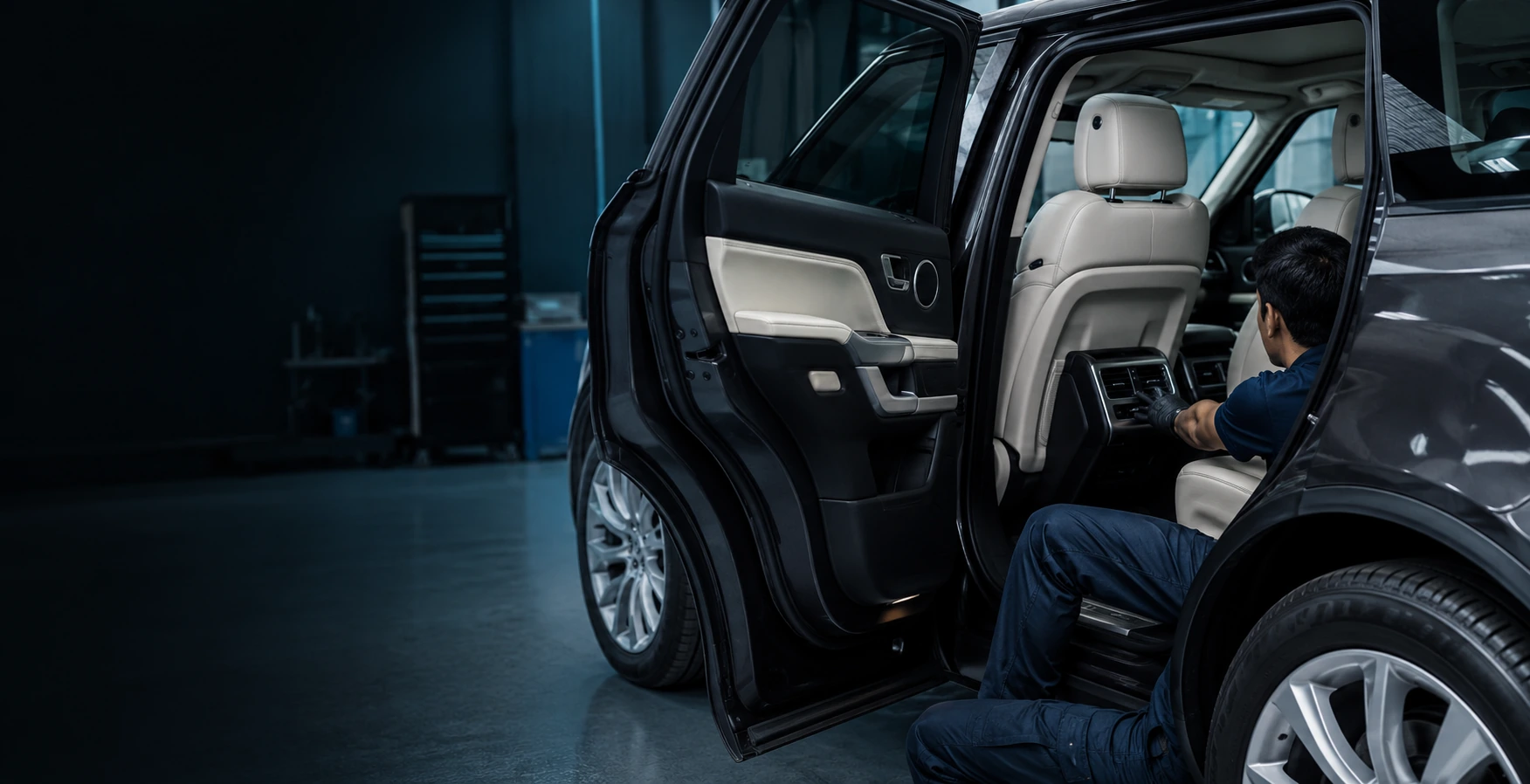
If the rear blower itself is weak or absent, the rear AC not working symptom route is useful context. If evidence points to an evaporator or hidden refrigerant leak, the repair scope can become access-heavy, so the diagnosis should be strong enough to justify it before interior dismantling begins.
What commonly earns a place near the top of the test list
Refrigerant loss from a confirmed leak
Cooling that improves after refill and then fades again supports a leak investigation. Hose joints, condenser, service connections, compressor seals and hidden evaporator leaks are different repair paths. Use AC leak detection and repair when charge loss is confirmed.
Condenser airflow weakness in traffic
If road speed restores cooling, fan operation and front-stack heat rejection move up the list. Sand, debris, damaged fins, fan control and weak fan output should be checked before a compressor is condemned.
Compressor regulation or mechanical wear
A compressor can be commanded correctly but produce weak output, or it can be limited by a control, pressure or electrical problem. Pressure and temperature response should agree with the repair recommendation.
Evaporator or hidden cooling-side fault
Internal evaporator leaks, icing or restricted flow can create gradual loss, weak output or intermittent cooling. Dashboard access is not the first diagnostic step.
Blower, filter or air-door issue
Cold air is not useful if too little reaches the cabin. Blower current, filter condition, evaporator icing and air distribution should be checked when volume is weak or one zone behaves differently.
Sensor or electrical control fault
Pressure, evaporator temperature, ambient inputs, relays, wiring and module commands can interrupt cooling without a failed refrigerant component. Compare command with response before replacing electronics.
Patrol evaporator work should be evidence-led because access can be significant
What should support an evaporator recommendation
- Cooling or charge-loss history fits a hidden leak or evaporator-side fault.
- Accessible engine-bay checks do not identify a stronger leak source.
- Electronic, dye, drain-path or other suitable evidence supports the hidden branch.
- Airflow and control faults have been separated from refrigerant loss.
- The estimate explains dashboard or trim access and what supporting parts may be needed.
A known model reputation is not enough. The exact vehicle still needs proof.
What should not trigger dashboard removal
- A single low-pressure reading without charge history.
- Warm air after an unknown refill.
- Old dye with no active confirmation.
- A smell complaint with normal cooling.
- Weak blower volume that has not been diagnosed.
If an evaporator repair is confirmed, the AC evaporator and cooling coil service is the relevant next path.
Choose the part route by access, specification and repeat-labour risk
Not every Nissan AC repair needs a genuine boxed component, and not every aftermarket option is sensible. The exact vehicle, fitted compressor or control type, labour access, warranty and the cost of doing the job twice determine which path makes sense.
Best when exact fit and repeat labour matter most
Often preferred for access-heavy evaporator, compressor or integrated electrical work where specification errors are expensive to correct later.
Strong value when the exact application is confirmed
Useful when the fitted component manufacturer, control type and correct part number are identified. Supplier reputation alone does not prove interchangeability.
Reasonable for selected lower-risk repairs
Can suit filters, some sensors, relays, hoses and accessible components when fit, warranty and specification are clear.
Identify the fitted unit before quoting
Nissan applications can vary by model, market and compressor-control strategy. We confirm the fitted unit, refrigerant and control type before recommending a compressor path.
What Nissan AC repair may cost
These are budgeting ranges only, not quotations. Nissan model, year, front or rear AC layout, refrigerant type, access, parts choice and the confirmed fault can change the final price substantially.
Diagnostic and performance testing
AED 200 to 500Focused testing to reproduce the symptom and isolate airflow, refrigerant, electrical and control branches.
Leak or seal repair path
AED 350 to 1,500+Depends on leak location, access, parts and required recovery and recharge work.
Condenser or fan path
AED 650 to 2,200+Fan modules, condenser replacement and front-end access vary widely by model.
Compressor repair path
AED 1,100 to 3,800+Control valve, clutch, complete compressor and contamination scope are very different jobs.
Rear AC blower or control
AED 450 to 1,800+Depends on rear trim access, blower assembly, wiring and control configuration.
Patrol evaporator path
AED 1,800 to 5,000+Access, refrigerant work, supporting seals and interior labour are the major variables.
Cabin filter or airflow service
AED 120 to 450Appropriate only when restriction or maintenance need is confirmed.
Electrical or sensor repair
AED 300 to 1,500+Simple relays differ from wiring, module or network diagnosis.
Planning ranges are indicative and non-binding. A written estimate follows diagnosis of the exact Nissan and confirmed repair scope.
Test the model under the condition that exposes the weakness
Brand knowledge helps choose efficient starting points, but the repair still has to be proven on the vehicle in front of us. A Patrol rear-zone complaint, Sunny traffic complaint and Altima heat-soak complaint should not receive the same workshop sequence.
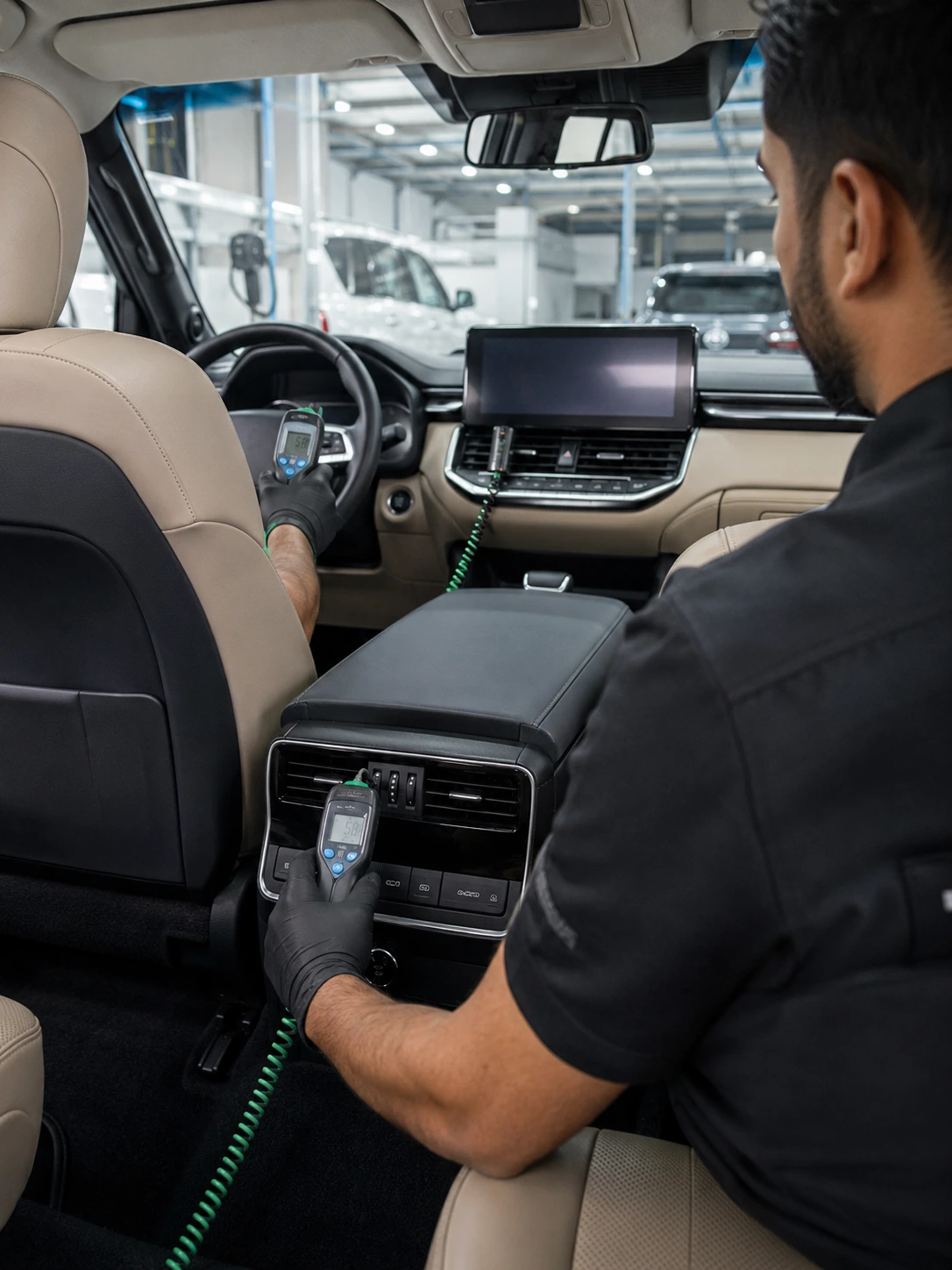
Identify model, year and system layout
We confirm front and rear zones, refrigerant label, compressor design where relevant and previous AC work.
Reproduce the complaint
The vehicle is tested at the fan speed, idle time, road condition and heat load that reveal the problem.
Separate airflow from cooling capacity
Vent volume, filter condition, blower response and distribution are checked before the refrigerant system is blamed.
Measure refrigerant and heat rejection
Temperatures, pressure behaviour, condenser airflow and compressor response are interpreted together.
Compare command with response
Fan, compressor, sensor and control requests are checked against what the components actually do.
Isolate front and rear branches
On multi-zone models, front and rear performance are compared so one side is not repaired for a fault on the other.
Define parts and access before approval
The estimate states the confirmed component, parts option, labour access and refrigerant work before dismantling starts.
Verify the original symptom
After repair, the same traffic, heat-soak, front-rear or airflow condition is checked again.
Use the service route that matches the finding
Unknown cooling fault
Start with full AC system diagnostics when compressor, charge, airflow and control faults still need separation.
Refrigerant loss
Use AC leak detection and repair when a low charge or repeated refill history supports active refrigerant loss.
Rear-zone complaint
The rear AC not working route helps explain blower, evaporator and refrigerant-line branches on large SUVs.
Compressor evidence
Move into compressor repair and replacement only after command and output evidence justify it.
Evaporator evidence
Confirmed hidden leaks or coil faults belong in the evaporator repair service with access clearly scoped.
Traffic-only cooling loss
Compare the AC stops at idle symptom page when road speed reliably restores cooling.
A Nissan AC repair quote should be specific enough to make a decision
Before work starts, the useful question is not simply whether the car needs “AC repair.” The quote should identify the confirmed fault, the repair path, the parts choice, the refrigerant work and the condition we will use to verify the result.
That matters most on access-heavy Patrol rear AC, evaporator and compressor jobs because repeating labour can cost more than choosing the correct part the first time.
Ready to book the repair check
WhatsApp the Nissan model, year and the exact symptom. Include whether the front, rear or whole cabin is affected and whether a refill was done recently.
WhatsApp Nissan Repair DetailsConfirmed finding
The repair scope names the failed component, leak location, circuit or airflow problem and the evidence that supports it.
Parts choice
Genuine, OEM, OE-supplier or quality aftermarket options are separated where sensible, with repeat-labour risk and fit considered.
Included workshop work
Access labour, seals, refrigerant recovery and recharge, oil correction, electrical repair or supporting work are stated instead of appearing later as surprises.
Verification condition
Patrol rear-zone complaints are rechecked front versus rear. Traffic complaints are verified at idle. Heat-soak faults get enough run time to prove the repair.
The exact Nissan determines the gas type and compressor service procedure
R134a and R1234yf must be confirmed from the vehicle
Nissan models do not all use the same refrigerant across every generation. We check the under-bonnet label and exact year before recovery or recharge. A vehicle specifying R1234yf follows the R1234yf service route. Other systems can use the measured gas refill route after the cause of any refrigerant loss is understood.
Electrified Nissan variants need configuration-specific AC service
Where the exact Nissan is electric, hybrid or otherwise uses an electrically driven compressor, lubricant compatibility and electrical safety can change the procedure. These vehicles are identified before AC work begins and can move into the EV and hybrid AC service route when required.
Repair time depends on cabin access and the failed branch
A reproducible diagnostic may be completed during the first workshop visit. Accessible wiring, filter and selected blower work can be shorter, while compressor and condenser repairs require refrigerant handling and verification. Patrol and other large-cabin rear AC work can take longer when rear lines, trim or hidden HVAC components need access.
Eligible Nissan repairs using original parts include six months of warranty cover, documented against the approved job scope. The written estimate should state the expected workshop time and warranty before major repair work starts.
What owners usually want to know before booking
Model, zone and timing are the three most useful details to send first.
Why is my Nissan AC not cold in Dubai traffic?
Condenser airflow, fan performance, refrigerant charge, compressor output and pressure control can all cause traffic-only cooling loss. Road-speed improvement makes airflow an important early test but does not prove the fan is the only fault.
Why is my Nissan Patrol rear AC warm while the front is cold?
Rear blower, ducting, rear evaporator feed, metering, control or refrigerant distribution can be involved. Front and rear performance should be measured separately before major trim or evaporator work is approved.
Does a Nissan Patrol evaporator always require dashboard removal?
Access depends on the exact component and model configuration. A hidden evaporator repair can be labour-intensive, which is why evidence should justify the work before dismantling begins.
Should I refill gas if my Nissan AC became weak again?
If cooling returned after a previous refill and then faded, investigate refrigerant loss. A sealed system should not repeatedly need top-ups.
Can a Nissan compressor be repaired instead of replaced?
It depends on the compressor design and confirmed fault. Some problems involve a clutch, pulley or control valve, while internal damage may require complete replacement. Diagnosis comes first.
Why is airflow weak even though the vents feel cold?
A restricted cabin filter, blower issue, evaporator icing or air-door problem can reduce useful airflow. Refrigerant work is not the first answer when air volume is low.
Do you use genuine Nissan AC parts?
Genuine, OE-supplier and quality aftermarket options can be discussed depending on the component, access, warranty, availability and cost of repeating the labour.
How much does Nissan AC repair cost in Dubai?
Simple diagnostics or accessible electrical repairs can be relatively modest, while compressor, rear AC or evaporator work can cost much more. A written estimate follows testing of the exact vehicle.
What should I send on WhatsApp?
Send the Nissan model, year, whether the front or rear is affected, what happens at idle or road speed, how long the fault takes to appear and any recent refill or AC repair history.
Send your Nissan model before you visit
Tell us whether it is a Patrol, Sunny, Altima, X-Trail, Pathfinder, Urvan or another Nissan, plus the year and the exact cooling pattern. We can then prepare the right diagnostic route at AMF Auto Services in Al Quoz 4.