
Hyundai AC Repair Dubai
From Accent and Elantra daily drivers to Sonata, Tucson and Santa Fe family cars, Hyundai AC problems in Dubai often show up under traffic heat, high daily mileage or long parking heat soak. We repair refrigerant leaks, compressor faults, condenser and fan problems, blower issues and climate-control electrical faults after confirming the actual failure on your Hyundai.
Choose the repair path from how the car is actually failing
Hyundai owners do not need the same six service links before they know which branch fits the car. We group the repair scope around the operating pattern first, then confirm the exact component before approval.
Cooling returns after service then becomes weak again
This route covers confirmed refrigerant loss from seals, hoses, condenser, evaporator or compressor connections, followed by the correct repair and measured recharge.
- Leak source identified before refill
- Repair scope matched to access and repeat-labour risk
- Final cooling checked under the original heat load
Cold on the road but weak at signals or after heat soak
This route focuses on condenser fan output, heat rejection, compressor response at low speed and electrical behaviour when the engine bay is hot.
- Fan command compared with actual airflow
- Condenser restriction checked before replacement
- Compressor output judged under stationary load
Air is weak, intermittent or does not follow the selected setting
This route covers cabin filter restriction, blower motor, resistor or module faults, connectors, sensors and climate-control commands before refrigerant work is added unnecessarily.
- Blower speed and electrical load tested
- Air path and icing separated from cooling capacity
- Control faults verified against physical response
Compressor, evaporator and dashboard-access repairs are quoted only after the failed branch is confirmed. The owner sees the parts route, labour access and verification plan before work starts.
Service planning changes with the model and daily use
High-mileage daily use can make traffic cooling, blower strength, fan reliability and repeat refrigerant history especially relevant.
Common bookings include weak cooling after parking, warm air at idle, compressor-control questions and blower or cabin airflow complaints.
Taxi and private-use vehicles benefit from a clear repair history because repeated gas top-ups, fan work or compressor replacement can change the next test.
Family SUV heat load can expose condenser airflow, charge accuracy, blower volume and slow cabin pull-down.
Larger cabin volume and multi-zone use make vent comparison and complete-cabin verification more useful than checking one centre vent.
Urban crossovers and larger passenger vehicles need the actual cabin layout and duty cycle considered before a repair is priced.
What usually brings Hyundai owners to the workshop
AC is not cold in traffic
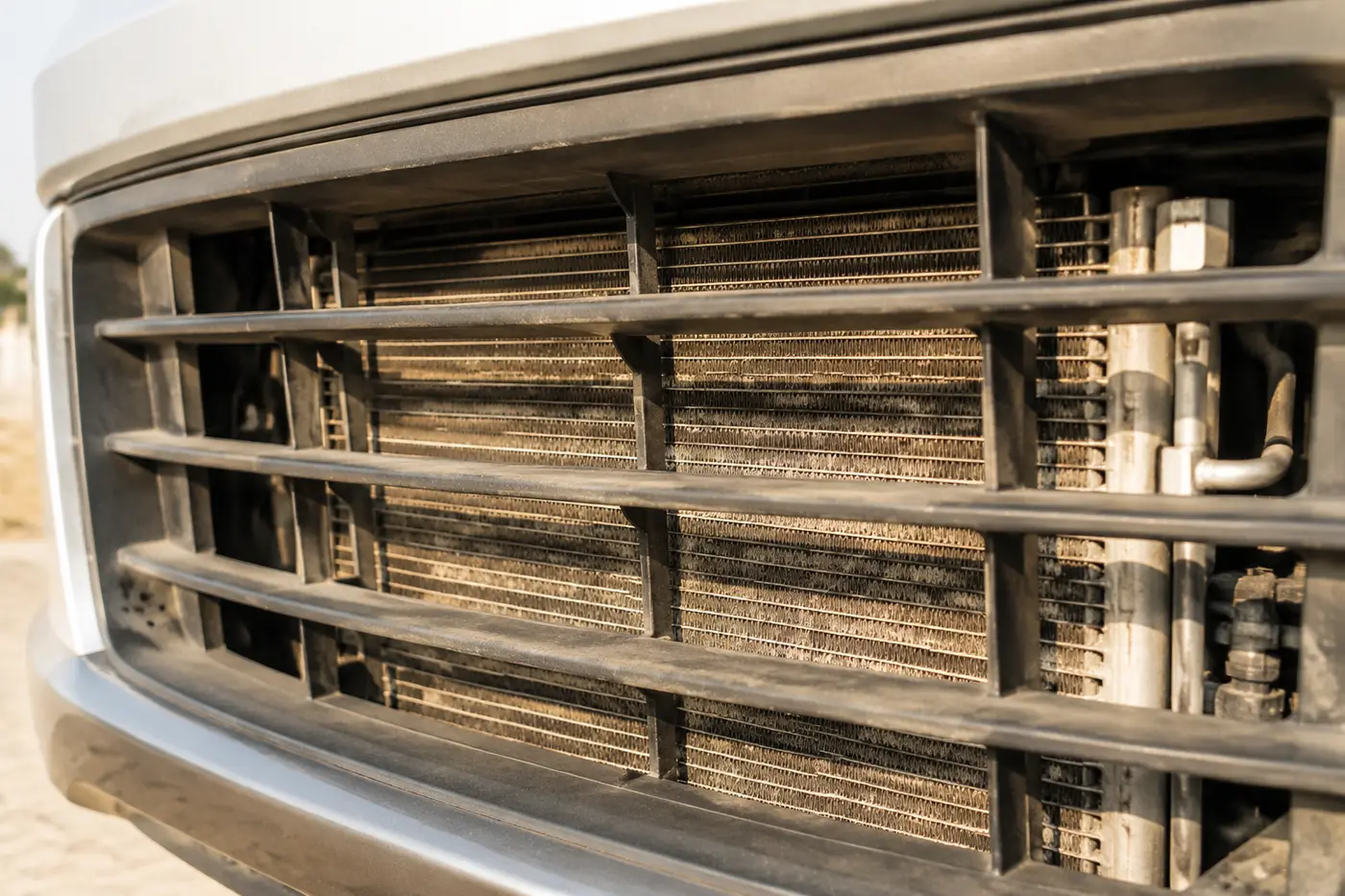
Condenser fan performance, heat rejection, charge condition and compressor output need to be separated. If testing confirms a front-stack fault, the repair can move into the condenser and cooling-fan service. If engine temperature also rises, the front cooling system becomes a safety priority.
Cooling fades after a refill
That history supports a leak investigation. A sealed system should not need repeated topping up just because the vehicle is used heavily in Dubai.
Strong airflow but warm vents
Refrigerant capacity, compressor command, condenser airflow and air-mix position are more useful starting points than replacing the cabin filter.
Weak or intermittent blower
Blower motor, resistor or power module, connectors, supply voltage and climate-control command should be tested before changing unrelated AC parts. A confirmed motor or controller fault can then move into the blower motor and fan repair route.
Cooling stops after heat soak
A compressor-control issue, fan fault, pressure protection, sensor drift or electrical heat-related failure may only appear after the engine bay becomes hot.
Compressor noise or engagement problem
Mechanical drive condition, command, refrigerant state and system pressure need to be checked together. A click or fault code alone does not prove the compressor is bad. When output or mechanical failure is proven, the job can move into the compressor repair and replacement service.
Separate maintenance wear from the actual repair
A high-mileage Hyundai can have several worn items at once. That does not mean every old-looking component needs replacement. The service decision should identify what is limiting cooling now, what is due as maintenance and what can safely wait.
For example, a loaded cabin filter can reduce airflow while a refrigerant leak also exists. Replacing the filter may improve vent volume but will not stop refrigerant loss. Likewise, cleaning a dusty condenser may improve heat transfer but will not repair a weak fan motor or compressor-control fault.
Cabin filter and airflow cleaning
Appropriate when restriction or contamination is confirmed. It should be quoted separately from a refrigerant or electrical repair.
Leak, fan, blower or compressor fault
Needs a component or circuit decision supported by the symptom and measurements, not by mileage alone.
Age-related item not causing the complaint
Can be documented for future attention instead of being bundled into the immediate AC repair without evidence.
Burning smell, smoke or overheating
Stop using the AC and treat the vehicle safely. Electrical heat, belt distress or engine overheating is more important than cabin comfort.
OEM and aftermarket choices should match the repair risk
Parts quality matters differently depending on access, integration and the consequence of repeat labour. An easy-access relay is not the same buying decision as an evaporator hidden behind the dashboard or an electronically controlled compressor.
We identify the exact Hyundai, fitted component and control strategy before recommending a parts route. Availability, warranty and how long you plan to keep the vehicle also matter.
Genuine or OEM path
Often sensible for access-heavy, electronically integrated or high-consequence repairs where exact specification and repeat-labour risk matter most.
OE-supplier path
Can provide strong value when the original component manufacturer, part number and application are clearly identified. Supplier reputation alone is not proof of fit.
Quality aftermarket path
Can suit selected filters, relays, sensors, hoses, blower parts and other accessible components when fit, warranty and performance are clear.
Fleet-value path
For high-use vehicles, a slightly higher parts cost can make sense if it reduces downtime, repeat access and future availability problems.
What Hyundai AC repair may cost
These are broad planning ranges and not quotations. Model, year, refrigerant type, part choice, access and the confirmed fault can move the final price considerably.
A written estimate follows diagnosis. It should state the repair scope, parts route, refrigerant work and verification rather than give one badge-level price for every Hyundai.
Reproduce the complaint and separate airflow, refrigerant, fan, compressor and electrical branches.
Seal, hose, condenser, evaporator or compressor leak location determines the real repair.
Fan motor, module, condenser condition and front-end access create a wide price range.
Ranges from filter and resistor work to blower motor, module and wiring repair.
Control valve, clutch or complete compressor work have very different scopes.
Interior access and labour are often the biggest variables.
Simple relays differ from connector, wiring, module or network diagnosis.
What should be clear before you approve the Hyundai AC job
What actually failed
The report should connect the cooling complaint to a confirmed component, circuit, leak or airflow restriction.
Which option is being fitted
Genuine, OEM, OE-supplier or aftermarket choice should be stated where a real option exists.
What labour and refrigerant work is included
Access, seals, recovery, recharge, oil procedure and supporting materials should not be hidden inside a vague total.
How the repair will be checked
Traffic faults need an idle check, heat-soak faults need run time, and airflow complaints need more than one cold vent reading.
Identify model, year and service history
We confirm refrigerant specification, prior refills, compressor or fan work and whether the vehicle is private, taxi or fleet use.
Reproduce the exact complaint
Traffic, heat soak, long idle time, road speed, blower setting and elapsed time are recorded so the symptom can be tested properly.
Separate airflow from cooling capacity
Filter, blower, vent distribution and icing are checked before low gas or compressor failure is assumed.
Measure heat rejection and refrigerant response
Condenser airflow, fan command, temperatures and relevant pressure behaviour are compared under load.
Compare command with physical response
Compressor, fan, blower, sensor and control requests are checked against what the components actually do.
Isolate the failed part or circuit
Power, ground, current, leak evidence and mechanical condition are tested only as far as the evidence requires.
Quote the repair before dismantling
Parts route, labour access, refrigerant work and conditional items are explained before major work begins.
Verify the original symptom after repair
The vehicle is tested again under comparable traffic, idle, heat-soak or airflow conditions.
Check the vehicle label before choosing the gas or compressor service
R134a and R1234yf depend on year and specification
Hyundai vehicles are not all charged with the same refrigerant. We confirm the under-bonnet refrigerant label and exact model year before connecting service equipment. Older and newer generations can use different gas, oil and service procedures.
If the label specifies R1234yf, use the R1234yf service route. Conventional systems can follow the measured AC gas refill route after the reason for any refrigerant loss is understood.
Hybrid and electric Hyundai AC systems need the correct compressor procedure
Where the exact Hyundai is hybrid or electric, compressor design, lubricant compatibility and electrical safety can change the service path. A generic belt-driven compressor test or universal oil top-up is not appropriate for every electrified configuration.
These vehicles are identified before AC work begins and can move into the EV and hybrid AC service route when the configuration requires it.
Repair time depends on the fault and the access needed
A reproducible diagnostic can often be completed during the initial workshop visit. Accessible filter, relay, wiring or selected blower work may be shorter, while compressor and condenser repairs need refrigerant handling and verification. Evaporator and dashboard-access work normally requires more workshop time.
For eligible Hyundai repairs using original parts, six months of warranty cover is recorded with the approved work. The estimate should state the part route, expected workshop time and warranty before major work starts.
What Hyundai owners ask before booking
The exact repair depends on the model and fault, but these answers help set the right expectation before the vehicle arrives.
Why is my Hyundai AC not cold in Dubai traffic?
Condenser fan performance, heat rejection, refrigerant charge, compressor output and pressure control all become more important at idle. The symptom should be reproduced stationary before a part is approved.
Does a Hyundai need AC gas every year?
No. Refrigerant is in a sealed circuit and is not a routine annual consumable. If charge is repeatedly low, the system should be checked for a leak or previous service problem.
Can you repair Hyundai taxi AC systems?
Yes. High-use vehicles need the same diagnosis but the parts and repair decision should also account for downtime, repeat access and availability. Send the model, mileage and exact use pattern on WhatsApp.
Why does my Hyundai AC work while driving but not at idle?
Road airflow can hide a weak condenser fan or heat-rejection issue. Compressor output and refrigerant condition can also change the pattern, so the fan should not be replaced on symptom alone.
Can a bad blower make the AC feel warm?
Yes. If very little cold air reaches the cabin, the system can feel ineffective even when the evaporator is cold. Blower speed, filter condition, resistor or module and distribution should be checked.
Do you fit OEM or aftermarket Hyundai AC parts?
Both can be considered where appropriate. The recommendation depends on component type, access, exact specification, warranty, availability and the cost of repeating the labour if a cheaper part fails.
How much does Hyundai AC compressor repair cost?
Planning can range from around AED 1,100 to AED 3,800 or more depending on whether the job involves a control valve, clutch, complete compressor, contamination work and refrigerant service. Diagnosis comes first.
What should I send before booking?
Send the Hyundai model, year, exact cooling symptom, whether it changes in traffic or after parking, and any recent gas refill, compressor, fan or electrical repair history.
Send the model and the exact cooling pattern
Tell us whether your Hyundai is an Accent, Elantra, Sonata, Tucson, Santa Fe or another model, what the AC does, when the problem appears and what work has already been done. We can prepare the right workshop diagnostic and repair route in Al Quoz 4.