
Burning Smell When the Car AC Runs
A burning smell that appears when the AC is switched on can come from a slipping belt, overheated compressor clutch, blower motor, resistor, wiring or debris in the air path. Because several causes can become electrical or mechanical fire hazards, the first job is to decide whether the AC should be switched off immediately and whether the vehicle itself is safe to continue driving.
A true burning smell is not a normal AC smell
Musty, sour or dusty odours can come from the cabin air path, but a smell like hot rubber, melting plastic, overheated insulation or a scorched clutch needs a different response. Turn the AC off and note whether the smell stops. If smoke, visible heat, a warning light, severe belt noise or electrical failure appears, stop the vehicle safely and arrange assistance rather than repeatedly testing the AC.
If the smell is mild and disappears when the AC is off, the car may still be driveable with the AC disabled, provided engine temperature, charging system and all other vehicle behaviour remain normal. The diagnostic should then separate the belt and compressor drive from the cabin blower circuit and electrical controls.
The important detail is timing. A smell that begins the instant the compressor engages points in a different direction from one that starts only when blower speed is increased. A smell from the vents is not proof the fault is inside the dashboard because engine-bay odours can sometimes enter through the fresh-air intake.
When the smell begins tells us which system to isolate first
Hot rubber or friction smell starts with a click
The compressor clutch, pulley, belt and compressor load move higher on the list. Listen for chirp, squeal, scraping or a sudden change in engine load, but do not keep cycling the AC to make it happen again.
Electrical smell grows as the fan runs faster
Blower motor current, resistor or power module, connector condition and wiring deserve attention. Weak airflow or an intermittent blower can support this branch.
Burning dust or debris smell enters the cabin
Leaves, debris, a contaminated filter area or an overheated blower component may be involved. Engine-bay smoke can also be drawn into the fresh-air intake, so location must be confirmed safely.
Smell appears only when the system heats up
A motor, connector, relay or clutch can fail under heat rather than immediately. The workshop may need a controlled heat-soak test while monitoring current and temperature.
Burning smell plus poor AC output
Compressor distress, clutch slip or a control fault becomes more important. The cooling complaint and smell should be diagnosed together rather than treated as two unrelated jobs.
Charging or temperature warning joins the smell
Stop treating it as an AC-only issue. Belt drive, alternator, fan system, wiring and engine cooling may be affected and the car can become unsafe to continue.
Describe the smell and the control that changes it
Odour descriptions are subjective, so the workshop should never replace a part just because the driver says “burning.” The useful evidence is what control triggers the smell, where it seems strongest, what other symptom appears at the same time and whether the smell remains after the AC request is removed.
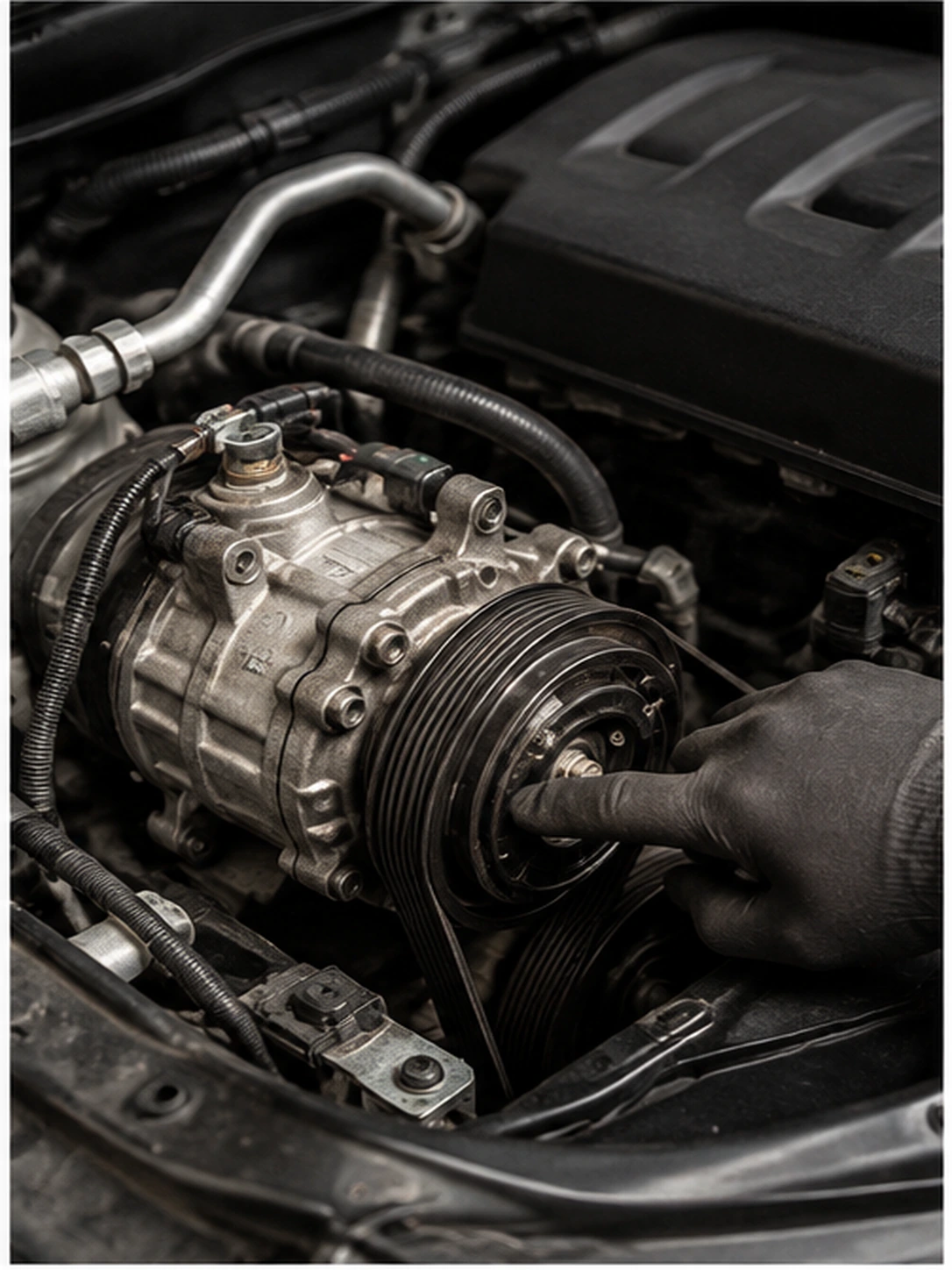
Often sends the first inspection toward a slipping belt, seized or dragging pulley, compressor clutch friction or a component creating excessive belt load. Belt dust and squeal make this branch stronger.
Raises concern for overheated connectors, blower wiring, resistor or power module, relay terminals or another electrical path. The AC should stay off until the source is assessed.
May be sharp or acrid and can accompany a failing motor or high-resistance connection. Current draw and voltage drop are more useful than looking for the darkest connector.
Can occur when debris or dust reaches a hot surface or when the blower has not run for a long time. If it is brief and never returns it can be less urgent, but persistent heat or smoke is not normal.
An engine oil leak or another fluid can produce a burning smell that seems related to AC because the fan or fresh-air intake changes when AC is on. The source may not be an AC component at all.
If the odour starts at compressor engagement and comes with noise or weak cooling, the compressor drive deserves urgent isolation before further AC use.
What most often fits a burning smell linked to AC operation
Compressor clutch or belt slip
A dragging compressor, clutch slip, worn pulley or belt condition can create heat rapidly when the AC is engaged. Noise, belt dust and smell timing are strong clues.
Blower motor overheating
A worn motor can draw excessive current, slow down, stop intermittently or heat its connector. The smell may increase with fan speed and come through the vents.
Blower resistor or power module fault
High current, poor connector contact or internal failure can overheat the blower control path. Missing fan speeds can appear before a strong smell.
Relay, fuse box or wiring resistance
A loose, corroded or damaged terminal can create heat without immediately blowing a fuse. Discolouration is evidence, but voltage drop and current testing prove the circuit condition.
Debris or non-AC fluid on a hot surface
Leaves near the blower intake, plastic debris or oil on a hot engine component can be mistaken for an internal AC failure. The smell path must be traced before parts are ordered.
Separate drive heat from cabin electrical heat
The fastest safe diagnosis is not to dismantle everything. It is to split the complaint into controlled branches. Each step reduces the number of systems that can still explain the smell.
AC request off and blower off
Establish whether the smell is already present with neither system operating. If it is, an engine-bay fluid leak or unrelated electrical issue may be the starting point.
Blower on without compressor request where the vehicle allows
If the smell appears with cabin fan operation alone, blower motor, filter area, resistor, module or cabin wiring moves ahead of the compressor branch.
AC requested under controlled observation
If the smell begins at engagement, belt, pulley, clutch, compressor load and engine-bay electrical circuits become more important.
Command compared with current and response
Electrical circuits are measured for voltage drop, current draw and control request. A motor that works but consumes abnormal current can still be failing.
Heat and smell source physically verified
Inspection looks for the real hot point, not merely the nearest darkened component. Damaged terminals, belt dust and heat marks are connected back to measured behaviour.
Repair verified without recreating a hazard
After repair, the original operating condition is checked only as far as needed to prove normal temperature, current, cooling and smell behaviour.
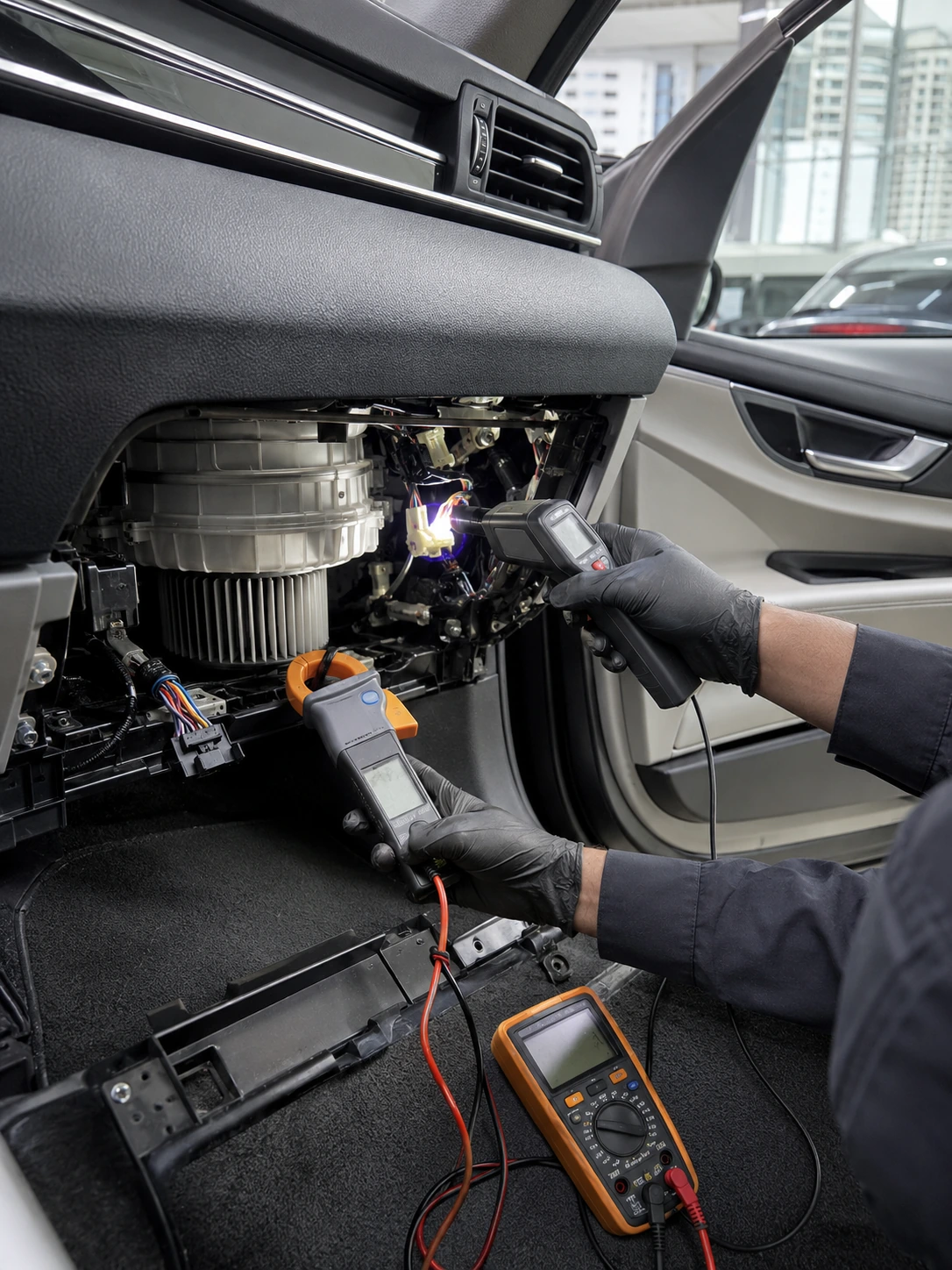
The split between blower-only and compressor-request conditions is especially useful. A burning smell through the vents can come from a blower motor or module, while a compressor clutch fault can create an engine-bay smell that the HVAC intake pulls into the cabin. The driver only experiences “smell from AC,” but the repair paths are completely different.
Some modern vehicles do not allow a simple manual separation because the climate control system automatically manages compressor request, fan speed or electric compressor operation. In those cases, scan data and the vehicle wiring strategy are used instead of forcing components directly.
Do not keep switching the AC on to prove a burning smell
If a smell is genuinely electrical, rubber-like or accompanied by visible heat, repeated testing can damage wiring, belt drive parts or a failing compressor. Record the trigger once, switch the AC off and let a controlled diagnostic reproduce it safely with access to measurements.
Do not fit a larger fuse
A fuse protects the wiring. Increasing its rating can allow a short or overloaded circuit to overheat before protection operates.
Do not bypass a relay
Forcing a compressor or fan can defeat control and protection logic. It may also energise a circuit that is already overheating.
Do not spray fragrance into the vents
Masking an electrical or friction smell wastes a valuable diagnostic clue and can add another odour to an already unclear complaint.
Do not pour water on a hot component
Rapid cooling can damage parts and creates electrical risk. Stop the system and allow safe inspection instead.
What a burning-smell AC fault may cost
Price follows the source. A connector repair is a very different job from a seized compressor or complete blower assembly. These are broad planning ranges only and are not quotations.
The final estimate depends on exact vehicle design, fault evidence, parts choice, labour access and whether related belt, wiring, refrigerant or control-system work is required.
Focused electrical and AC diagnosis
AED 200 to 500Planning band for controlled reproduction, current or voltage testing and mechanical inspection without major dismantling.
Belt, tensioner or pulley path
AED 300 to 1,400Part count and engine layout change the job. Compressor pulley involvement can increase scope.
Blower resistor or connector repair
AED 350 to 1,100Depends on whether the fault is a module, connector, wiring repair or heat damage extending into the harness.
Blower motor replacement
AED 550 to 1,800+Motor price and access vary widely. Some vehicles require dashboard-side trim or module work.
Relay or local wiring repair
AED 250 to 900Simple terminal repair is at the lower end. Harness damage or module diagnosis can move higher.
Compressor clutch or drive repair
AED 700 to 2,200+Some vehicles allow clutch or pulley work while others require a larger compressor repair scope.
Compressor replacement path
AED 1,200 to 3,800+Part type, contamination, oil procedure and refrigerant service determine the final scope.
Control module or network fault
After diagnosisModule replacement should follow signal, power, ground and communication testing rather than code reading alone.
Use the smell, smoke and vehicle warnings to choose the safe response
Mild smell stops completely when AC is disabled
If there is no smoke, no severe noise, no engine-temperature change, no charging warning and the vehicle otherwise behaves normally, leave the AC off and arrange prompt diagnosis. Keep the cabin ventilated if needed.
Rubber or electrical smell returns every time AC runs
Do not keep testing it. A slipping belt, clutch or overloaded electrical component can heat further with every cycle. Drive only if the vehicle is otherwise clearly safe and the smell disappears with AC off.
Smoke, melting plastic, severe belt noise or warnings appear
Stop in a safe place and arrange assistance if there is smoke, visible melting, strong electrical burning, a charging warning, engine overheating, loss of steering assistance where belt-driven, or any condition that makes continued driving unsafe.
Measure the circuit or drive while the smell condition is safely reproduced
A smell is not a measurement. The diagnostic converts the smell into an operating condition that can be tested without repeatedly stressing the vehicle.
When the branch is unclear, begin with full AC system diagnostics. For electrical control faults, the AC electrical and climate control diagnostic service gives the correct route into power, ground, command and network testing.
Record the trigger once
We note whether the smell begins with compressor engagement, blower speed, recirculation, heat soak, engine RPM or a specific traffic condition. Any smoke, warning, noise and cooling change is recorded.
Inspect belt drive and visible heat evidence
Belt condition, tension, pulley alignment, compressor clutch or pulley, debris and visible fluid contamination are checked before controlled operation.
Separate blower operation from compressor request
Where the vehicle design permits, the two branches are tested independently. If it does not, scan data and command states are used to identify what is active when the smell starts.
Measure electrical load
Blower motor current, circuit voltage drop, connector condition, relay terminals and control-module behaviour are tested according to the fault branch. A hot connector is investigated for the reason it became hot.
Compare command with response
If the system requests fan, clutch or compressor operation, actual response is checked. A control code is not accepted as proof of a failed part until supply, ground and load behaviour make sense.
Inspect the air path when the smell comes through vents
Cabin filter area, blower housing and accessible intake are checked for debris or heat damage. The engine bay is also considered because outside-air intake can carry odours into the cabin.
Define the smallest justified repair
The estimate states whether the fault is mechanical drive, blower, connector, wiring, relay, control module, debris or another vehicle system. Parts are not stacked together as a precaution.
Verify temperature, current and smell after repair
The repaired system is checked under the original trigger condition. Normal cooling alone is not enough if electrical load or heat remains abnormal.
Where the confirmed finding should lead
Compressor or clutch distress
Noise, friction heat or confirmed compressor load faults move into the compressor repair and replacement route.
Blower motor or fan circuit
If current draw, speed or blower heat is abnormal, use the blower motor and fan repair service after the circuit is proven.
Electrical control problem
Power, ground, relay, sensor or module faults belong in the electrical and climate control diagnostic route.
Unknown source
Start with full AC diagnostics when the smell could still be mechanical, electrical, airflow-related or outside the AC system.
Noise at AC engagement
If the smell comes with rattle, scrape or grind, compare the related compressor noise symptom page and keep the AC off until assessed.
Cooling also fails
Poor cooling with burning smell should be diagnosed as one combined operating fault. Do not buy a gas refill before the heat source is known.
Burning smell from car AC questions
Smell descriptions help with triage, but the source needs to be physically and electrically verified.
Why does my car smell like burning rubber when I turn the AC on?
A slipping belt, compressor clutch or pulley can create a hot-rubber smell when AC load is applied. Turn the AC off and arrange diagnosis, especially if there is squealing, belt dust or weak cooling.
Can a blower motor cause a burning smell from the vents?
Yes. A worn blower motor can draw high current and overheat, while its connector, resistor or power module can also generate heat. The smell may increase with fan speed or appear with weak or intermittent airflow.
Is a burning dust smell normal when I first use the AC?
A brief dusty smell after a long period without blower use can be less concerning if it disappears quickly and there is no heat, smoke or abnormal sound. A persistent or returning burning smell should be inspected.
Should I keep driving if the AC smells electrical?
Leave the AC off. If the smell disappears and the vehicle has no smoke, charging warning, overheating, severe belt noise or other unsafe behaviour, driving to a workshop may be possible. Stop safely if any serious warning appears.
Can a bad AC compressor make a burning smell?
Yes. A compressor that is dragging, seizing or causing clutch slip can create friction heat and belt distress. It often comes with noise, poor cooling or a strong smell at AC engagement.
Why does the burning smell only happen on high fan speed?
Higher blower speed increases motor current and airflow. A motor, connector or control module that is marginal may overheat only at the higher load. Current draw and voltage drop should be measured rather than guessing from the smell alone.
Can a fuse be the problem if it does not blow?
Yes. A poor terminal or high-resistance connection can create heat while current remains below the fuse rating. That is why connector temperature, voltage drop and circuit load matter even when the fuse is intact.
Can leaves in the AC intake smell like burning?
Debris can create dusty or scorched odours if it reaches a warm surface or blower area. The intake and cabin filter housing can be inspected, but visible smoke or electrical smell needs a more urgent electrical check.
Can I spray AC cleaner to remove a burning smell?
No cleaner should be used to mask an electrical, rubber or friction smell. First identify the heat source. Cleaning products are appropriate only for confirmed contamination or odour problems after safety faults are excluded.
Tell us exactly what switches on before the smell starts
Send the vehicle make, model and year, whether the smell starts with the AC button or blower speed, whether it seems strongest at the vents or engine bay, and whether you hear belt, clutch or fan noise. If there is smoke or a vehicle warning, do not keep driving just to reach the workshop.