
Pre-Summer Car AC Check Package
A pre-summer check is a condition screen, not a promise that every future failure has been prevented. Use the mileage-based AC maintenance planner to record the car’s condition between seasonal checks. It measures current cooling, airflow, fan response, visible component condition, control data and drainage so emerging faults can be prioritized before the hottest use.
What a useful summer-readiness check measures
Cooling should be measured under stated ambient, blower and engine conditions. The number becomes useful when paired with airflow and humidity awareness, not when compared with an unrelated vehicle. Pull-down time, left-to-right variation and idle behaviour can reveal a developing problem that a single cold blast misses.
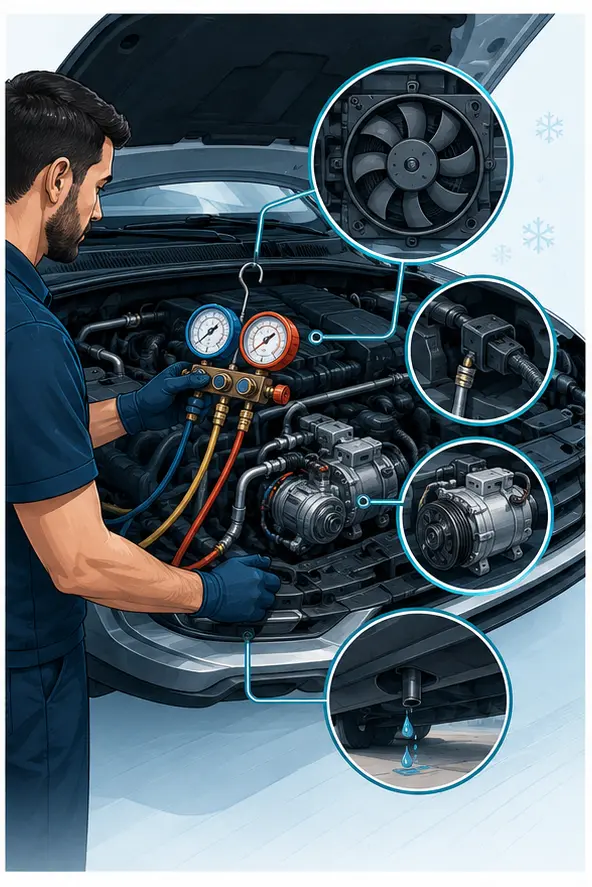
Heat rejection deserves attention before summer. Condenser contamination and cleaning, bent fins, weak fans and blocked spaces between heat exchangers can all affect heat rejection in traffic. The screen also checks the cabin filter, blower stages, visible belts or connectors where applicable, condensate drainage and relevant climate-control data.
If the screen finds low charge or leak evidence, the vehicle moves to leak diagnosis or the correct measured gas service. If the system performs poorly with an apparently correct charge, the full diagnostic owns the deeper decision.
How the package becomes an actionable condition report
The process is designed to stop preventive checks from turning into automatic parts sales.
History and season pattern
Record prior refills, slow pull-down, idle changes, noise, odour and water. Recent collision or dashboard work changes inspection priority.
Cooling and airflow baseline
Measure selected vents and blower modes under stated conditions. Compare cabin zones and fan stages.
External system screen
Review accessible condenser, fans, belts, hoses, ports, wiring and drainage without dismantling beyond the package.
Control and fault review
Check relevant panel functions and scan information where included. Preserve intermittent evidence before resets.
Finding category
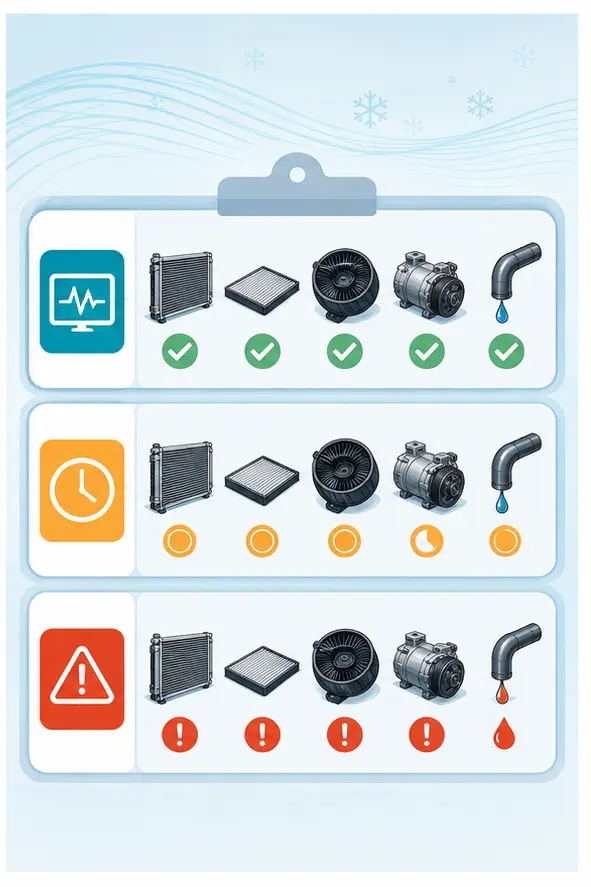
Mark each item monitor, service planned, diagnosis required or repair recommended. State the evidence and limit.
Quotation and schedule
Provide a separate estimate for work outside the package and book it according to urgency, parts and customer approval.
A readiness screen looks at airflow, heat rejection and evidence status
The illustrations teach the inspection categories and do not claim an actual vehicle passed.

Six summer checks with clear limits
Each result should show what was inspected and what would require another scope.
Vent temperature is recorded in context
Ambient temperature, blower setting, recirculation, engine speed and measurement point affect the result. A single target number is not applied blindly to every vehicle.
The baseline supports future comparison and shows whether a deeper cooling-performance diagnosis is justified.
Volume matters alongside temperature
A cold evaporator cannot cool passengers effectively when the filter is restricted, the blower is weak or ducts and doors misdirect air.
The screen checks fan stages and outlet distribution. Motor-current testing or dashboard access is quoted separately if the pattern is abnormal.
Traffic heat rejection is screened
Visible contamination, fan operation and accessible heat-exchanger condition are reviewed. Hidden debris between stacked coolers may require additional access.
Cleaning is recommended only when the method and access suit the vehicle. Bent fins and leaks are not repaired by aggressive washing.
Refrigerant is not added as prevention
A sealed system should not need seasonal gas. Pressures or temperature patterns may suggest a charge issue, but the correct service identifies refrigerant and considers leakage.
The package records the concern and proposes the next test. It does not top up an unknown quantity to improve a checklist score.
Condensate needs a clear route
Water under the car can be normal after cooling, while wet carpet, roof drips or persistent odour require source separation. Visible drain performance is checked where appropriate.
Rain entry, coolant and body leaks remain different systems. A blocked drain or contaminated evaporator moves to targeted cleaning or repair.
Commands and warnings are preserved
Climate panel operation, relevant scan data and stored faults can reveal an intermittent fan, sensor or actuator issue before peak demand.
Codes are interpreted with the symptom and not cleared as the service. Programming or electrical tracing requires a separate diagnostic authorization.
A package fee should not hide follow-on work
The booking states whether scan data, refrigerant connection, filter removal, cleaning or leak testing are included. A visual and performance screen is different from full system diagnosis. The report names the boundary.
Any repair estimate is indicative until the fault and vehicle are confirmed. Exact specification, severity, parts, access, refrigerant, required work and current availability determine the final written amount.
A good test result describes the moment tested. It cannot guarantee the system will remain leak-free or electrically faultless through the season. The customer receives warning signs and a sensible review trigger.
How to read the pre-summer result
The category states the next action, not a warranty period.
| Screen result | Included observation | Next category |
|---|---|---|
| Monitor | Condition met during the recorded test | Return if cooling pattern, noise, smell or warnings change |
| Service planned | Maintenance item such as filter or cleaning is due | Confirm product, access and inclusion before booking |
| Diagnosis required | Abnormal result exists but the cause is not confirmed | Approve the targeted test before parts |
| Repair recommended | Fault and scope are sufficiently supported | Review estimate, parts and downtime |
| Safety response | Burning, overheating, high-voltage or severe mechanical issue appears | Stop routine package and move to the appropriate inspection |
| Test limitation | A load, weather or intermittent condition was not reproduced | Keep evidence and define the repeat condition |
The package price and exact inclusions are confirmed at booking for the vehicle and requested scope.
Turn a readiness screen into a sensible maintenance decision
Use the result to choose a repair, a monitored condition, a review trigger or a documented baseline.
Separate repair findings from observations
The most useful report does not turn every observation into immediate repair. A cabin filter can be marked service planned when it is approaching restriction but still functional. Minor condenser fin wear can be recorded for monitoring when airflow and pressure response remain acceptable. A stored historic code can remain an observation if the related function operates and no current evidence supports replacement. The category, evidence and return trigger should be clear enough that another technician can understand why work was or was not recommended.
A vehicle with a slow leak needs a different plan from one with weak traffic cooling. The leak path may require electronic detection, dye review or controlled pressure testing. The traffic path may require fan, shroud and heat-exchanger investigation. Combining both under a generic summer tune-up can lead to unnecessary gas and missed airflow problems. The pre-summer screen should therefore own the baseline and route each abnormal finding to the correct service page and quotation.
Keep a useful driver baseline
Owners can preserve the value of the baseline by noting any change in pull-down time, blower sound, vent balance, smell or water during the following weeks. They should not compare performance on a mild morning with a closed car that has heat-soaked in afternoon sun. If the original failure appears, share the recorded conditions. That comparison helps the workshop decide whether the system deteriorated or whether the operating load simply changed.
Vehicles used by different family members or drivers benefit from a short shared symptom note. Record the fan setting, recirculation state, traffic condition and approximate time when cooling changed. The workshop can compare that observation with the package baseline. A return visit then begins with a measurable difference instead of a general statement that summer air feels hotter. This is particularly helpful for intermittent fan control, side-to-side temperature and hot-soak complaints.
Include the parts around the AC circuit
Summer readiness also includes the parts around the AC system. A weak 12-volt supply can disturb fans and modules, while an engine-cooling problem can make AC testing unsafe. The package does not become a full electrical or cooling-system inspection, but obvious warnings and abnormal behaviour are documented and routed correctly. The technician should not continue a comfort test through rising engine temperature only to complete a checklist.
The report can set a review trigger rather than an arbitrary replacement date. A filter may be rechecked after a known dusty period. A borderline fan noise may be monitored for speed loss or a stored fault. A tiny oil stain without confirmed refrigerant leakage can be photographed for comparison. Trigger-based advice respects the actual vehicle and avoids filling the package with automatic seasonal replacements.
Document what was and was not opened
The owner should also understand what was not opened. A non-invasive seasonal screen cannot see every hidden evaporator joint, internal compressor surface or buried wiring splice. Listing those exclusions does not weaken the package; it prevents a limited inspection from being sold as a complete teardown. When evidence points toward a hidden area, the customer receives the reason, next access step and separate authorization before trim or refrigerant is disturbed.
Keep the report in the glove box or digital service file. It provides a dated comparison for the next hot season and helps another technician see which items were normal before a later change.
Pre-summer package questions
The package is useful when its depth and exclusions are understood.
Does the check include a gas refill?
Not automatically. Refrigerant is not preventive consumable. If evidence suggests low charge, the workshop proposes identification, leak-aware testing and a measured service as a separate scope unless the confirmed package says otherwise.
Can the package guarantee summer cooling?
No. It records current condition and can expose developing problems. Future leaks, electronic faults, damage and operating conditions remain possible. The report states what was tested and when to return.
Should I replace the cabin filter every time?
Replacement depends on condition, specification and service schedule. A clean filter should not be discarded only to fill a package. A restricted, wet, damaged or incorrect filter needs the right corrective action.
What if the AC is cold on the day?
The screen can still review pull-down, airflow, traffic heat rejection, controls and evidence from your history. Intermittent faults may require the precise failure condition to return.
How long does it take?
Timing depends on the confirmed package, vehicle and abnormal findings. If the screen discovers a fault, extended diagnosis or repair is quoted before proceeding and can require another booking.
Create a cooling baseline before peak use
Send the vehicle and any small change you have noticed. We will confirm the package contents, appointment time and what happens if the screen finds a fault.