
Mercedes-Benz AC Repair Dubai
If your Mercedes-Benz AC is not cold, one side is warmer than the other, the blower changes speed unexpectedly, or cooling fades in Dubai traffic, the repair should start with the exact model and operating condition, not a guess based on the badge. We diagnose refrigerant, compressor, condenser, airflow, sensors, actuators and climate-control commands together before recommending parts.
Mercedes-Benz AC repair is usually a system diagnosis, not one part
Warm vents do not automatically mean “low gas,” and a stored fault code does not automatically mean the named component is defective. On a modern Mercedes-Benz, cabin temperature depends on the refrigeration circuit, condenser airflow, blower output, temperature inputs, flap positions and the logic commanding them.
The fastest route to a reliable repair is to reproduce the complaint and compare what the car is requesting with what the hardware is actually delivering. That is especially important when the complaint is zone-specific or intermittent.
What we can inspect on a Mercedes-Benz AC system
Depending on the vehicle, the inspection can include vent temperatures by zone, blower output, cabin-filter restriction, condenser airflow, compressor request and response, refrigerant pressure and charge evidence, leak testing, sensor plausibility, actuator movement, wiring, module faults and relevant live data.
If the issue turns out to be a general refrigerant or component problem, the vehicle can move into the same measured repair process used for our AC leak repair, compressor repair and replacement, condenser service or blower motor repair.
Nine Mercedes AC symptoms that point in different directions
A warm passenger vent, weak cooling at idle and an AC system that quits after half an hour can all be described as “AC not working,” but they point in different directions. On a Mercedes, the pattern matters: which vents change, when it happens, whether airflow stays strong and whether the problem follows heat soak, traffic or a long drive.
Mercedes AC not cold
Low refrigerant, a leak, compressor-control problem, condenser airflow issue, temperature-door position or an electronic input can all leave the cabin warm. Pressure alone is not enough to decide which one.
Cold while driving, warm at idle
Road speed can hide poor condenser airflow. Fan operation, heat rejection, pressure response and engine-cooling condition deserve attention before a compressor is blamed.
Driver side cold, passenger side warm
Dual-zone or multi-zone temperature differences can come from flap or actuator control, sensor feedback, calibration, refrigerant distribution or another system condition. Measure both sides under identical settings.
Rear AC warmer than front
On vehicles with separate rear climate functions, the rear zone may have its own control path and airflow hardware. The repair depends on the exact configuration; “rear AC” does not describe one universal Mercedes system.
Weak or changing airflow
A restricted cabin filter, blower motor, blower controller, wiring, evaporator icing or air-door position can reduce airflow even when the refrigerant side is producing a cold evaporator.
Cooling stops after 20–40 minutes
Intermittent faults need time. Sensor drift, evaporator icing, pressure protection, heat-related electrical failure or compressor control may appear only after the system has been operating under load.
AC noise when switched on
Bearing, belt-drive, fan, compressor or airflow noises need to be identified by location and timing. Severe mechanical noise, smoke or a burning smell is a reason to stop AC use and inspect the car promptly.
Musty smell from vents
The source may be the filter, evaporator surface, intake, drain or retained moisture. Fragrance does not remove the cause. See our car aircon cleaning service for the source-first approach.
Fault after battery or dashboard work
Low-voltage history, disturbed connectors, actuator initialization, control changes or a coincidental physical fault may be involved. The timeline matters, so tell us what work was done immediately before the symptom started.
What changes when the symptom changes
The first test changes with the complaint. Warm air everywhere calls for a different starting point from weak airflow or a single warm zone. Pick the closest symptom below to see where the inspection should begin.
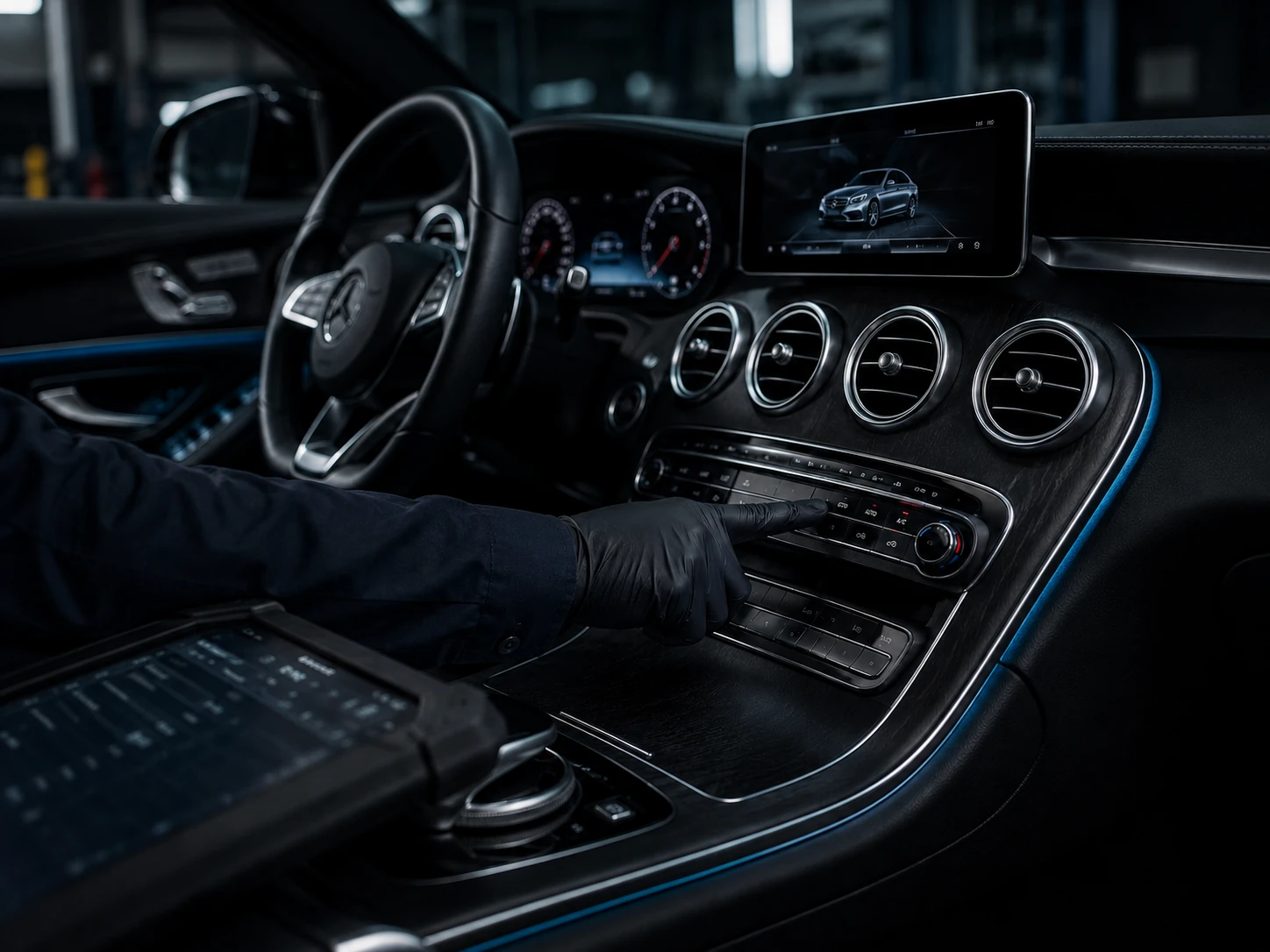
Luxury climate control can add many actuators, sensors and software decisions
Mercedes-Benz does not use one HVAC architecture across every model. Equipment changes by platform and option package, and newer vehicles can integrate climate functions deeply with electronic controls. A dual-zone or four-zone complaint can therefore involve more than refrigerant pressure. The selected temperature is only a request; the system still has to move air through the correct path and regulate cooling to reach it.
We test the part of the system that matches the symptom
A Mercedes with one warm vent should not enter the workshop on the same test path as a car that cools well on Sheikh Zayed Road but warms up in traffic. The complaint decides where the measurements begin.
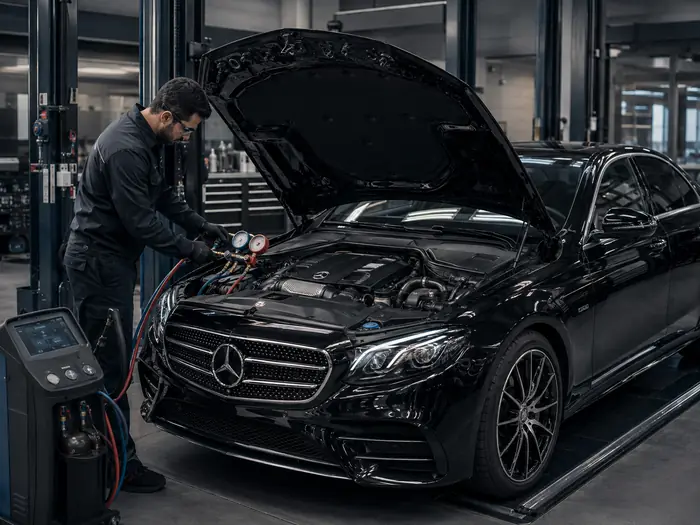
Map the cabin first
Set the climate system consistently and record front, side and rear vent temperatures where fitted. A zone problem becomes much clearer when the affected outlet is compared with the vents beside it.
Load the system at idle
Dubai traffic exposes condenser and fan problems that can disappear at road speed. We watch cooling, fan operation and refrigerant behaviour while the car is stationary and heat load is high.
Check what the car is commanding
Compressor request, blower output, sensor values and flap positions are compared with the temperatures and airflow coming from the vents. Electronic data only matters when it matches the physical result.
Open the refrigerant circuit only when needed
If the evidence points to charge loss, restriction, compressor damage or a leaking component, the refrigerant work is scoped from that finding. We do not open the system just to see whether a refill helps.
For a full assessment when the complaint crosses several systems, see our full car AC diagnostic service. If refrigerant loss is confirmed, our car AC leak detection page explains why the test method depends on the fault and system condition.
Newer Mercedes models may use R1234yf, but the label decides
Mercedes-Benz vehicles span generations that use different refrigerants and different charge quantities. Many newer cars use R1234yf, while older models may use R134a. The correct approach is not to guess by age or badge: inspect the under-hood refrigerant label and vehicle data, then use equipment and oil compatible with that system.
R1234yf service is not simply “the newer gas.” The machine, fittings, recovery process, leak-control approach and charge weight must match the vehicle. If the system is low, the reason for the loss still matters. Recharging a leaking car without addressing the cause can produce temporary cooling and a repeat visit.
See our dedicated R1234yf gas refill service and general car AC gas refill Dubai page for the charging process and current site-wide planning range.
Genuine, OEM-equivalent, aftermarket or remanufactured choose by risk, access and evidence
Some Mercedes AC parts are worth buying genuine; others have solid OE or aftermarket alternatives. The sensible choice depends on the component, how much labour is required to reach it, the cost of doing the job twice, vehicle age, availability and the warranty on the part. We show the parts route separately on the quote so you know what is being fitted.
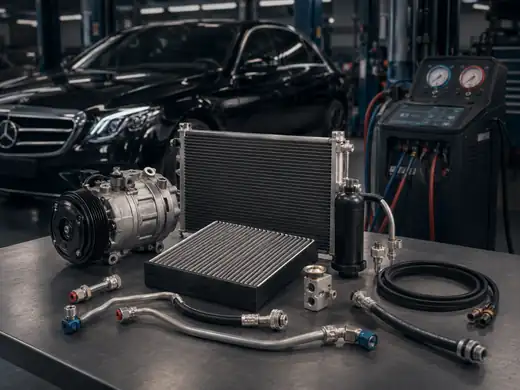
Genuine Mercedes-Benz
Appropriate when exact fit, calibration, integrated electronics, access cost or owner preference makes genuine supply the strongest choice. Availability and price vary by chassis and part number.
OE / OEM-equivalent
Where a traceable original-equipment supplier or equivalent specification is available, this can balance fit and cost. The quotation should identify what is being supplied rather than using “OEM” as a vague quality word.
Quality aftermarket
Useful for selected filters, sensors, hoses, condensers or supporting parts when specification, supplier history and warranty are acceptable. It is not automatically the right route for every electronic or access-heavy component.
Remanufactured / rebuilt
Sometimes considered for high-cost assemblies where a reputable, model-correct unit with a clear warranty exists. Internal contamination, electrical compatibility and the reason the original part failed still have to be addressed.
For a compressor, the quote may also need to consider refrigerant recovery, oil specification, contamination, receiver-drier or related parts, flushing or line replacement where appropriate, evacuation and final verification. A compressor price by itself can hide the real scope of the job.
What can Mercedes-Benz AC repair cost in Dubai?
Mercedes AC pricing changes with the chassis, refrigerant, failed component, access and parts choice. The ranges below are planning estimates that help you judge the likely scale of the job before inspection. Dashboard removal, multi-zone faults, electrical diagnosis and high-voltage compressor work may cost outside these bands.
Interactive AC cost planner
Select the confirmed or suspected repair category. The result is a planning guide, not a quotation.
Use these as scale, not a quote. An AMG, S-Class, G-Class, rear-climate system, electric compressor or difficult access can move the final price considerably. Your written estimate should show the part being fitted, labour, refrigerant work and anything that remains conditional after access.
What evidence should exist before a big repair
| Mercedes AC symptom | Check first | Do not jump straight to |
|---|---|---|
| AC not cold from any vent | Refrigerant label and charge evidence, compressor request and response, pressures and temperatures, condenser airflow, blend position, relevant faults and sensor values. | “It needs gas” or “the compressor is dead” before the system has been tested under load. |
| One side warmer than the other | Same-settings vent temperature comparison, zone commands, flap or actuator movement, sensor plausibility and overall evaporator or refrigerant performance. | Replacing an actuator solely because the temperature difference is left-to-right. |
| Cold at speed, weak at idle | Condenser fan command and actual operation, condenser condition, pressure movement, heat rejection, charge and engine-cooling context. | Calling the compressor weak because road speed improves cooling. |
| Strong fan noise but low airflow | Cabin filter, blower wheel, evaporator icing, door position, duct restriction and whether fan speed command matches airflow at the vents. | Assuming refrigeration is the cause because cabin cooling is poor. |
| Cooling cuts out after time | Fault memory before clearing, temperature and pressure inputs, compressor command, electrical supply, evaporator icing and the exact minute or condition when cooling stops. | Declaring the system healthy because it was cold for five minutes in the workshop. |
| AC issue after front-end damage | Condenser, lines, pressure-sensor area, fan and shroud, fittings, leaks, wiring and airflow through the cooling pack. | Replacing the condenser without checking surrounding damage or fan operation. |
| AC issue after dashboard work | Connectors, sensors, actuator operation, air-door position, ducts and the exact symptom that started after reassembly. | Adding refrigerant when the complaint is actually airflow or distribution related. |
Electric compressors and thermal-management systems need configuration-specific handling
Mercedes-Benz hybrid and electric vehicles can use electrically driven refrigerant compressors and may integrate cabin cooling with broader thermal-management functions. That changes the safety boundary, compressor type, oil compatibility and diagnostic context compared with a conventional belt-driven system.
A high-voltage warning, visible battery-area damage, smoke, unusual heat or post-collision thermal warning is not a normal “AC not cold” appointment. The vehicle should be handled according to appropriate high-voltage and recovery procedures. Routine DIY probing around orange high-voltage cabling or an electric compressor is not appropriate.
For EQ and hybrid vehicles, send the exact model and year before booking. You can also review our EV and hybrid car AC service page, which explains why compressor lubricant, electrical isolation and thermal-management context matter.
Mercedes-Benz AC service across sedans, SUVs, coupes, AMG and EQ models
We can assess Mercedes-Benz climate complaints across common Dubai model families. The badge below is only the starting point; model year, chassis and installed climate equipment still determine the exact refrigerant, actuator layout, compressor design and parts required.
If your exact model is not shown, send it anyway. The brands we service hub covers the wider vehicle range handled by Car AC Heroes.
A Mercedes AC quote should tell you exactly what you are paying for
For a high-value vehicle, the repair decision should be easy to follow. The estimate should connect the customer’s symptom to the evidence, identify the proposed part or circuit, state the parts route, explain refrigerant work and access, and separate confirmed scope from anything conditional after disassembly.
If the fault is intermittent and could not be reproduced, that should be written as a limitation rather than turned into certainty. If the system is low on refrigerant, the refill should not hide the question of why it became low. If a compressor has failed internally, contamination risk should be considered before a replacement is installed into the same circuit.
Ask these before saying yes
- What test confirmed this component is the cause?
- Is the part genuine, OE or OEM-equivalent, aftermarket or remanufactured?
- Does the price include refrigerant recovery, evacuation and recharge?
- Are seals, drier, oil or supporting parts included where required?
- Could dashboard or front-end access reveal additional work?
- How will the original fault be rechecked after repair?
- What warranty applies to the supplied part and labour?
What Mercedes owners usually want to know
Why is my Mercedes AC not cold in Dubai?
Possible causes include low refrigerant from a leak, poor condenser airflow, compressor-control problems, a blocked cabin filter, evaporator icing, sensor errors, blend or distribution doors, electrical faults or more than one issue at once. The best first step is to reproduce the failure and compare the refrigerant, airflow and electronic-control paths rather than starting with a refill by default.
Does my Mercedes-Benz use R1234yf?
Many newer Mercedes-Benz vehicles use R1234yf, while older vehicles may use R134a. The refrigerant label on the vehicle and model-specific information should be used to confirm the exact type and charge quantity. Do not select refrigerant from the model badge alone.
Why is one side of my Mercedes colder than the other?
Multi-zone temperature differences can involve flap actuators, sensor feedback, control logic, calibration or the refrigerant system itself. A correct diagnosis compares vent temperatures at the same settings, looks at relevant commands and sensor values, and confirms that the evaporator and refrigerant side is performing consistently before replacing an actuator.
Can you repair Mercedes AC compressors?
The first decision is whether the compressor itself is faulty and what type of compressor the vehicle uses. Some issues are electrical or control related; others involve internal mechanical damage. Where replacement is needed, the scope may include contamination control, related parts, refrigerant and oil handling, evacuation and post-repair testing. See our compressor repair and replacement page for the wider process.
How much is Mercedes AC repair in Dubai?
There is no single Mercedes-Benz AC price because a gas refill, hose leak, actuator, condenser, evaporator and compressor are completely different jobs. Car AC Heroes currently publishes site-wide planning bands of AED 150–500 for regas, AED 200–800 for lower-scope leak detection and repair, AED 1,000–3,500 for condenser replacement and AED 1,500–4,500 for compressor replacement. These are non-binding ranges and some Mercedes jobs can be outside them.
Should I use genuine Mercedes AC parts?
Genuine parts are one option, especially where fit, calibration, access cost or owner preference justifies them. OE or OEM-equivalent and quality aftermarket parts can also be suitable in selected repairs. The quotation should identify the actual parts route and warranty instead of treating every non-genuine option as equal.
Can you check an AMG, hybrid or EQ Mercedes?
Yes, but send the exact model and year first. AMG, plug-in hybrid and EQ vehicles can differ in packaging, compressor type and thermal-management requirements. High-voltage vehicles require model-appropriate safety and lubricant procedures.
What should I WhatsApp before booking?
Send the Mercedes model, year, exact symptom, whether the problem affects one or all zones, when it becomes worse, and any recent AC, battery, dashboard or accident work. If requested, send a clear photo of the refrigerant label. This helps prepare the correct diagnostic route before the car arrives.
Book Mercedes-Benz AC repair in Dubai
Send your Mercedes model, year and exact AC symptom on WhatsApp. Tell us whether the air is warm everywhere, one zone is different, cooling fades in traffic, the blower is weak or the fault appears only after a long drive. We’ll use that information to prepare the right inspection at Car AC Heroes in Al Quoz 4.