
Mitsubishi AC Repair Dubai
Pajero, L200, Outlander, ASX and Mitsubishi fleet vehicles often reveal AC faults under very different working conditions. A family SUV may struggle after a long hot-soak, while an L200 can spend extended time idling or working in dust and heat. We reproduce the real operating load, then separate condenser airflow, refrigerant condition, compressor performance, cabin airflow and electrical control before parts are approved.
Use pattern matters as much as the model badge
A Mitsubishi that spends most of its day at road speed should not be tested the same way as an L200 that idles for long periods, a Pajero with a large heat-soaked cabin or a fleet vehicle that cycles through many drivers and routes.
For Mitsubishi air conditioning service in Dubai, we begin with the condition that exposes the weakness. That may be a red light after ten minutes of idling, the first pull-down after parking outdoors, high blower speed with poor airflow, or cooling that fades only after a long drive. The vehicle is then tested under a comparable load.
Strong airflow with warm air directs attention toward heat rejection, refrigerant charge and compressor output. Weak airflow moves filter, blower, evaporator icing and duct control higher. If the system was refilled recently and cooling faded again, leak diagnosis becomes more important than another gas top-up.
This prevents a common mistake on older or heavily used vehicles where several maintenance and repair issues exist at the same time. A dirty condenser can coexist with a low charge. A weak blower can coexist with good refrigerant performance. The estimate should separate those findings instead of bundling every possible part into one repair.
Match the Mitsubishi to the condition that makes the AC fail
Hot cabin takes too long to pull down
Large cabin volume, ageing seals, condenser condition, charge accuracy and compressor reserve all matter. Measure how quickly the cabin stabilises rather than judging one cold vent moment.
Cooling weakens while idling on site
Condenser airflow, fan performance, compressor output at low speed and accumulated dust move high on the test list. Engine temperature should be observed at the same time.
Good on road but inconsistent after parking
Heat soak can expose marginal compressor control, condenser airflow or sensor behaviour that is not visible during a cool morning test.
Airflow or temperature changes in traffic
Blower performance, cabin filter, condenser fan and pressure response should be compared before refrigerant is added.
Several small weaknesses combine
Age can affect hoses, seals, electrical connectors, fan motors and heat exchangers. Diagnosis should rank the faults by effect instead of replacing parts because they look old.
Repeat faults need a documented root cause
Repair history, previous recharge dates, driver reports and recurring operating conditions help distinguish a one-off issue from a pattern across the fleet.
A weak system often fails first at the highest load
Condenser airflow loses reserve
At low road speed, the cooling fan has to replace natural airflow through the condenser. Weak fan output, debris or damaged fins can raise pressure and cabin temperature only when the vehicle is stationary.
Marginal charge becomes more obvious
A slightly low or incorrect refrigerant quantity can feel acceptable in mild conditions but lose capacity during Dubai daytime heat. If the charge is low, the reason for the loss still needs investigation.
Compressor output is tested harder
A worn or poorly controlled compressor may manage a low-load condition and struggle after heat soak or at idle. Pressure and temperature response should be measured before replacement is proposed.
Cabin airflow becomes part of comfort
A hot Pajero or Outlander needs both cold evaporator performance and strong air movement. A restricted filter or weak blower can make a healthy refrigerant circuit feel ineffective.
What usually belongs near the top of the diagnostic list
Condenser airflow and fan weakness
Dubai traffic and dusty use make heat rejection an important first branch. A fan can spin but still move too little air, and a condenser can look acceptable while packed debris reduces performance. If cooling improves clearly with road speed, this branch moves even higher.
Refrigerant leak or incorrect charge
Cooling that improved after gas and then faded again supports leak investigation. Seals, hoses, condenser, compressor and evaporator are different repair paths. Use AC leak detection and repair instead of repeated top-ups.
Compressor wear or control problem
Low-speed weakness, noise, poor pumping or control-valve behaviour can reduce cooling without a completely failed compressor. Command, pressure and temperature evidence should agree before replacement.
Blower or cabin airflow restriction
A blocked filter, worn blower motor, resistor or evaporator icing can reduce cabin cooling even when the refrigerant circuit is functioning. Measure airflow as well as temperature.
Evaporator or expansion-side fault
Hidden leaks, icing or restricted refrigerant flow can cause intermittent or weak cooling. Access-heavy work should follow evidence, not model reputation.
Electrical sensor or control fault
Relays, pressure input, evaporator temperature, wiring and command faults can interrupt cooling. A stored code is a clue and must be compared with actual component response.
Pajero and L200 AC performance can be shaped by how the vehicle lives
Vehicles used on construction sites, desert routes, dusty parking areas or long idle shifts can accumulate conditions that reduce AC reserve. The answer is not to assume every dusty vehicle needs a condenser wash. The restriction has to be confirmed, and cleaning has to protect fins, fan wiring and surrounding components.
Fleet history is equally valuable. If several L200 vehicles show the same complaint after similar mileage or operating time, the workshop can compare fan current, filter condition, condenser restriction and service history. If only one vehicle is affected, that changes the probability of a usage-wide issue.
Repeated gas top-ups are especially important to record. Refrigerant is not routine consumable fluid. A pattern of cooling returning after refill and disappearing again should move the job toward leak detection.
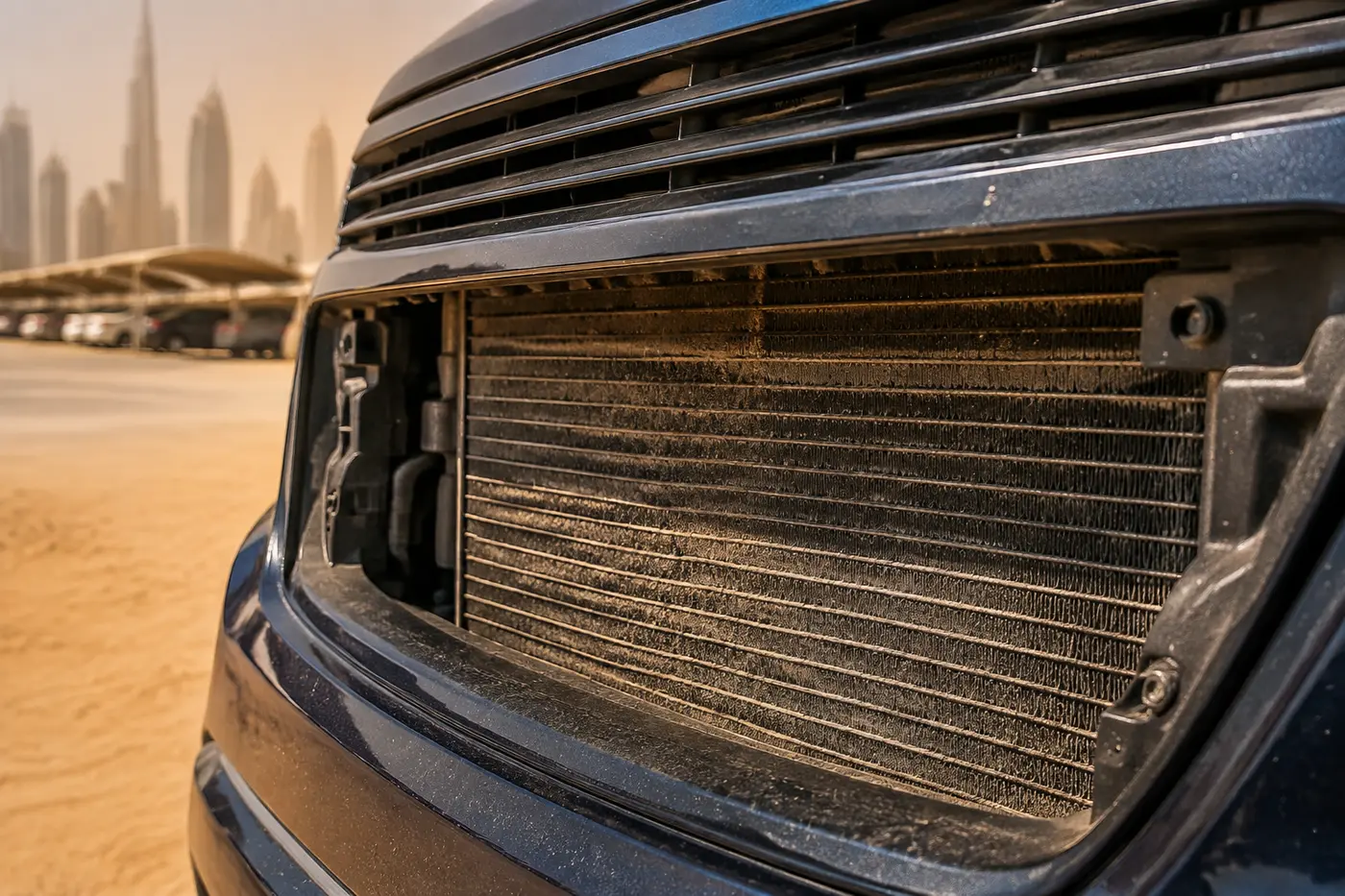
Condenser face
Check whether dust, bent fins or debris are actually limiting air passage rather than cleaning automatically.
Fan response
Observe commanded fan operation, actual speed and heat-related failure instead of listening for the fan from a distance.
Cabin filter and blower
Work vehicles can load filters quickly. A weak blower may also draw abnormal current and fail more when hot.
Hose and line condition
Age, vibration and previous work can affect crimps, supports and seals. Oil residue should be confirmed as active leak evidence.
Engine cooling interaction
If engine temperature rises with the AC, stop treating it as a cabin-only complaint. Fan and radiator performance become safety issues.
Choose parts by access, duty cycle and repeat-labour risk
Genuine or OEM path
Best suited to components where exact fit, control characteristics or difficult access make repeat labour expensive. This can be important for compressor, evaporator or integrated electrical work.
OE-supplier path
Can offer strong value when the fitted component manufacturer and correct part number are identified. Supplier reputation alone is not enough because control type and application can vary.
Quality aftermarket path
Reasonable for selected filters, relays, sensors, hoses and accessible components when fit, warranty and specification are clear. Cheapest purchase price is not always the lowest repair cost.
Fleet repeatability path
For commercial vehicles, parts availability, consistent fit, downtime and future service support may matter more than saving a small amount on one component.
Tell us how the vehicle is used and we can test the right condition first
A Pajero used for family driving, an L200 working on dusty sites and a fleet vehicle that idles for long periods do not stress the AC in the same way. The useful question is not which use pattern is “harder.” It is which condition makes the fault appear.
Cold while moving but warmer at traffic lights
Natural road airflow disappears while cabin and engine-bay heat remain high.
Weak condenser fan output, restricted front-stack airflow or a marginal charge.
Fan command versus actual airflow, condenser condition and AC performance at stable idle.
Works well at speed but the weakness returns after slowing down
Strong road airflow can compensate for a fan or heat-rejection weakness.
A fault that is hidden during highway driving but appears once the vehicle becomes stationary.
Repeat the complaint after the drive, then compare road-speed cooling with stationary idle.
Cooling has gradually become weaker during site or off-road use
Condenser fins, cabin filters and air paths can accumulate dust and debris faster.
Actual airflow restriction, filter loading or fan performance that has lost reserve capacity.
Inspect and measure restriction before cleaning or replacing anything automatically.
Starts cold then fades after extended stationary running
Under-bonnet temperature rises while fans, wiring and compressor control remain under sustained load.
Heat-sensitive fan motors, connectors, modules, compressor control or electrical voltage weakness.
Reproduce the heat soak and monitor fan response, voltage, current and cooling until the fault appears.
Reproduce the owner’s real complaint condition first. A Mitsubishi that is cold during a five-minute shaded workshop check can still have a genuine traffic, dust or heat-soak fault.
What Mitsubishi AC repair may cost
These are broad planning ranges and not quotations. The exact Pajero, L200, Outlander, ASX or fleet configuration, refrigerant type, access and parts choice determine the final estimate.
A written repair scope follows testing. If the complaint cannot be reproduced, that uncertainty should be stated rather than converted into an expensive parts guess.
Reproduce the complaint and separate airflow, refrigerant, compressor and control branches.
Ranges from maintenance items to blower motor, resistor or wiring work.
Leak location and required part determine the real repair cost.
Fan assembly, module, condenser condition and front-end access change scope.
Control valve, clutch, complete compressor and contamination work differ significantly.
Interior access, seals and refrigerant work are major variables.
Simple relays differ from wiring, module or network diagnosis.
Identify model and use pattern
Record year, refrigerant label, typical driving, long idle periods, fleet use and recent AC repairs.
Reproduce the weakness
Use the heat soak, traffic idle, road speed or blower setting that makes the symptom appear.
Check cabin airflow first
Filter, blower speed, air distribution and icing are assessed so low air volume is not mistaken for low gas.
Check heat rejection
Condenser condition, fan command and actual airflow are observed while the system is under load.
Measure refrigerant and compressor response
Pressure and temperature behaviour are interpreted against ambient conditions and known airflow.
Compare command with response
Electrical inputs and requested component states are compared with physical operation.
Define parts and access
Genuine, OE-supplier or aftermarket options are discussed only after the failed branch is isolated.
Verify under the original load
The repaired vehicle is checked at the same idle, heat-soak or road condition that exposed the problem.
Where a Mitsubishi AC diagnosis can lead
Unknown cooling fault
Start with full AC system diagnostics when the fault still crosses airflow, refrigerant and electrical systems.
Repeated low charge
Use AC leak detection and repair if cooling repeatedly returns after refill and then fades.
Compressor evidence
Move to compressor repair and replacement when measured output, noise or control evidence supports it.
Traffic-only weakness
Compare the AC stops at idle symptom route when road speed restores cooling.
Condenser damage or restriction
The condenser repair service is relevant when front-stack heat rejection or leakage is confirmed.
Weak cabin airflow
Use the weak airflow symptom route when blower volume or distribution is the main complaint.
Mitsubishi AC service should fit the way the vehicle is actually used
A private Pajero or Outlander owner and an L200 fleet operator can need the same component repaired for very different reasons. The booking and quotation should reflect the vehicle, use pattern, downtime needs and the cost of repeating labour.
Private SUV and daily-driver repair
For Pajero, Outlander, ASX and other privately used Mitsubishi vehicles, the repair decision focuses on cabin comfort, correct fit, parts warranty and proving the original traffic, heat-soak or airflow complaint.
- Model, year and refrigerant specification recorded
- Repair scope separated from maintenance items
- Genuine, OE-supplier or quality aftermarket choice explained where relevant
- Post-repair cooling checked under the original symptom condition
L200 and fleet repair planning
Commercial vehicles need the same diagnostic accuracy, but downtime and repeatability matter more. If several vehicles share a complaint, repair history and component performance can be compared instead of treating every unit as an isolated case.
- Fleet or work-use pattern added to the job card
- Parts availability and repeat-labour risk considered before approval
- Recurring refill or fan history used to avoid repeat temporary fixes
- Repair outcome documented so the next vehicle starts with better evidence
Reproduce the actual complaint and identify the failed repair branch.
State parts, access, refrigerant work and conditional items before approval.
Carry out the agreed work using the approved parts route.
Retest the vehicle under the traffic, heat, dust or idle condition that mattered.
Send the model before you visit
Include year, symptom, private or fleet use, previous refill history and whether the problem appears at idle, after heat soak or during dusty work use.
The model year and powertrain decide the correct Mitsubishi AC service path
Confirm R134a or R1234yf from the vehicle label
Mitsubishi models do not use one refrigerant across every year and market. We confirm the label before recovery or recharge and avoid charging by assumption. Vehicles specifying R1234yf follow the R1234yf service route, while other systems can use the measured gas refill route after leak concerns are addressed.
Electrified Mitsubishi variants need a different compressor procedure
Where the exact Mitsubishi is a plug-in hybrid, hybrid or electric configuration, compressor type, lubricant compatibility and electrical safety can change the job. The vehicle is identified before AC service and can move into the EV and hybrid AC service route when required.
Workshop time follows the confirmed repair
A reproducible fault can often be diagnosed during the first visit. Accessible electrical, filter and selected blower work may be shorter. Compressor and condenser work requires refrigerant handling and loaded verification, while evaporator and dashboard access usually needs longer workshop time.
Where qualifying Mitsubishi work uses original parts, six months of warranty cover is recorded with the repair approval. The repair scope should state expected timing and warranty before major work begins.
What owners and fleet managers usually ask
The exact operating condition often gives the fastest route to a useful diagnosis.
Why is my Mitsubishi Pajero AC not cold enough in Dubai?
A large heat-soaked cabin can expose weak condenser airflow, low charge, compressor wear or reduced blower performance. The system should be tested after the vehicle has reached the condition where the complaint occurs.
Why does my Mitsubishi L200 AC get warm while idling?
Low road airflow makes the condenser fan and heat rejection more important. Fan performance, condenser restriction, compressor output and charge condition should be compared at idle before parts are replaced.
Can dust make a Mitsubishi AC weak?
Dust can restrict condenser or cabin filter airflow when enough accumulates, but cleaning should follow inspection. A dusty vehicle can still have a separate refrigerant, compressor or electrical fault.
Should I refill gas if the AC is weak?
Only if testing supports an incorrect or low charge and the reason for loss is understood. Repeated refrigerant addition without leak diagnosis is not a complete repair.
Can a Mitsubishi compressor be repaired?
It depends on the compressor and confirmed failure. Some faults involve controls or clutch-side components, while internal damage can require complete replacement. Diagnosis determines the scope.
Why is airflow weak even when the air feels cold?
Cabin filter restriction, blower motor weakness, resistor or module faults, evaporator icing and air-door issues can reduce air volume. The refrigerant circuit may not be the problem.
Do fleet vehicles need a different AC repair approach?
The diagnosis is the same in principle, but uptime, repeated use patterns, parts availability and consistent repair documentation become more important when several vehicles are managed together.
Do you use genuine Mitsubishi parts?
Genuine, OE-supplier and quality aftermarket options can be considered depending on the component, access, warranty, availability and the cost of repeating the repair.
What should I send on WhatsApp?
Send the Mitsubishi model, year, whether it is private or fleet use, when cooling becomes weak, whether road speed changes it and any recent refill or repair history.
Tell us how your Mitsubishi is used before you visit
Send the model, year, private or fleet use, whether the problem appears after parking, in traffic, at a work site or after a long drive. We can prepare the diagnostic route at AMF Auto Services in Al Quoz 4.