
Car AC Condenser Replacement Dubai
When cooling is weak at idle, the high-side pressure rises or the front of the car has impact damage, the condenser deserves careful inspection. We distinguish external blockage and fan airflow faults from refrigerant leaks and internal restriction before recommending cleaning, repair or replacement.
Why condenser problems often show up in traffic
At road speed, natural airflow passes through the front heat exchangers. At idle, electric or engine-driven fans do more of the work. That difference helps separate condenser airflow faults from other AC problems. If engine temperature also rises when the AC is switched on, see our car overheats with AC on guide for the fan, condenser and engine-cooling crossover.
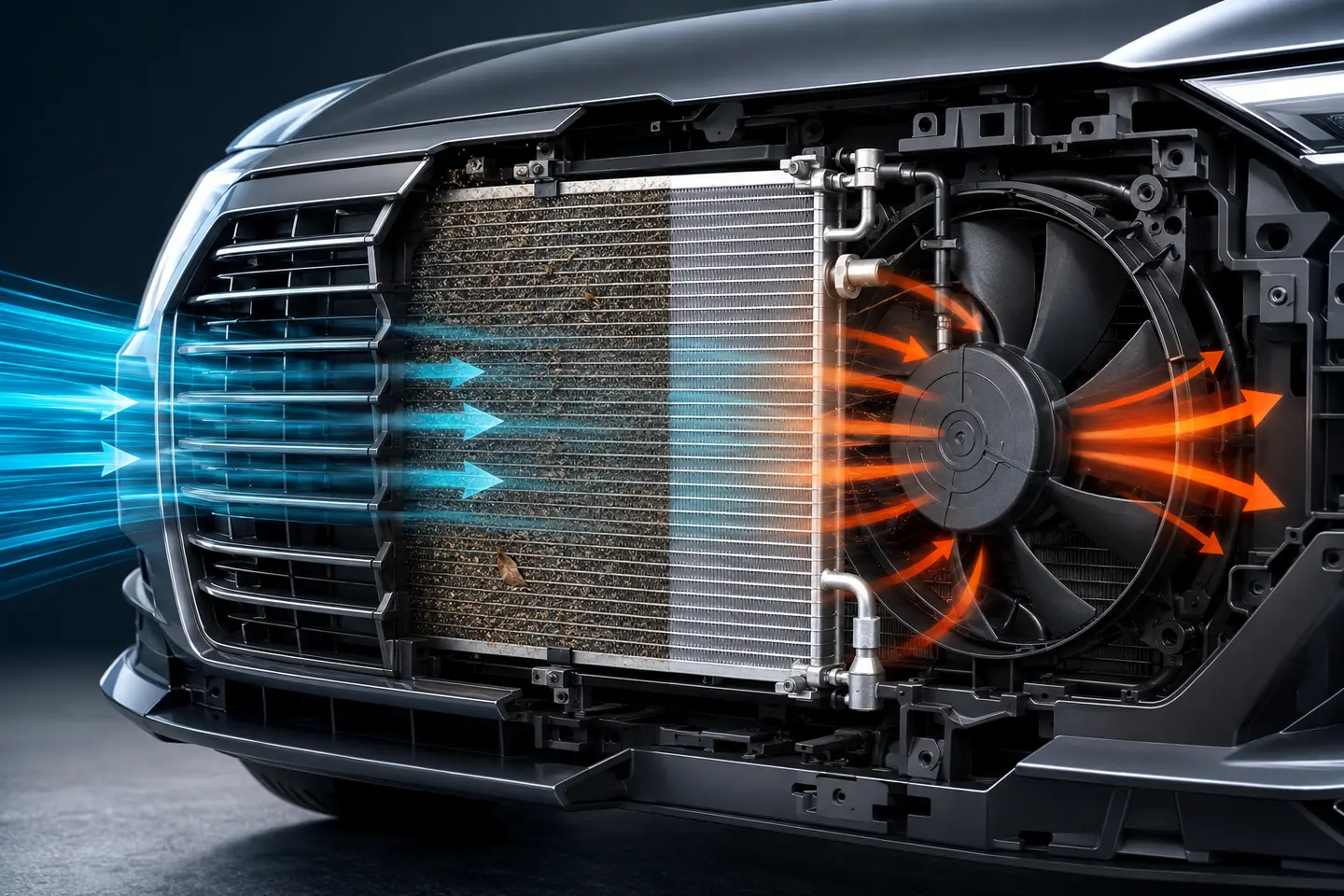
Air reaches the grille
Grille design, accessories, debris and front covers affect how much air reaches the condenser face.
Inspect obstructionAir crosses the fins
Sand, dirt and bent fins reduce effective surface area and make heat harder to reject.
Assess cleaning and fin conditionFans support low-speed cooling
A fan motor, relay, module, wiring or command fault can make the AC warm at idle even when the condenser itself is intact.
Verify fan operation and commandHeat leaves the refrigerant
Pressure and temperature behaviour show whether heat rejection is improving or a restriction or charge issue remains.
Test the full systemCooling behaviour helps separate airflow, leakage and restriction
The same weak-cooling complaint can lead to very different repairs. The table shows what each pattern makes worth checking first; it is not a parts verdict.
| Cooling pattern | What it may suggest | Useful first checks | Why a condenser replacement may be wrong |
|---|---|---|---|
| Cold at road speed, warmer at idle | Low-speed airflow loss, fan control fault, blocked cooling pack or excessive heat load | Fan request and speed, grille blockage, fin condition, pressure response at idle and with airflow | The condenser may be structurally sound while the fan, relay, module, wiring or airflow path is faulty. |
| Weak at all speeds after a recharge | Incorrect charge, leak, compressor output problem, restriction or sensor/control issue | Recovered charge, pressure and temperature pattern, compressor command, leak evidence | Airflow may not be the main limitation, and replacing the heat exchanger would not correct the real fault. |
| Cooling changed after front impact | Crushed fins or tubes, refrigerant leak, damaged mounts, fan or wiring damage | Front structure and cooling-pack alignment, leak test, fan clearance, pipe and connector condition | A minor external obstruction needs a different response from a leaking or distorted condenser. |
| High pressure with good visible airflow | Overcharge, internal restriction, non-condensable gas, sensor error or poor heat transfer between stacked coolers | Charge specification, temperature drop, service history, internal restriction evidence and hidden debris between heat exchangers | Visible fan movement alone does not confirm correct airflow or prove that the condenser core is restricted. |
Inspection note. Pressure limits and fan strategies are vehicle-specific. A technician should use the correct service information rather than a universal pressure target.
Three different condenser decisions
The correct choice depends on what failed. Cleaning cannot seal a refrigerant leak, and replacement will not correct a fan that never switches on.
Clean and restore airflow
Appropriate when external dust, sand, leaves or debris is restricting the face and the condenser remains structurally sound and leak-free.
- Use a fin-safe method.
- Protect adjacent electrical parts.
- Recheck pressure and cooling afterward.
Repair a local fault
Possible only when the damaged area and component construction allow a dependable repair, and contamination or corrosion does not make replacement safer.
- Confirm the leak or damage.
- Consider access and repair durability.
- Pressure-test and recheck after work.
Replace the condenser
Often selected for widespread fin damage, unrecoverable leakage, corrosion, impact distortion, internal restriction or designs that should not be repaired.
- Match the exact vehicle specification.
- Inspect mounting and adjacent cooling parts.
- Follow system contamination guidance.
What condenser cleaning can and cannot fix
Cleaning is useful when the problem is external heat-transfer blockage. It is not a substitute for leak detection, fan diagnosis or internal circuit testing.
Cleaning may restore airflow when
Dust, leaves, insects or road debris cover the exposed face or collect between stacked heat exchangers. A fin-safe process can remove loose contamination while protecting delicate aluminium fins, nearby sensors, electrical connectors and the radiator behind the condenser.
The result should be verified rather than judged only by appearance. Fan operation, pressure response and vent cooling are compared before and after cleaning in similar operating conditions. If the readings do not improve, the diagnosis continues.
Cleaning cannot correct these faults
A cracked tube, leaking joint, corroded core or impact-damaged header needs a sealing or replacement decision. Cleaning also cannot reopen a refrigerant passage restricted internally by debris or correct an overcharged system.
High-pressure water can create a new problem by folding fins, driving contamination deeper or damaging adjacent parts. A visually clean condenser can still have poor airflow between cooling-pack layers, a weak fan or an internal flow issue, so a “cleaned” appearance is not the completion check.
Sand is only one possible cause
Desert dust can collect between the condenser, radiator and other heat exchangers, but a visual layer of dirt does not explain every high-pressure or warm-at-idle complaint. The cooling fan, charge, airflow path and internal refrigerant flow must also be considered.
What happens after the condenser fault is confirmed
The service scope changes if there is front-end damage, compressor contamination, a fan fault or another heat exchanger problem.
Recover safely
Recover refrigerant using equipment suited to the identified gas.
Access and inspect
Remove required trim and inspect mounts, fans, radiator and nearby components.
Replace and seal
Fit the correct condenser and specified seals, accounting for oil where required.
Leak-test and charge
Apply the appropriate test, evacuate and charge refrigerant by specification.
Verify at idle
Confirm fan operation, pressure response and vent cooling in the conditions that exposed the fault.
Why condenser replacement prices vary
How the condenser fits into the refrigerant circuit
Condenser repair questions
Describe whether the AC is warmer at idle, after impact or all the time. That pattern helps direct the first checks.
How do I know if the AC condenser is faulty?
Possible clues include cooling that weakens at idle, high-pressure behaviour, a confirmed condenser leak or visible front-end damage. These symptoms can also come from fan, refrigerant-charge and airflow problems, so testing is required.
Can a dirty car AC condenser be cleaned?
External dust and debris can often be removed when the condenser is structurally sound. The method should protect delicate fins and nearby electrical parts. Cleaning does not repair a leak or internal restriction.
Can bent condenser fins be straightened?
Light local fin distortion may be improved carefully, but widespread crushing, damaged tubes or leakage can justify replacement. The risk of creating further damage has to be considered.
Why is my AC cold while driving but warm in traffic?
Road speed increases airflow through the condenser. At idle, cooling depends heavily on fan operation. A blocked condenser face, weak fan, control fault, charge problem or other system issue may be involved.
How much does car AC condenser replacement cost in Dubai?
The homepage shows AED 1,000 to 3,500 as an indicative guide. The exact vehicle, condenser design, access, parts, refrigerant and related damage or faults determine the final written amount.
How long does condenser replacement take?
Time varies with cooling-pack access, collision damage, parts availability and required testing. Straightforward jobs may be completed in one visit; more complex front-end or contamination work can take longer.
Tell us whether cooling changes at idle
Send your vehicle details, the cooling pattern and a safe photo through the front grille if there is visible damage. We will arrange condenser and airflow checks at AMF Auto Services, 39 Al Quoz 4, Dubai.