
Land Rover Range Rover AC Repair Dubai
Range Rover, Range Rover Sport, Velar, Evoque, Discovery and Defender models can develop front or rear cooling problems, refrigerant leaks, compressor faults, blower issues and climate-control electronics complaints that become obvious in Dubai heat. We separate the failing cabin zone, whole-system cooling capacity and major-access repair branch before you approve expensive parts or dismantling.
The cabin pattern should decide how far the Land Rover AC job goes
Large premium SUVs can turn a small wrong assumption into a large repair bill. We therefore separate local zone problems, whole-system weakness and major-access work before parts are ordered.
Front cooling is good but one rear or side zone is not
The first job is to prove that the weakness is local to that cabin branch. Rear blower, distribution, actuator response and refrigerant-side operation can then be tested without treating the whole system as low on gas.
- Compare front and rear vent temperature
- Compare blower volume by zone
- Check local control and air distribution
- Approve trim access only when the rear branch is proven
All zones are weak or cooling fades after service
Charge condition, leak evidence, compressor output and condenser airflow move ahead of local zone work when the whole cabin loses capacity.
- Confirm refrigerant loss before refill
- Measure fan and condenser performance
- Test compressor output under heat load
A compressor, evaporator or dashboard job has been suggested
Bring the earlier estimate if you want a second opinion. High-labour work should have clear leak, mechanical or electrical evidence before dismantling begins.
- Identify the failed branch first
- State the parts route and access
- Explain supporting seals and refrigerant work
These are the complaints that deserve a model-aware workshop test
Rear vents stay warm while front vents are cold
This pattern supports a rear-specific diagnostic branch. The rear AC not working route can help describe the complaint before the visit.
AC weakens at signals but improves when moving
Condenser fan performance and heat rejection move high on the list. Charge and compressor response still need to be interpreted with the airflow result. See our Range Rover AC not cold case study for a transparent composite example of this diagnostic path.
One side or one selected temperature does not match
Air-mix actuators, sensor values, calibration and whole-system cooling capacity need to be compared under identical settings.
Cooling returns after refill then fades again
Repeated low charge supports AC leak detection and repair. Refrigerant should not be treated as an annual consumable.
AC begins cold then changes after a long drive
Pressure protection, compressor control, sensors and heat-sensitive electrical behaviour may need sufficient run time to reproduce.
Evaporator or compressor replacement has been recommended
High-labour parts deserve strong evidence. A confirmed compressor fault can move into compressor repair and replacement once output and control failure are proven.
Range Rover system identification
Read the exact vehicle label before service because R134a and R1234yf applications require different refrigerant, oil and recovery procedures.
Front, rear, driver and passenger results are separated so a local HVAC problem is not confused with weak whole-system capacity.
Electrified configurations can use different compressor and thermal-management strategies and are routed through EV-aware diagnosis where required.
Accessible faults may be completed in a shorter visit, while rear HVAC, compressor and dashboard-access repairs need additional parts and verification time.
Qualifying Land Rover repairs using original parts include six months of warranty cover against the approved repair branch.
Model year and powertrain now matter as much as the cabin symptom
Range Rover and Land Rover climate systems span conventional petrol and diesel vehicles, mild hybrids and plug-in hybrid configurations. That means the badge alone cannot determine refrigerant, compressor type or electrical service boundary. Vehicle identification comes before any recovery machine or replacement part is connected.
The refrigerant label decides whether the job follows the standard AC gas service or the dedicated R1234yf service. The specified refrigerant mass and lubricant remain vehicle-specific.
Where a plug-in hybrid or other electrified configuration uses an electric compressor or climate system linked to high-voltage thermal management, the vehicle moves to the EV and hybrid AC service. This keeps a rear-zone or cooling complaint from being approached with a conventional compressor procedure that does not fit the powertrain.
What usually brings these vehicles to the workshop
Front and rear temperatures do not agree
Rear blower, distribution, air-mix control and local refrigerant-side operation are checked before the whole system is treated as undercharged.
AC is cool but not enough for Dubai heat
Charge accuracy, condenser airflow, compressor reserve and cabin heat load should be measured before a refill or major part recommendation.
Cooling weakens at idle
Fan command and actual airflow, condenser condition and low-speed compressor response need to be checked. The idle cooling symptom page explains this pattern.
Blower is weak or inconsistent
Filter restriction, blower motor, control module, connectors and air path can reduce useful cooling even when the evaporator is cold.
Selected temperature does not match the vent result
Sensor values, actuator commands and physical movement need to agree. A confirmed electrical branch can move into climate-control electrical diagnostics.
Cooling fades after a previous recharge
Leak evidence should identify the source before another recharge is presented as the repair. Access can vary widely between an external seal and an evaporator-side leak.
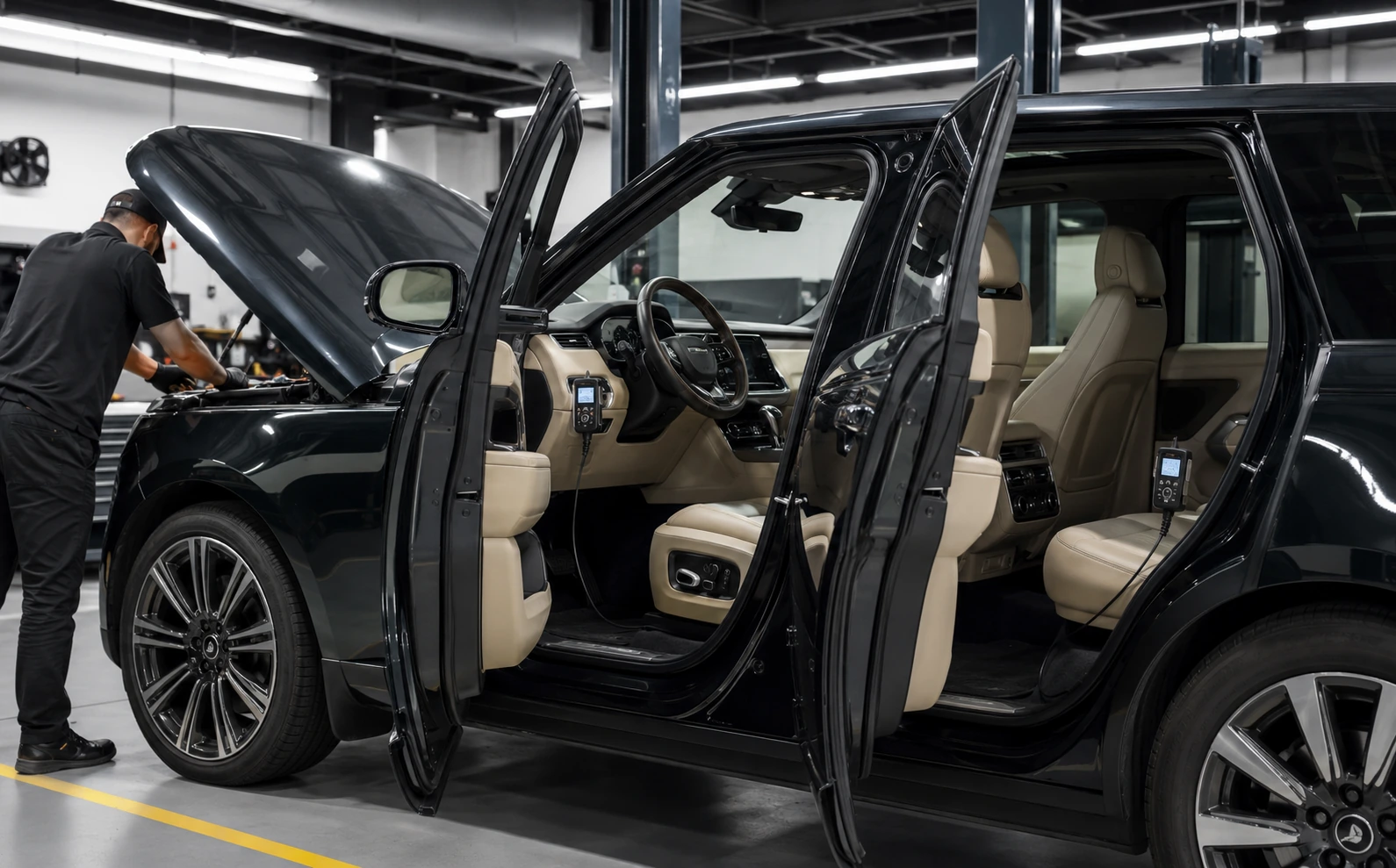
Parts choice changes when the labour to reach them is expensive
Premium SUV AC repairs can involve very different access levels. An easy relay or hose should not be treated like a rear HVAC unit, dashboard evaporator or electronically controlled compressor.
We identify the exact vehicle and failed branch first, then discuss genuine, OEM, OE-supplier or quality aftermarket options where a real choice exists.
Accessible repair
Filters, selected relays, hoses, connectors and some external components can allow broader parts options when specification and warranty are clear.
Integrated repair
Fans, actuators, sensors and compressor-control components need exact fit and control compatibility, not just a similar-looking part.
Access-heavy repair
Evaporator, rear HVAC and difficult compressor jobs make repeat labour expensive. Exact parts quality and supporting seals become more important.
Electrical repair-first route
Power, ground, wiring and connectors should be repaired correctly instead of converting a circuit fault into an unnecessary control-module purchase.
What Land Rover and Range Rover AC repair may cost
These are broad planning ranges, not quotations. Model, front and rear system layout, refrigerant type, access and parts choice determine the written estimate.
Stop using the AC if there is smoke, burning smell or overheating
Electrical heat, belt distress or engine overheating takes priority over cabin comfort. If engine temperature continues rising, stop driving safely and arrange inspection rather than continuing with the AC on.
Diagnostic and zone comparison
AED 250 to 600Reproduce the complaint and compare front, rear, airflow, refrigerant and control branches.
Leak and recharge path
AED 450 to 2,000+External seals and hoses differ substantially from condenser or evaporator leaks.
Rear blower or control repair
AED 550 to 2,300+Rear trim access, blower assembly, wiring and control configuration affect scope.
Condenser or fan repair
AED 850 to 3,000+Fan modules, assemblies, condenser damage and front-end access vary by model.
Compressor repair path
AED 1,600 to 5,000+Control, clutch where applicable, complete compressor and contamination work differ significantly.
Evaporator or rear HVAC path
AED 2,000 to 6,500+Interior access, trim, seals and refrigerant work are major variables.
Planning ranges are indicative and non-binding. A written estimate follows inspection of the exact vehicle and confirmed repair scope.
Identify model, year and cabin layout
Front and rear zones, refrigerant label, previous AC work and the exact complaint are documented.
Reproduce the symptom where it happens
Traffic, hot-soak start, long run time, blower setting and selected zones are used to make the weakness appear.
Compare cabin zones
Front, rear, driver and passenger temperatures and airflow are measured where the complaint involves uneven comfort.
Separate airflow from cooling capacity
Filter, blower, distribution and icing are checked before low gas or compressor failure is assumed.
Measure condenser and compressor response
Fan output, heat rejection, refrigerant behaviour and compressor command are interpreted together.
Test electronic command and physical movement
Sensors, actuators, relays, modules and wiring are checked where the symptom points.
Quote the failed branch and access
Front, rear or whole-system repair scope, part route and refrigerant work are explained before dismantling.
Verify the same cabin complaint after repair
The original heat, zone and run-time condition is checked again before the job is considered complete.
What owners ask before booking
These answers focus on practical Range Rover and Land Rover repair decisions.
Why is my Range Rover rear AC not cold?
Rear blower, air distribution, rear evaporator-side operation and whole-system cooling capacity can all cause the symptom. Front and rear results should be compared before rear trim is removed.
Why is my Land Rover AC cold while driving but warm at traffic lights?
Condenser fan performance and heat rejection become important at idle. Charge condition and compressor output can also contribute, so the fan should be tested rather than assumed bad.
Does a Range Rover need regular AC gas top-ups?
No. Refrigerant is in a sealed circuit. Repeated low charge should lead to leak diagnosis rather than routine topping up.
Can one side of the cabin be warm because of electronics?
Yes. Sensors, actuators and control commands can create zone differences, but overall cooling capacity must also be checked before a climate component is replaced.
Do you repair Land Rover climate-control electronics?
Yes. Sensors, actuators, relays, wiring and modules can be tested when the complaint supports that branch. A fault code alone is not enough to approve a part.
Do you fit OEM or aftermarket Range Rover AC parts?
Both can be considered where appropriate. Access, exact specification, warranty and repeat-labour risk determine the sensible option.
How much can Range Rover AC compressor repair cost?
A broad planning range is around AED 1,600 to AED 5,000 or more depending on model, compressor design, contamination work and refrigerant service.
What should I send before visiting?
Send the model, year, whether front, rear or both zones are affected, when cooling changes, blower strength and any recent refill, compressor, fan or dashboard AC work.
Tell us the model and which cabin area is failing
Send the Range Rover, Sport, Velar, Evoque, Discovery, Defender or other Land Rover model, year, affected zones and when the problem appears. That lets us prepare the correct front, rear or whole-system workshop route in Al Quoz 4.