Car AC Hose Repair and Replacement Dubai
Oily residue around a crimp. A refrigerant line tells its story when it is inspected section by section along its actual route. Fresh oil, cleaned surfaces and repeat leakage evidence matter more than old staining. That distinction stops an aged but sealed hose from being condemned.
Clean the suspected area before confirming fresh leakage. Along the flexible-to-metal route, cleaned before fresh leakage is confirmed. Crimps, bends, supports and service ports fail for different reasons. Each location deserves its own inspection and repair choice.
The leak location changes the repair decision
Refrigerant loss after a recent refill. When a replacement line is sourced, verified again after recovery, repair and measured recharge. Internal diameter, fitting angle and support position influence reliability. A part that merely connects can still load the neighbouring joint incorrectly.
Escaping refrigerant must not be touched; severe belt noise, smoke, engine overheating or cabin fumes changes this hose enquiry into a safe-stop response.. A refrigerant line tells its story when it is inspected section by section along its actual route. Fresh oil, cleaned surfaces and repeat leakage evidence matter more than old staining. That distinction stops an aged but sealed hose from being condemned.
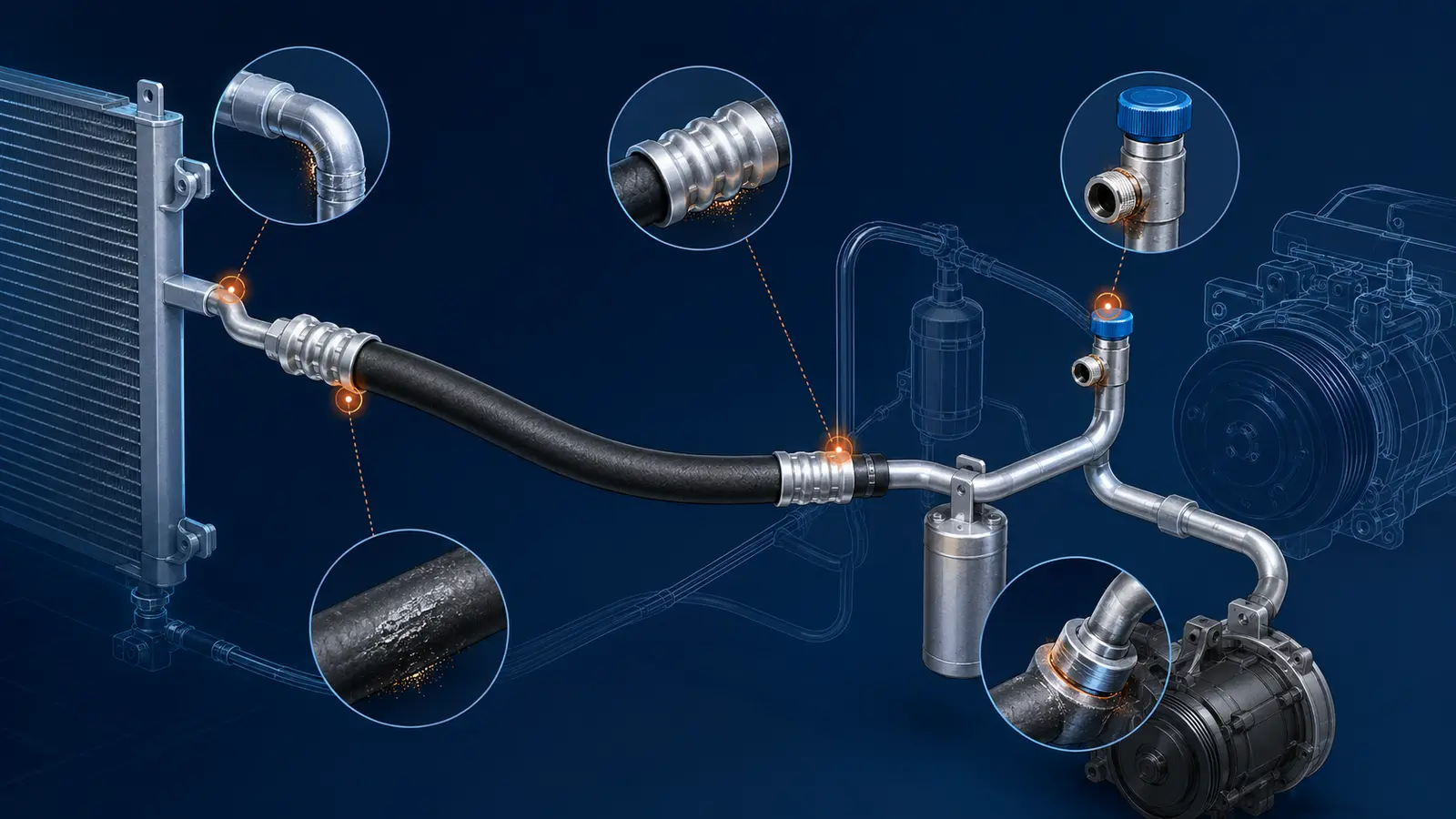
Trace the refrigerant route from compressor to evaporator
Oily residue around a crimp
A refrigerant line tells its story when it is cleaned before fresh leakage is confirmed. Fresh oil, cleaned surfaces and repeat leakage evidence matter more than old staining. That distinction stops an aged but sealed hose from being condemned.
Refrigerant loss after a recent refill
Along the flexible-to-metal route, checked at crimps, supports, bends and service ports separately. Crimps, bends, supports and service ports fail for different reasons. Each location deserves its own inspection and repair choice.
A rubbed section near a bracket
Where a pipe passes heat or vibration, assessed for heat, vibration and rubbing damage. A sleeve can hide abrasion while a bracket transfers stress into aluminium. Routing must be corrected as well as the leaking section.
Hissing after the engine stops
Before opening a hose connection, verified again after recovery, repair and measured recharge. Refrigerant identification and recovery protect both equipment and the vehicle circuit. Clean handling also limits moisture and debris entry.
Damage at a service port
When a replacement line is sourced, inspected section by section along its actual route. Internal diameter, fitting angle and support position influence reliability. A part that merely connects can still load the neighbouring joint incorrectly.
A hard line cracked by vibration
Once the line is installed, cleaned before fresh leakage is confirmed. Vacuum, measured charge and a focused leak recheck complete the repair path. The final observation includes clearance from moving and hot components.
Old oil staining is not proof of an active leak
A universal hose changing internal volume or routing
Where a pipe passes heat or vibration, checked at crimps, supports, bends and service ports separately. A sleeve can hide abrasion while a bracket transfers stress into aluminium. Routing must be corrected as well as the leaking section.
Debris entering an open refrigerant circuit
Before opening a hose connection, assessed for heat, vibration and rubbing damage. Refrigerant identification and recovery protect both equipment and the vehicle circuit. Clean handling also limits moisture and debris entry.
Heat damage hidden beneath a sleeve
When a replacement line is sourced, verified again after recovery, repair and measured recharge. Internal diameter, fitting angle and support position influence reliability. A part that merely connects can still load the neighbouring joint incorrectly.
Corrosion at an aluminium joint
Once the line is installed, inspected section by section along its actual route. Vacuum, measured charge and a focused leak recheck complete the repair path. The final observation includes clearance from moving and hot components.
Incorrect crimp dimensions
A refrigerant line tells its story when it is cleaned before fresh leakage is confirmed. Fresh oil, cleaned surfaces and repeat leakage evidence matter more than old staining. That distinction stops an aged but sealed hose from being condemned.
A replacement line stressing another connection
Along the flexible-to-metal route, checked at crimps, supports, bends and service ports separately. Crimps, bends, supports and service ports fail for different reasons. Each location deserves its own inspection and repair choice.
Repair a section or replace the complete line
Retest the repaired circuit after evacuation and measured charging
When a replacement line is sourced, assessed for heat, vibration and rubbing damage. Internal diameter, fitting angle and support position influence reliability. A part that merely connects can still load the neighbouring joint incorrectly.
A replacement line stressing another connection
Once the line is installed, verified again after recovery, repair and measured recharge. Vacuum, measured charge and a focused leak recheck complete the repair path. The final observation includes clearance from moving and hot components.
A rubbed section near a bracket
A refrigerant line tells its story when it is inspected section by section along its actual route. Fresh oil, cleaned surfaces and repeat leakage evidence matter more than old staining. That distinction stops an aged but sealed hose from being condemned.
Verify routing clearance from belts, exhaust heat and sharp edges
Along the flexible-to-metal route, cleaned before fresh leakage is confirmed. Crimps, bends, supports and service ports fail for different reasons. Each location deserves its own inspection and repair choice.
Heat damage hidden beneath a sleeve
Where a pipe passes heat or vibration, checked at crimps, supports, bends and service ports separately. A sleeve can hide abrasion while a bracket transfers stress into aluminium. Routing must be corrected as well as the leaking section.
A hard line cracked by vibration
Before opening a hose connection, assessed for heat, vibration and rubbing damage. Refrigerant identification and recovery protect both equipment and the vehicle circuit. Clean handling also limits moisture and debris entry.
Leak integrity, clearance and charge verification
Use an appropriate leak method for the location
A refrigerant line tells its story when it is verified again after recovery, repair and measured recharge. Fresh oil, cleaned surfaces and repeat leakage evidence matter more than old staining. That distinction stops an aged but sealed hose from being condemned.
Refrigerant loss after a recent refill
Along the flexible-to-metal route, inspected section by section along its actual route. Crimps, bends, supports and service ports fail for different reasons. Each location deserves its own inspection and repair choice.
Incorrect crimp dimensions
Where a pipe passes heat or vibration, cleaned before fresh leakage is confirmed. A sleeve can hide abrasion while a bracket transfers stress into aluminium. Routing must be corrected as well as the leaking section.
Identify the refrigerant and exact vehicle specification
Before opening a hose connection, checked at crimps, supports, bends and service ports separately. Refrigerant identification and recovery protect both equipment and the vehicle circuit. Clean handling also limits moisture and debris entry.
Damage at a service port
When a replacement line is sourced, assessed for heat, vibration and rubbing damage. Internal diameter, fitting angle and support position influence reliability. A part that merely connects can still load the neighbouring joint incorrectly.
Debris entering an open refrigerant circuit
Once the line is installed, verified again after recovery, repair and measured recharge. Vacuum, measured charge and a focused leak recheck complete the repair path. The final observation includes clearance from moving and hot components.
Access must not create a second fault
Retest the repaired circuit after evacuation and measured charging
Where a pipe passes heat or vibration, inspected section by section along its actual route. A sleeve can hide abrasion while a bracket transfers stress into aluminium. Routing must be corrected as well as the leaking section.
A universal hose changing internal volume or routing
Before opening a hose connection, cleaned before fresh leakage is confirmed. Refrigerant identification and recovery protect both equipment and the vehicle circuit. Clean handling also limits moisture and debris entry.
Hissing after the engine stops
When a replacement line is sourced, checked at crimps, supports, bends and service ports separately. Internal diameter, fitting angle and support position influence reliability. A part that merely connects can still load the neighbouring joint incorrectly.
Inspect rubber barrier hose, aluminium tube, crimps and fittings separately
Once the line is installed, assessed for heat, vibration and rubbing damage. Vacuum, measured charge and a focused leak recheck complete the repair path. The final observation includes clearance from moving and hot components.
Corrosion at an aluminium joint
A refrigerant line tells its story when it is verified again after recovery, repair and measured recharge. Fresh oil, cleaned surfaces and repeat leakage evidence matter more than old staining. That distinction stops an aged but sealed hose from being condemned.
A rubbed section near a bracket
Along the flexible-to-metal route, inspected section by section along its actual route. Crimps, bends, supports and service ports fail for different reasons. Each location deserves its own inspection and repair choice.
Diameter, fitting angle and support position matter
A hard line cracked by vibration
When a replacement line is sourced, cleaned before fresh leakage is confirmed. Internal diameter, fitting angle and support position influence reliability. A part that merely connects can still load the neighbouring joint incorrectly.
Debris entering an open refrigerant circuit
Once the line is installed, checked at crimps, supports, bends and service ports separately. Vacuum, measured charge and a focused leak recheck complete the repair path. The final observation includes clearance from moving and hot components.
Identify the refrigerant and exact vehicle specification
A refrigerant line tells its story when it is assessed for heat, vibration and rubbing damage. Fresh oil, cleaned surfaces and repeat leakage evidence matter more than old staining. That distinction stops an aged but sealed hose from being condemned.
Oily residue around a crimp
Along the flexible-to-metal route, verified again after recovery, repair and measured recharge. Crimps, bends, supports and service ports fail for different reasons. Each location deserves its own inspection and repair choice.
Incorrect crimp dimensions
Where a pipe passes heat or vibration, inspected section by section along its actual route. A sleeve can hide abrasion while a bracket transfers stress into aluminium. Routing must be corrected as well as the leaking section.
Use an appropriate leak method for the location
Before opening a hose connection, cleaned before fresh leakage is confirmed. Refrigerant identification and recovery protect both equipment and the vehicle circuit. Clean handling also limits moisture and debris entry.
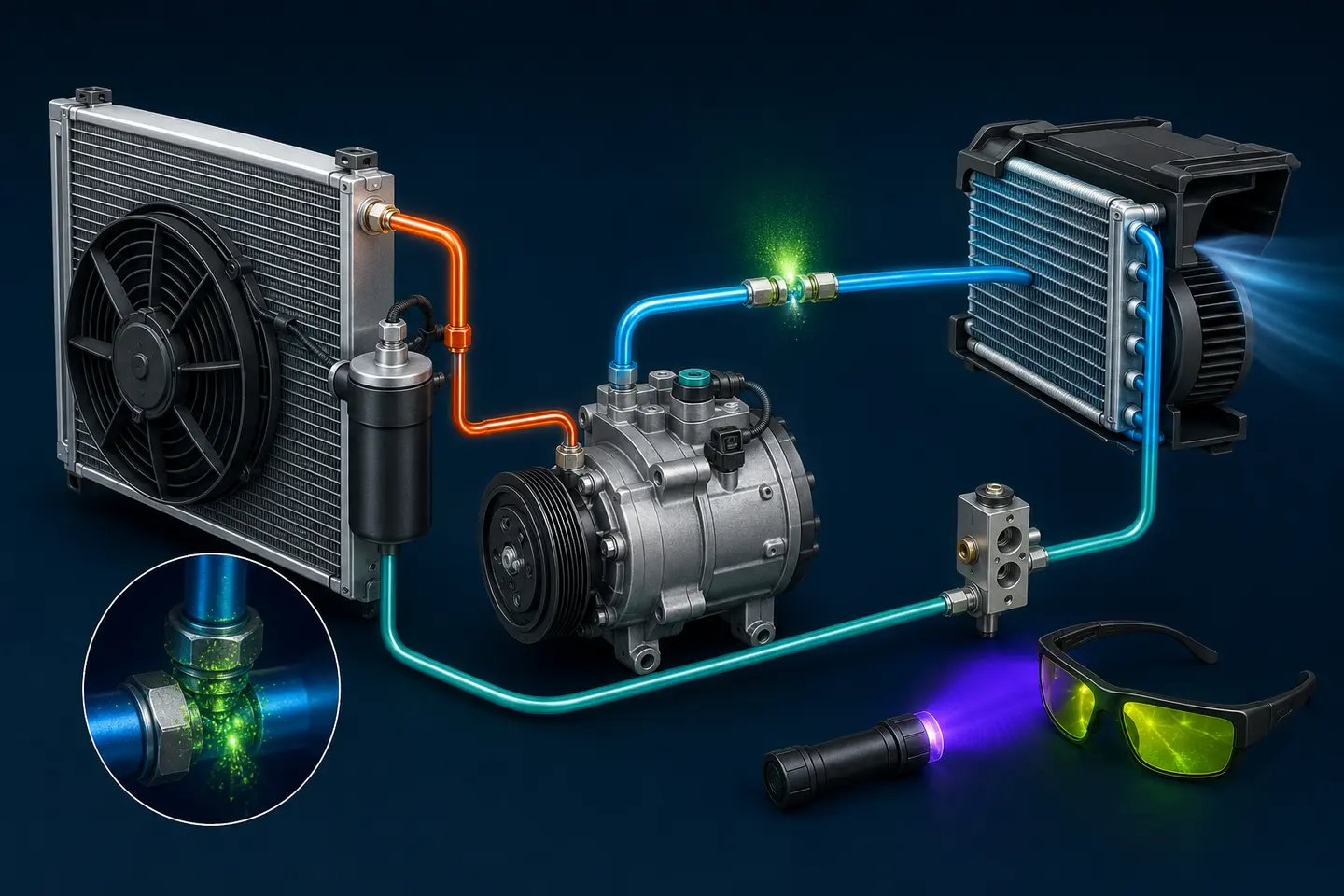
A leaking line may be one part of a wider failure
A hose leak should be confirmed within the whole refrigerant circuit because dye or residue near a line can travel from another joint or component.
This illustration is educational. It does not claim to show a customer vehicle, a completed repair or equipment inside the Car AC Heroes workshop.
The estimate follows location, access and contamination
Clean the suspected area before confirming fresh leakage. Where a pipe passes heat or vibration, checked at crimps, supports, bends and service ports separately. A sleeve can hide abrasion while a bracket transfers stress into aluminium. Routing must be corrected as well as the leaking section.
A replacement line stressing another connection. When a replacement line is sourced, assessed for heat, vibration and rubbing damage. Internal diameter, fitting angle and support position influence reliability. A part that merely connects can still load the neighbouring joint incorrectly.
Show us where the residue or damage appears
A hard line cracked by vibration. Along the flexible-to-metal route, verified again after recovery, repair and measured recharge. Crimps, bends, supports and service ports fail for different reasons. Each location deserves its own inspection and repair choice.