
Check Which AC Gas Your Car Uses
Select the vehicle, model year and market to see whether it usually uses R134a, R1234yf or needs label confirmation. The result helps you plan the correct service without guessing or mixing refrigerants.
Car AC refrigerant lookup
Choose the closest match. If the vehicle is imported or modified, select Unknown or imported for the market.
JavaScript is required for the interactive lookup. You can still use the label guide below or send a label photo for confirmation.

Use the result to find the right label
The lookup gives a careful planning result based on vehicle generation, year and market. It deliberately avoids claiming certainty when manufacturers changed refrigerant during a production run or supplied different systems to different markets.
Open the bonnet only when the vehicle is safely parked, switched off and cool enough to inspect. Look around the upper radiator support, bonnet underside, front slam panel or engine-bay side panels. The AC label may be combined with an emissions or service-information sticker.
Look for the exact text R134a, R1234yf or another refrigerant designation. The same label may show a number followed by g, which is the specified refrigerant mass. Do not confuse that quantity with a pressure reading.
Adapters, previous repairs and imported components can mislead. If the sticker is missing, damaged or contradictory, the correct next step is manufacturer information matched to the VIN and refrigerant identification before recovery.
What each lookup result means
The tool only suggests a refrigerant when its database has a relevant vehicle-generation record. Year and market clues are shown for context, but they no longer produce a gas-type answer by themselves.
A relevant model record was found
The make, model and year match a known generation record that usually specifies R134a or R1234yf. Market, engine, rear AC and production-date differences can still apply, so confirm the label before service.
Transition or special system
The selected model may use more than one refrigerant or an unusual system such as R744. The under-bonnet label and manufacturer information matched to the VIN must decide the answer.
The tool will not guess
If there is no vehicle-specific database match, the result asks you to check the label. A broad year-based assumption is not reliable enough for refrigerant service.
The same model year can use different AC refrigerants
Refrigerant transitions did not happen on one universal date. A manufacturer could introduce R1234yf with a new vehicle generation, a particular engine, an electrified version or one destination market while another version continued with R134a.
Registration year can also differ from production year. A car registered in Dubai in 2019 may have been produced earlier. Imported vehicles create another variation because a European, North American and GCC version can share the same badge while using different AC specifications.
Rear AC matters too. Large SUVs, vans and multi-zone vehicles may use a different charge quantity from a front-only version even when the gas type is the same. This lookup therefore identifies the likely refrigerant, not the number of grams needed for service.
For a fuller explanation of both gases, read R134a vs R1234yf and how to read the vehicle label.
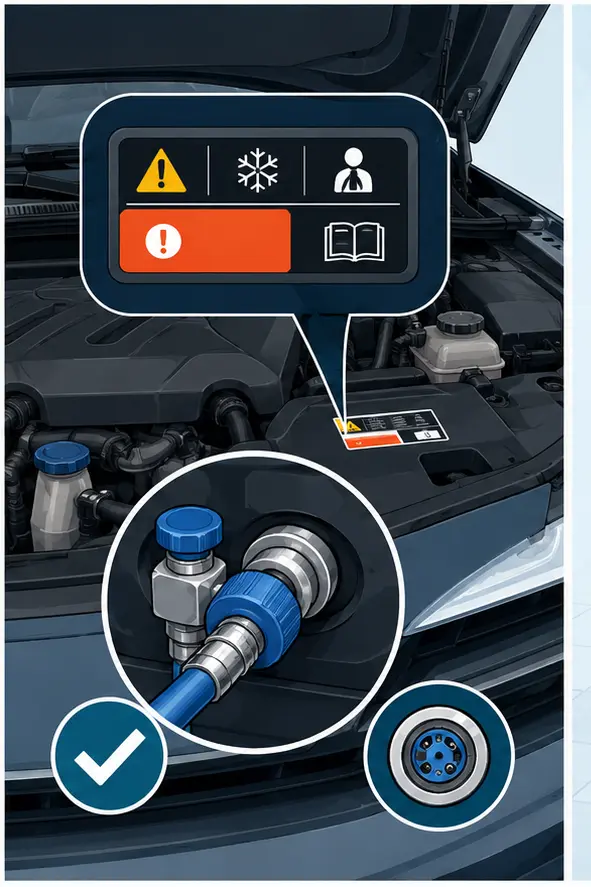
Confirm the gas type before any refill
Use the lookup
Select make, model, year and market. Treat the result as a likely route, especially during a transition period.
Find the label
Read the refrigerant designation exactly. Photograph the full sticker so the gas type and gram value remain together.
Match the VIN if needed
If the label is missing or the car is imported, use manufacturer service data for the exact VIN and installed AC system.
Identify unknown gas
If previous service history is uncertain, a workshop may need refrigerant identification before connecting recovery equipment.
Knowing the gas type does not prove the car needs gas
Warm air can result from low refrigerant, but it can also come from condenser airflow, compressor control, a pressure sensor, a blend door, a blower fault or an electrical problem. Refrigerant is not normally consumed like fuel. If charge is low, the system may have a leak or a previous service may have left the wrong amount.
A measured recharge recovers the existing refrigerant where appropriate, checks the system condition and installs the manufacturer-specified mass. A top-up adds an uncertain quantity to an uncertain starting amount. That difference matters in Dubai heat, where condenser load and fan performance have a strong effect on operating pressure.
If the AC recently lost cooling again after a refill, use the car AC leak detection service rather than paying for the same gas repeatedly. For an uncertain symptom, the free online AC symptom checker can help organise the likely test paths.
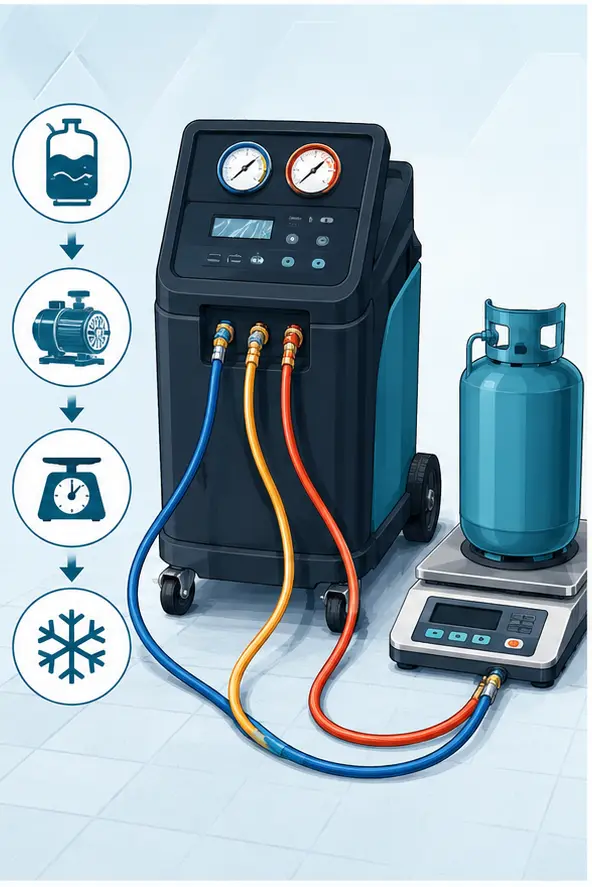
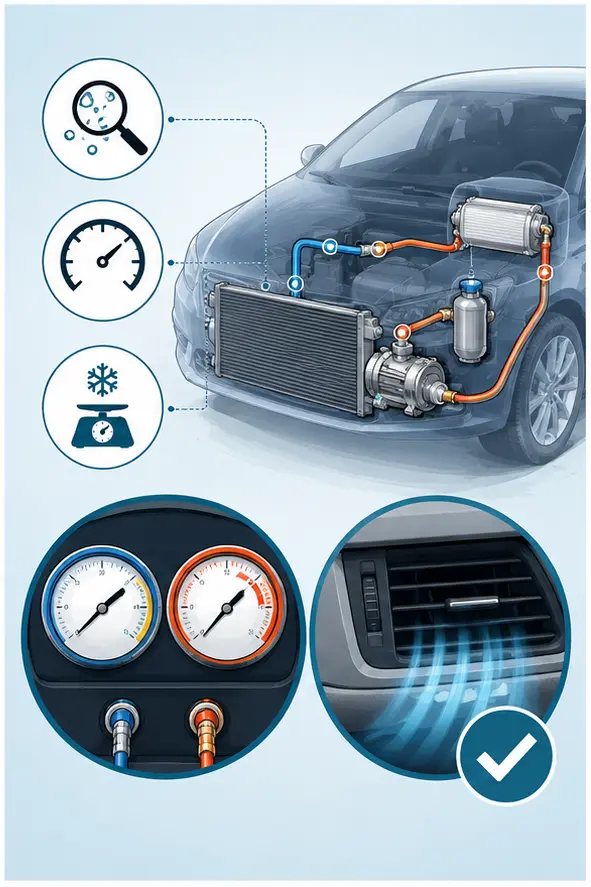
Refrigerant type and charge quantity are different answers
| Information | What it tells you | What it does not prove |
|---|---|---|
| Refrigerant type | Whether the system is designed for R134a, R1234yf or another specified refrigerant. | It does not reveal how much remains in the system. |
| Charge mass | The manufacturer-specified refrigerant quantity, normally written in grams. | It cannot be replaced by one generic amount for every car. |
| Pressure readings | How the circuit behaves under stated temperature, airflow and control conditions. | Pressure alone does not measure the refrigerant mass. |
| Vehicle year | A clue to the likely refrigerant generation. | It does not confirm market, engine, production date or previous conversion. |
Car AC gas lookup questions
These answers cover the points that most often prevent an incorrect refill.
How do I know whether my car uses R134a or R1234yf?
Use the lookup as a starting point, then read the under-bonnet AC label. If the label is missing or the result says transition or special system, confirm the specification through manufacturer data matched to the VIN.
Can I identify the gas from the model year?
Not with certainty. Model year is useful evidence, but refrigerant changes happened at different times across generations and markets. Imported and late-registered vehicles make year-only identification less reliable.
Can R134a and R1234yf be mixed?
No. They use different service requirements and must remain separate. If the existing refrigerant is unknown or contaminated, identify it before recovery or charging.
Does the lookup tell me how many grams my car needs?
No. Charge quantity can change with engine, body style, rear AC and market specification. Use the gram value on the vehicle label or exact manufacturer service data.
What if my make or model is not listed?
Select Other model after choosing the make. The tool will use a conservative year-and-market result and direct you to the label. You can also send a clear label photograph for confirmation.
Does finding the gas type mean I can refill the AC?
No. The gas type identifies the intended refrigerant. It does not diagnose why the AC is warm, whether the system leaks or how much refrigerant remains.
How this free lookup is maintained
The lookup uses conservative model-generation and market ranges checked against vehicle filling references. Current reference sources include the MAHLE refrigerant and compressor-oil filling guide and the NRF passenger-vehicle filling chart. Both sources contain model, engine and production-range distinctions that explain why a badge and registration year are not always enough.
The lookup was reviewed in September 2026. It does not replace the vehicle label, manufacturer workshop information or refrigerant identification. Results intentionally become less certain for transition years, imported cars, electric compressors, converted systems and vehicles with missing labels.
If you find a result that conflicts with a clear original vehicle label, use the label and send us the vehicle details so the lookup record can be reviewed.
Send the vehicle details before booking
Share the make, model, year, market and a clear photograph of the under-bonnet refrigerant label. Car AC Heroes can confirm the appropriate starting service before the vehicle arrives.