When Car AC Condenser Cleaning Helps in Dubai
When sand, insects and road film restrict the condenser face, careful cleaning can restore designed airflow and improve heat rejection. It is worthwhile only when contamination is confirmed and the heat exchanger is not leaking, corroded, internally restricted or paired with a fan fault.
Cleaning uses access and care rather than a replacement component.
The before-and-after result reveals whether airflow mattered.
The refrigerant circuit stays closed during external cleaning.
Leaks, weak compressors and electrical faults remain separate.
Why the condenser controls hot-weather performance
The condenser receives hot high-pressure refrigerant from the compressor and rejects that heat to outside air. Thin fins create a large surface area, while electric or engine-driven fans move air when the vehicle is stationary. If dust mats over the fins or debris fills the space between stacked heat exchangers, heat cannot leave efficiently.
In Dubai traffic, this weakness appears most clearly after a hot soak or while idling. Road speed can force more air through the front grille and temporarily improve cooling. That pattern makes airflow worth checking, but it does not prove the condenser needs cleaning. A slow fan, blocked radiator stack, incorrect refrigerant charge and internal condenser restriction can produce similar pressure behaviour.
Cleaning is inexpensive relative to major component work because the refrigerant circuit usually remains sealed. The value comes from restoring the designed external airflow without bending fins, forcing water into electrical equipment or masking an existing leak.
What Dubai contamination looks like
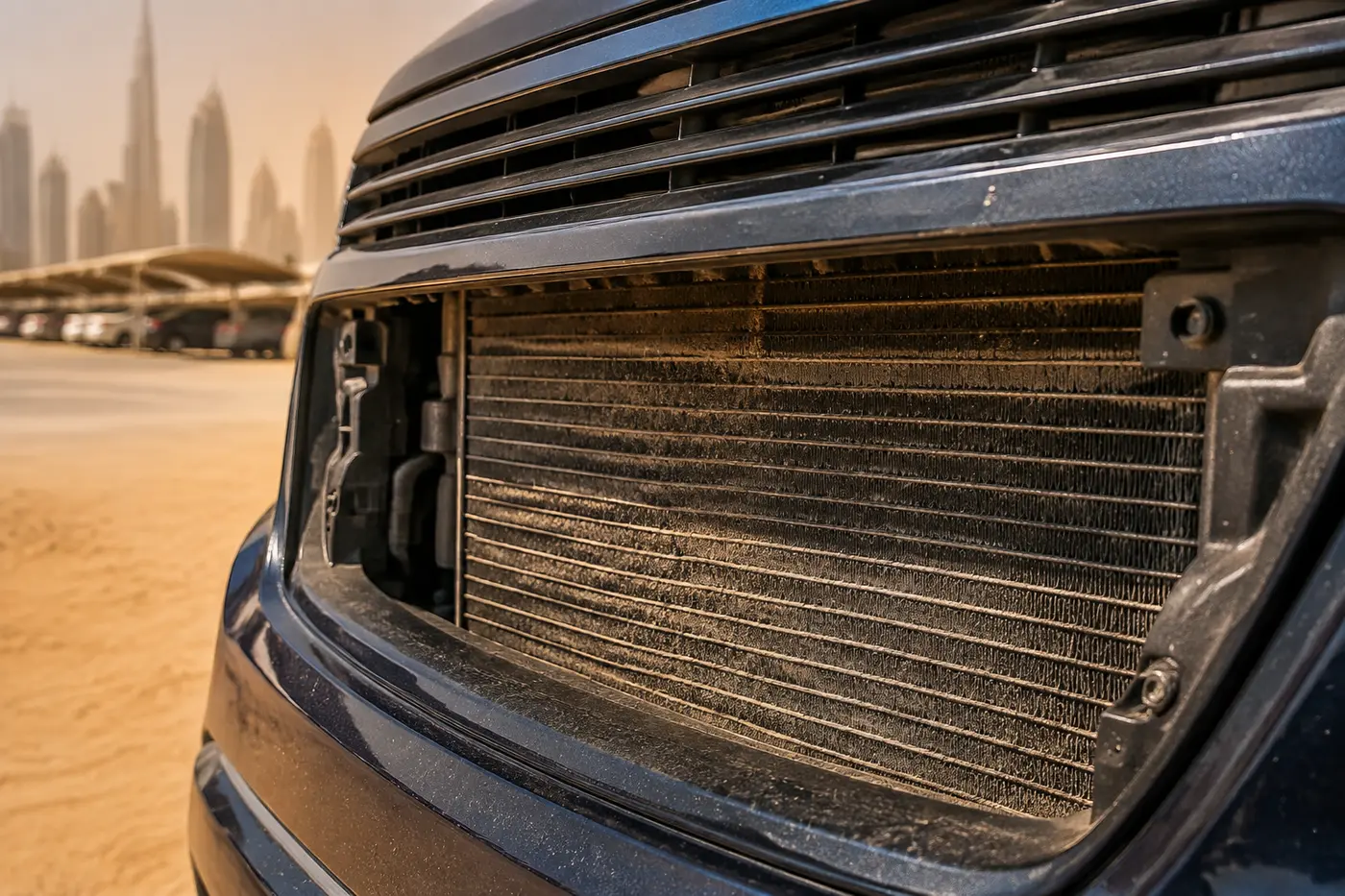
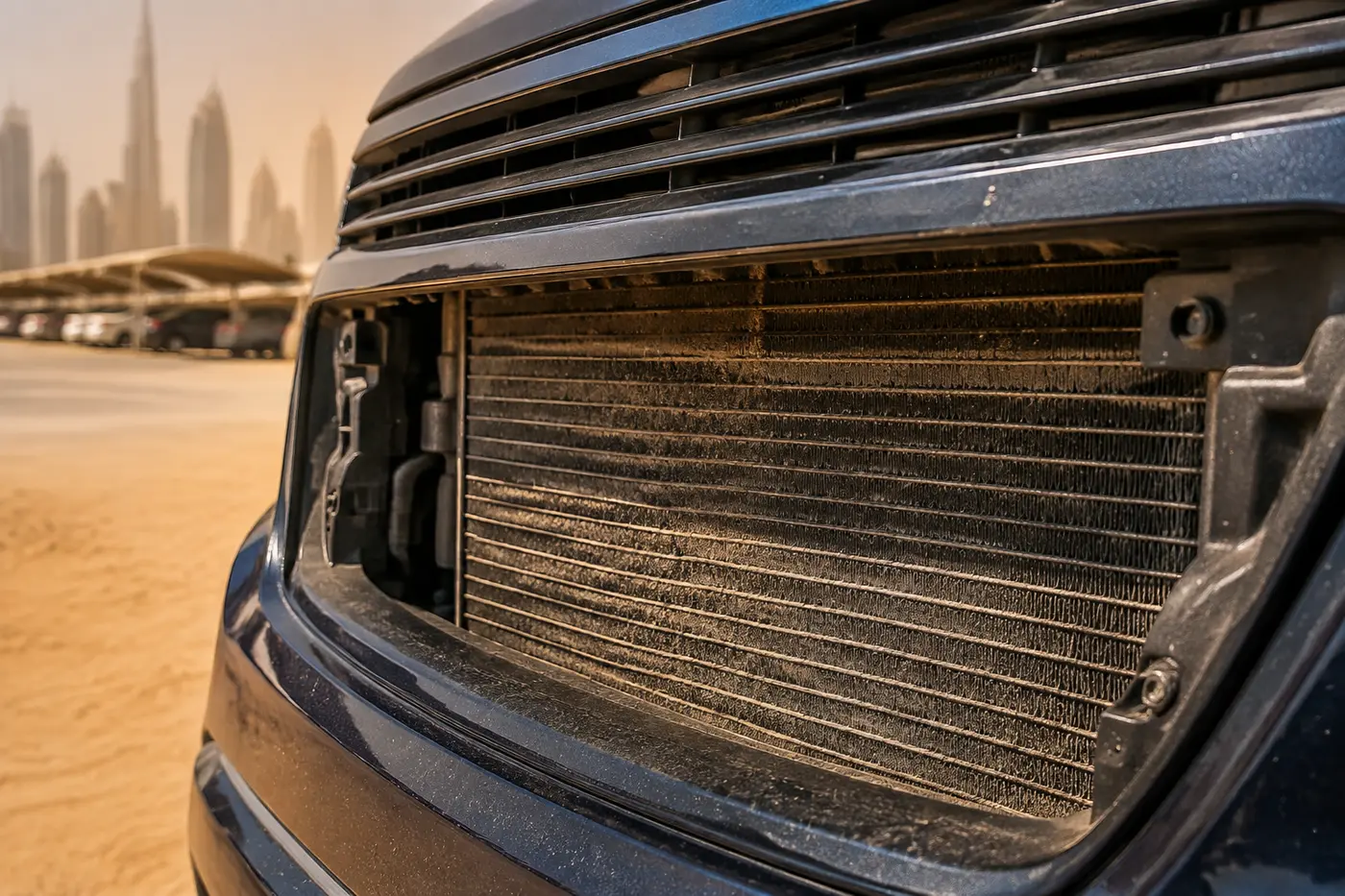
Fine airborne dust forms an even film that reduces the open area between fins. Larger sand collects at the lower edge. Insects, leaves and plastic fragments block local zones. Oil or coolant mist makes dry particles stick and can signal another leak that should be repaired before cleaning.
The visible front surface is only part of the stack. Many vehicles place a transmission cooler, intercooler, condenser and radiator close together. Debris can accumulate between them where a casual front rinse never reaches. Access must respect wiring, active grille shutters, sensors and fragile mounts.
Coastal exposure can leave deposits that retain moisture. Cleaning removes external material but cannot rebuild fins weakened by corrosion. White oxidation, oil staining, flattened fins or damaged tubes need closer inspection before water is applied.
Before and after evidence that makes cleaning worthwhile
Before cleaning
Record ambient temperature, parking exposure, vent temperature, fan speed, idle pressure behaviour and whether cooling improves at road speed. Photograph the same condenser zones. Confirm both fans respond as expected and identify any oil residue or impact damage.
After cleaning
Repeat the test after the fins are dry and the stack is reassembled. Use comparable load and settings. Improvement in pressure stability, fan effort or cabin pull-down supports an airflow benefit. No change redirects diagnosis without pretending the cleaning was a repair.
The best result is not a dramatic ice-cold claim. It is a controlled comparison. Weather and cabin heat change quickly, so the notes should state the conditions. A surface photo also prevents an old dent or corroded zone from being blamed on the cleaning process.
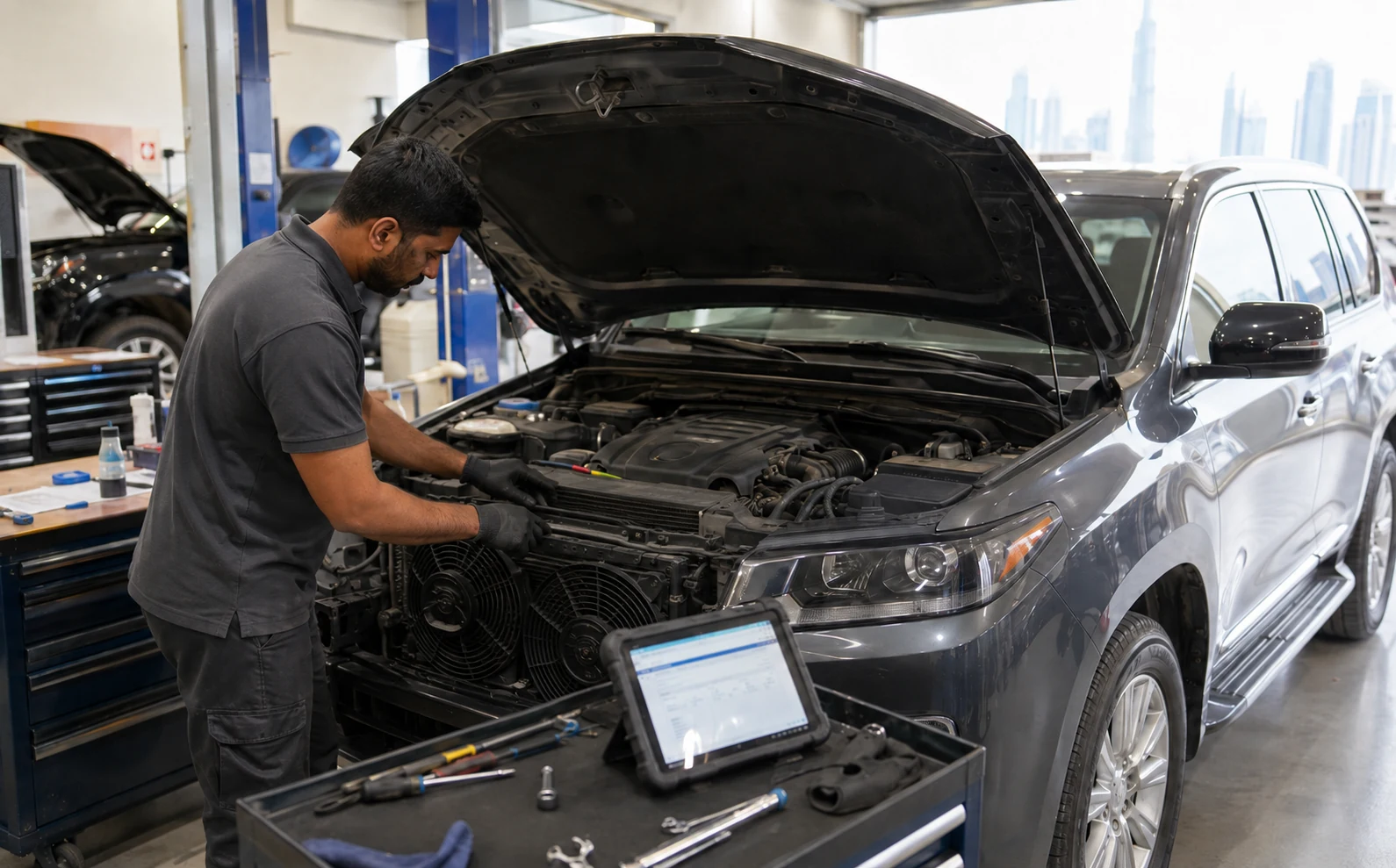
A safe professional condenser-cleaning sequence
Identify the stack
Confirm which heat exchanger is the condenser, where the fans and sensors sit, and whether access panels or grilles need removal. Let hot components cool.
Inspect before wetting
Look for oil residue, cracked tubes, loose mounts, impact marks, electrical connectors and corrosion. Photograph damage and stop if cleaning could worsen it.
Remove loose debris
Use gentle dry methods for leaves and surface material. Avoid dragging a brush across soft fins or pushing stones deeper into the stack.
Apply suitable cleaner
Use a product compatible with aluminium, coatings, paint and nearby plastics. Strong alkaline or acidic chemicals can attack fins and leave residue.
Rinse with controlled flow
Work in a direction that carries debris out rather than deeper. Keep pressure and distance safe for the fin condition. Protect connectors and modules.
Dry, inspect and retest
Confirm fins remain open, drains are clear and panels are secure. Test fan operation and AC performance under recorded conditions.
Three ways a cheap cleaning becomes an expensive mistake
A narrow pressure-washer jet can fold fins flat, reducing airflow more than the original dust. It may also drive water into fan motors, connectors or control modules.
Aggressive wheel cleaner or household acid can attack aluminium and protective coatings. Residue left between stacked cores continues reacting after the surface looks clean.
Cleaning a condenser with a fan failure, low charge or internal blockage delays the real repair. A cosmetic result is not proof of improved heat rejection.
Do not straighten extensive fin damage with improvised sharp tools. A fin comb must match the spacing and the tubes beneath must remain protected. Severe stone impact, bowed cores or leaking passages belong to the condenser repair and replacement service, not a stronger rinse.
When condenser cleaning helps and when it does not
Cleaning has the strongest case when the condenser face is visibly loaded, the fans operate, the fins are structurally sound and cooling improves with vehicle speed. A more stable high-side pressure pattern under comparable operating conditions adds supporting evidence. Vehicles used near construction, desert roads or heavy traffic can accumulate material faster than a sheltered low-mileage car.
It can also be sensible maintenance after a dusty weather period when inspection shows a real deposit. Maintenance should follow condition, not a fixed monthly upsell. A clean and open condenser does not benefit from repeated chemical washing.
When cleaning cannot solve the complaint
It cannot seal a refrigerant leak, repair a weak compressor, restore a dead fan, correct an expansion restriction or move a stuck blend door. It cannot reverse internal condenser contamination after destructive compressor failure. It cannot rebuild corroded tubes or straighten a collision-damaged mount.
The guide to AC that becomes warm during the day explains the wider diagnostic path when heat load exposes the symptom.
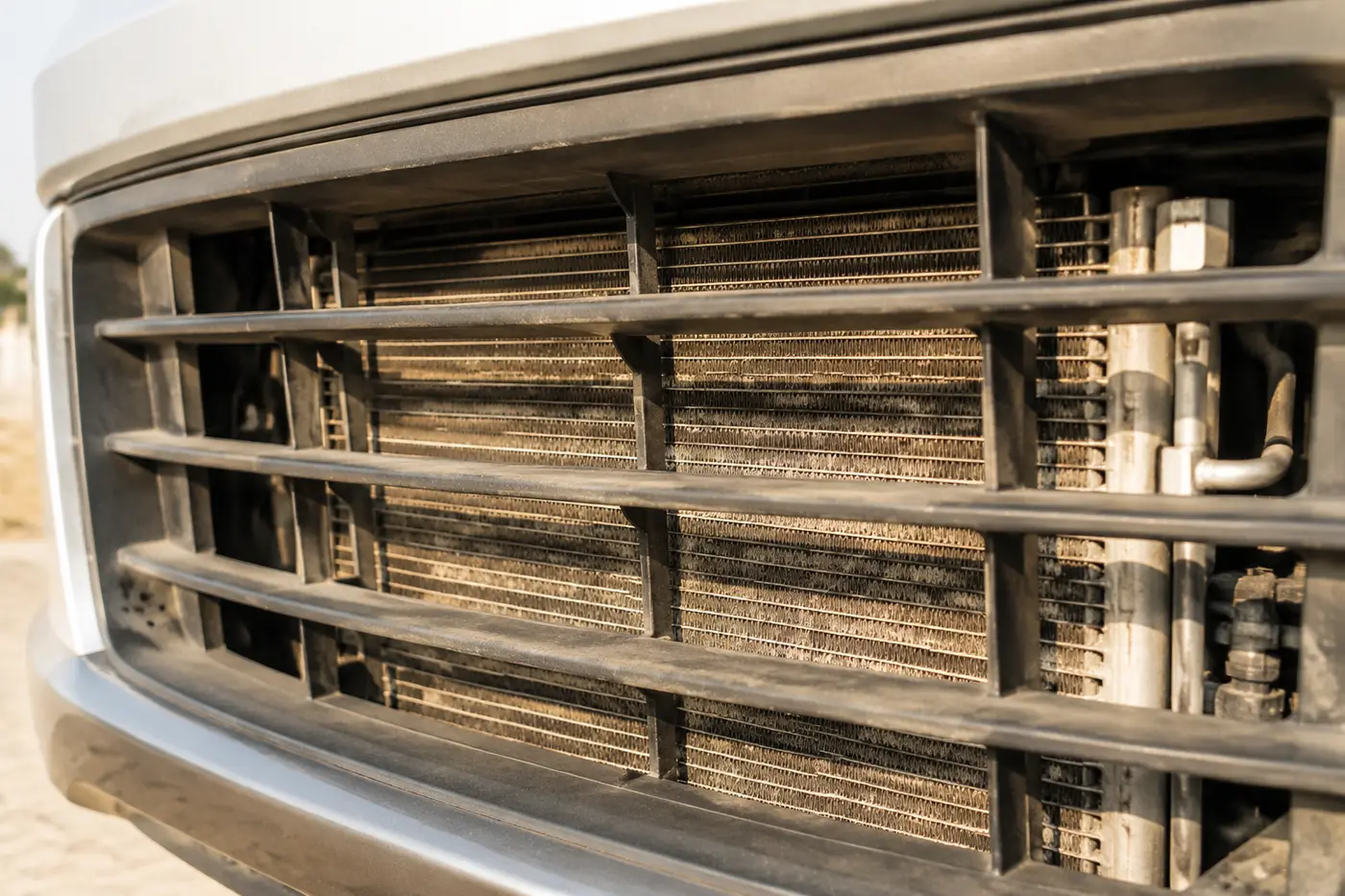
How often should the condenser be inspected
There is no defensible universal cleaning interval for every Dubai car. Inspect after significant dusty weather, construction exposure, front-end repair, a noticeable idle-versus-road cooling change or as part of a pre-summer condition check. A vehicle parked indoors and driven on clean roads may need little intervention. A fleet vehicle crossing dusty sites can need inspection much sooner.
Do not judge only by the top edge visible through the bonnet. Use safe access and lighting to view the lower corners and, where practical, the space between heat exchangers. If the bumper or active grille system must be dismantled, the inspection becomes workshop work.
The pre-summer AC check can include condenser condition, fan response and a cooling baseline without making cleaning automatic. The result should classify the stack as open, restricted, damaged or requiring deeper access.
Cleaning, repair or replacement
| Finding | Best next step | Why |
|---|---|---|
| Dry dust and insects on sound fins | Controlled external cleaning | Restores open area without opening the refrigerant circuit. |
| Folded fins without tube damage | Limited careful straightening and airflow review | Improves local passage area if the metal remains sound. |
| Oil residue at an impact mark | Leak confirmation and repair estimate | Cleaning would remove evidence but not seal the tube. |
| Weak or inactive fan | Electrical and fan diagnosis | A clean condenser still overheats without commanded airflow. |
| Internal debris after compressor failure | Vehicle-specific contamination decision | External washing cannot clear trapped refrigerant-side particles. |
| Corroded, bowed or leaking core | Repairability or replacement assessment | Structural damage sits beyond maintenance. |
Safe owner checks and professional cleaning
After the vehicle cools, inspect through the grille with a light. Remove only loose material that can be reached without forcing tools into the fins. Do not open the refrigerant circuit, place hands near a fan or assume the fan cannot start because the engine is off. Electric fans can be commanded unexpectedly.
A gentle exterior rinse may be acceptable when the vehicle manufacturer permits it and sensitive equipment is protected, but access and water direction vary. Avoid close pressure washing, harsh degreaser and spraying directly into electrical connectors. If stacked cores hide the restriction, a surface rinse can create false confidence.
After cleaning, watch the engine-temperature display as well as AC performance. The condenser and radiator share airflow. Stop if temperature rises, a fan makes contact, a warning appears or water has reached an electrical area.
What a workshop quote should include
Ask whether the service is inspection only, surface cleaning or deeper stack access. Confirm whether bumper removal, grille calibration, fin correction, fan diagnosis and before-and-after testing are included. The quote should separate cleaning from refrigerant work because a closed external clean does not require a gas refill.
If damage appears during access, the workshop should pause and obtain approval. Keep the before-and-after photos and written scope with the handover record so the result can be checked later.
Four cleaning situations that need different decisions
The car cools well on the motorway but warms in a queue
This pattern makes stationary airflow important. Inspect fan command, fan speed, shrouds and condenser restriction together. If the fan is weak, cleaning alone may create a modest improvement while leaving the primary fault. If the fan is healthy and a dust mat is documented, cleaning has a stronger case.
The front grille is dusty but cooling remains stable
A visible film is not automatically a performance restriction. Inspect the deeper fins and lower zones, then document condition. Gentle maintenance may be reasonable after heavy exposure, but repeated chemical washing adds risk without a measured benefit. Monitoring can be the correct recommendation.
The condenser has oil residue below a stone mark
Preserve the evidence. Confirm whether refrigerant oil and compatible dye are present before washing. A leak repair estimate can include external cleaning after the circuit fault is documented. Removing the residue first can make later detection harder and encourages an unnecessary refill.
The engine temperature also rises with AC
Switch the AC off and respond to the engine-temperature warning. The condenser and radiator use the same airflow path, so a blocked stack or failed fan can affect more than comfort. Diagnosis should review the complete heat-exchanger pack, fan system and cooling condition before the car returns to hot-weather traffic.
How to judge value after the service
Compare the before-and-after photographs and operating notes. The invoice should say whether access was limited to the visible face or included separation of stacked cores. It should identify any fins that remained damaged and confirm fan operation. If the performance did not change, the workshop should route the complaint toward charge, compressor, controls or cabin airflow instead of selling a second cleaning.
A good low-cost service earns its value through evidence. It either restores heat rejection or rules out external restriction with minimal disruption. Both outcomes are useful when they are recorded honestly.
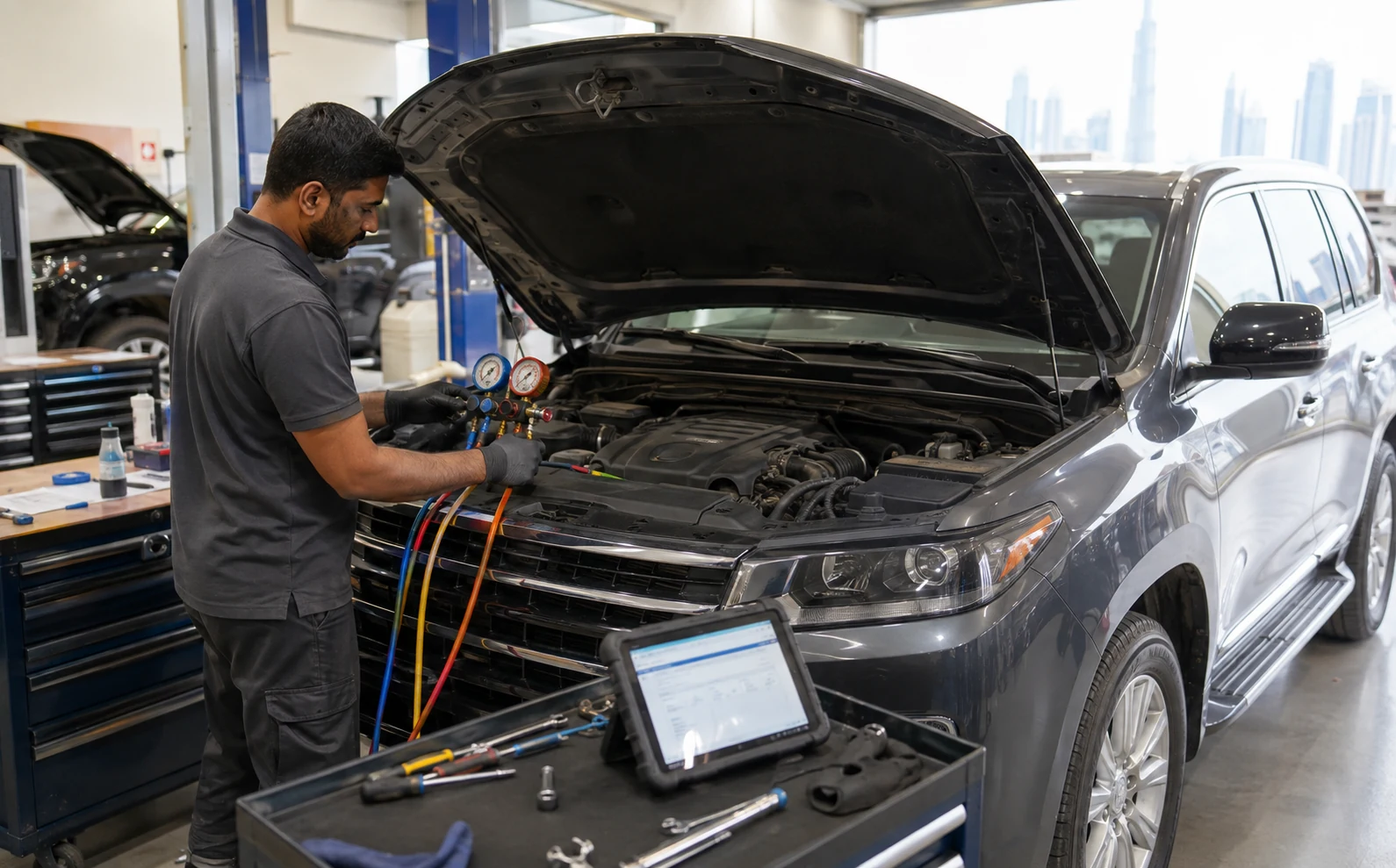
For fleets and high-dust routes
Keep inspection photos and operating notes for each vehicle. If the same restriction returns at similar mileage, on the same route or during the same season, that history can support a tailored cleaning checkpoint without turning one dusty vehicle into a rule for the whole fleet.
Car AC condenser cleaning questions
Can condenser cleaning improve car AC cooling?
Yes, when external dust, insects or debris are genuinely restricting airflow through sound fins. It will not repair a refrigerant leak, weak compressor, failed fan, internal blockage or climate-control fault.
Can you pressure-wash a car AC condenser?
A close or narrow pressure-washer jet can fold delicate fins and force water into electrical components. Cleaning pressure, direction, distance and product choice must suit the vehicle and the condition of the heat-exchanger stack.
Does condenser cleaning require a gas refill?
External cleaning normally leaves the refrigerant circuit sealed, so a gas refill is not required by default. Refrigerant work should be authorised separately only when testing supports a charge or leak problem.
How often should a condenser be inspected in Dubai?
There is no universal interval. Inspect it after heavy dust exposure, construction driving, front-end work, a pre-summer check or a repeatable change between idle and road-speed cooling.
Check condenser airflow before buying a replacement part
If cooling weakens at idle or the condenser face is visibly restricted, we can inspect the heat-exchanger stack and fan response first. The result shows whether careful cleaning is worthwhile or whether the fault belongs elsewhere.
Related Car AC Guides