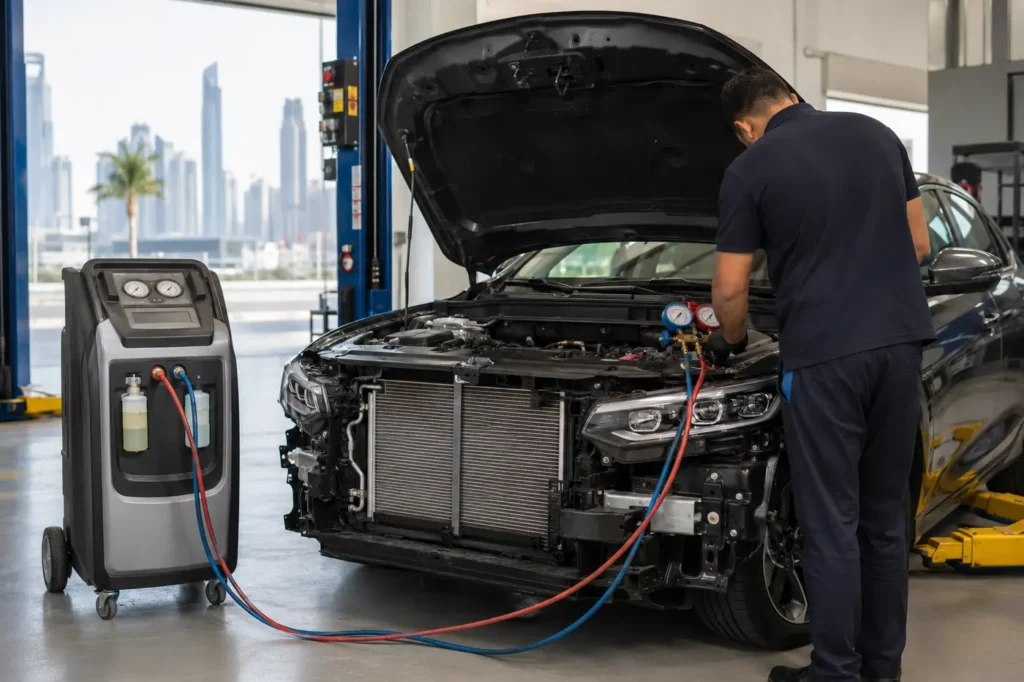
Measured diagnosis without gauge myths
What a Proper AC Diagnostic Includes and What Pressures Mean
Pressure readings are valuable only when refrigerant type, ambient heat, airflow, compressor command, line temperature and cabin performance are measured together.
Start with the relationship
Pressure is useful only when the test conditions are known
People searching for car AC pressure readings explained usually want to know whether the low-side and high-side numbers mean low gas, a restriction, a weak compressor or an airflow problem. A manifold gauge reading can narrow the diagnosis, but the same numbers can mean different things on different cars because refrigerant type, ambient heat, compressor design, blower load and condenser airflow all change the result.
The useful question is therefore not “is this one pressure normal?” but “what were both sides doing when the symptom appeared, and what else changed at the same time?” A car that cools while moving but warms at idle needs a different test from one that starts cold and fades after twenty minutes, or one that stays warm on only one side of the cabin.
If the complaint is simply weak cooling, start with our guide to a car AC that is not cold enough. Pressure testing becomes meaningful after the refrigerant identity, airflow settings and operating condition are known.
Practical pressure chart
What common low-side and high-side pressure patterns can mean
This car AC pressure chart is a diagnostic direction guide, not a universal PSI specification. On both R134a and R1234yf systems, a manifold gauge set reports low-side PSI and high-side PSI, but normal AC pressure depends on ambient temperature, refrigerant, compressor strategy, airflow and the exact running condition. R134a pressure readings should not be treated as interchangeable with R1234yf pressure readings or with another vehicle’s specification. If the refrigerant history is uncertain, see why putting R134a in an R1234yf system is not a valid shortcut.
A professional test sequence
What happens before anyone recommends a refill or compressor
The sequence matters. Airflow faults can imitate refrigerant faults, and control faults can imitate weak compressors. The recommendation should follow the branch that remains supported after the symptom is reproduced.
When refrigerant service is actually justified, recovery and measured charging equipment preserves the known system state. It is not used to keep adding gas until a gauge happens to look acceptable.
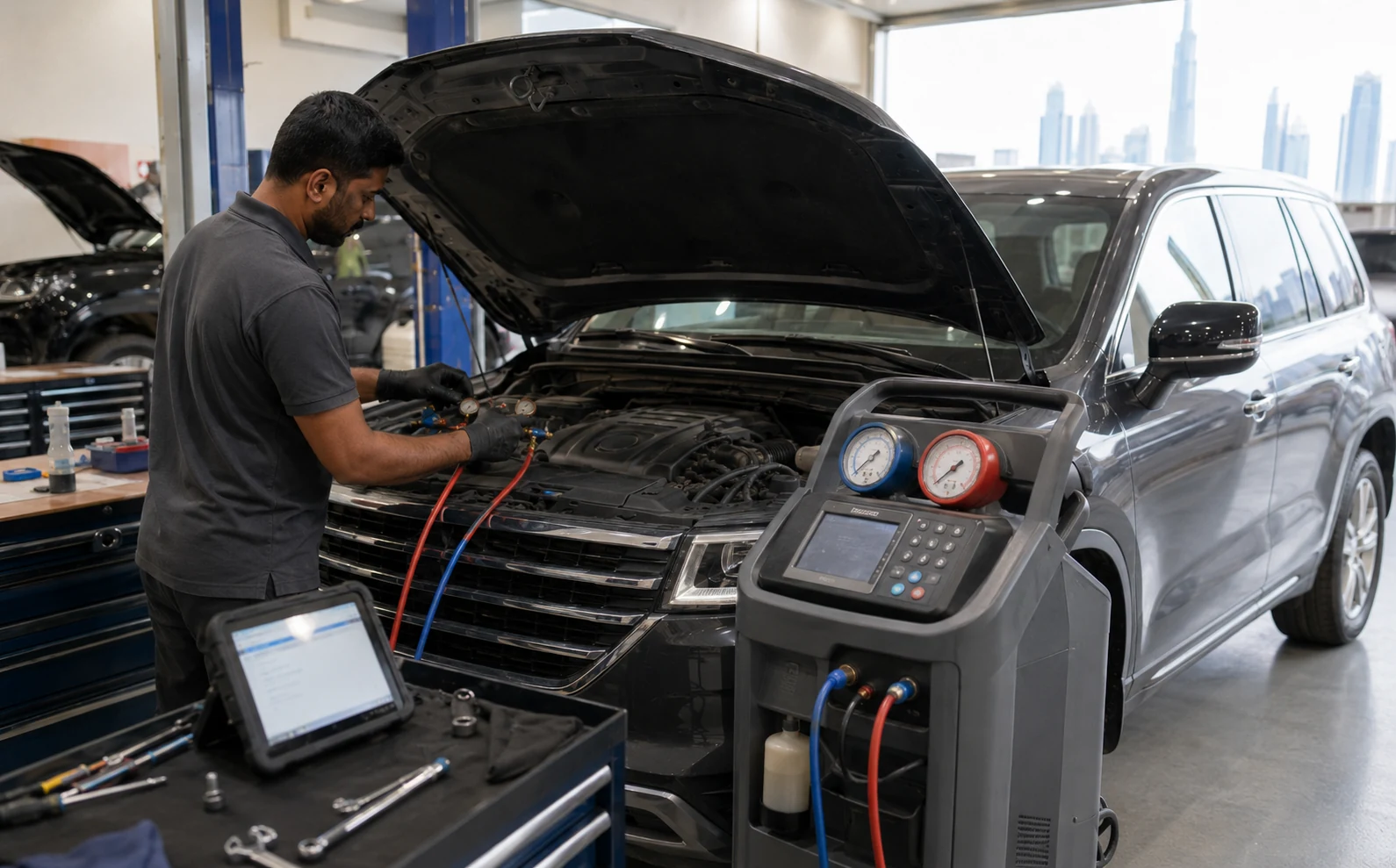
Dubai testing context
Dubai heat makes the test condition part of the diagnosis
A car brought in after sitting under direct sun is not starting from the same thermal state as one that has just left basement parking. Cabin surfaces, the evaporator housing, condenser, engine bay and refrigerant circuit can all be heat-soaked. If those conditions are not recorded, a pressure comparison can look precise while describing two different tests.
For Dubai complaints we separate hot-soak pull-down from steady-state cooling. We also compare stationary behaviour with road-speed behaviour when the customer says the AC becomes warm in traffic. If cooling improves as the vehicle moves, condenser airflow becomes an important branch; it is not automatic proof that a fan motor itself has failed.
Dust and debris on heat exchangers, weak fan performance and under-bonnet heat can become more visible when the car is stationary. The diagnostic record should therefore state whether the vehicle was sun-soaked, how long it idled, whether recirculation was selected, the blower setting, ambient conditions and when the readings were taken.
What changes the interpretation
A useful Dubai reading has a condition attached to it
“High side was high” is incomplete. “High side continued rising during a hot stationary test while vent temperature deteriorated and commanded fan response did not produce the expected airflow” is diagnostic evidence. The second statement can be retested after the suspected branch is corrected.
The same principle applies to a vehicle that cools initially and fades later. The technician keeps the test running long enough to capture the failure, then records which changed first: evaporator airflow, pressure, compressor command, sensor value or cabin outlet temperature.
This is especially important on modern variable-displacement and electric compressors because output can change without the obvious on-off cycling associated with older clutch systems.
Static AC pressure and temperature mapping
Engine-off static AC pressure can confirm presence, not charge quantity
After the system has been off long enough for both sides to approach equilibrium, static AC pressure can show that refrigerant pressure exists and can flag an obviously empty circuit. It cannot prove that the specified mass is present. A partly charged circuit may still show a plausible static value because pressure is strongly related to refrigerant temperature while liquid remains.
That is why an abnormal static value is compared with actual temperature and service history before conclusions are drawn. A recently operated or heavily heat-soaked system may not yet be equalised. Wrong refrigerant or non-condensable gas can further distort the relationship.
Temperature mapping then adds what gauges cannot: vent output, suction-line temperature and liquid-line behaviour at repeatable points. Those measurements help distinguish a refrigerant problem from restricted airflow or poor heat rejection.
Running AC pressure and dynamic control
Modern compressors may change output without switching off
Running AC pressure on variable-displacement and electrically driven systems changes as the compressor alters output. The control module may change displacement, speed or valve command according to heat load, sensor input, battery strategy and protection limits. A technician therefore compares commanded output with measured response rather than judging only whether a clutch clicks.
If command is high but the expected pressure split never develops, weak pumping, a control-valve problem, incorrect charge or a restriction may be considered. If command stays low despite a hot cabin, sensor plausibility, power management and control logic need attention. When the evidence points toward the compressor itself, our AC compressor repair and replacement page explains the next diagnostic and repair decisions.
On an EV, compressor speed and high-voltage operation can also be tied to battery thermal management. The system type has to be identified before service procedures are chosen.

Low side in context
Low-side PSI is affected by airflow, heat load and metering
The low side reflects refrigerant leaving the evaporator and returning toward the compressor. Technicians interpret low-side PSI with suction-line temperature, blower airflow, cabin load, compressor displacement and the metering device.
A restricted cabin filter can reduce heat entering the evaporator and contribute to icing even when refrigerant charge is not the primary fault. An inaccurate evaporator sensor can also make the compressor run too long or stop too early.
High side in context
High-side PSI exposes heat-rejection problems
The high side reflects compression and the system’s ability to reject heat through the condenser. If high-side PSI climbs at idle and improves with vehicle movement, condenser airflow deserves early attention. The cause can be fan speed, wiring, a control module, sensor input or restricted heat-exchanger airflow—not automatically the fan motor.
Our page on AC cooling that fails at idle covers that symptom in more detail. Refrigerant identity also matters because mixed or contaminated refrigerant can create misleading behaviour and service risks.


The electrical layer
A gauge cannot show what the control unit believes
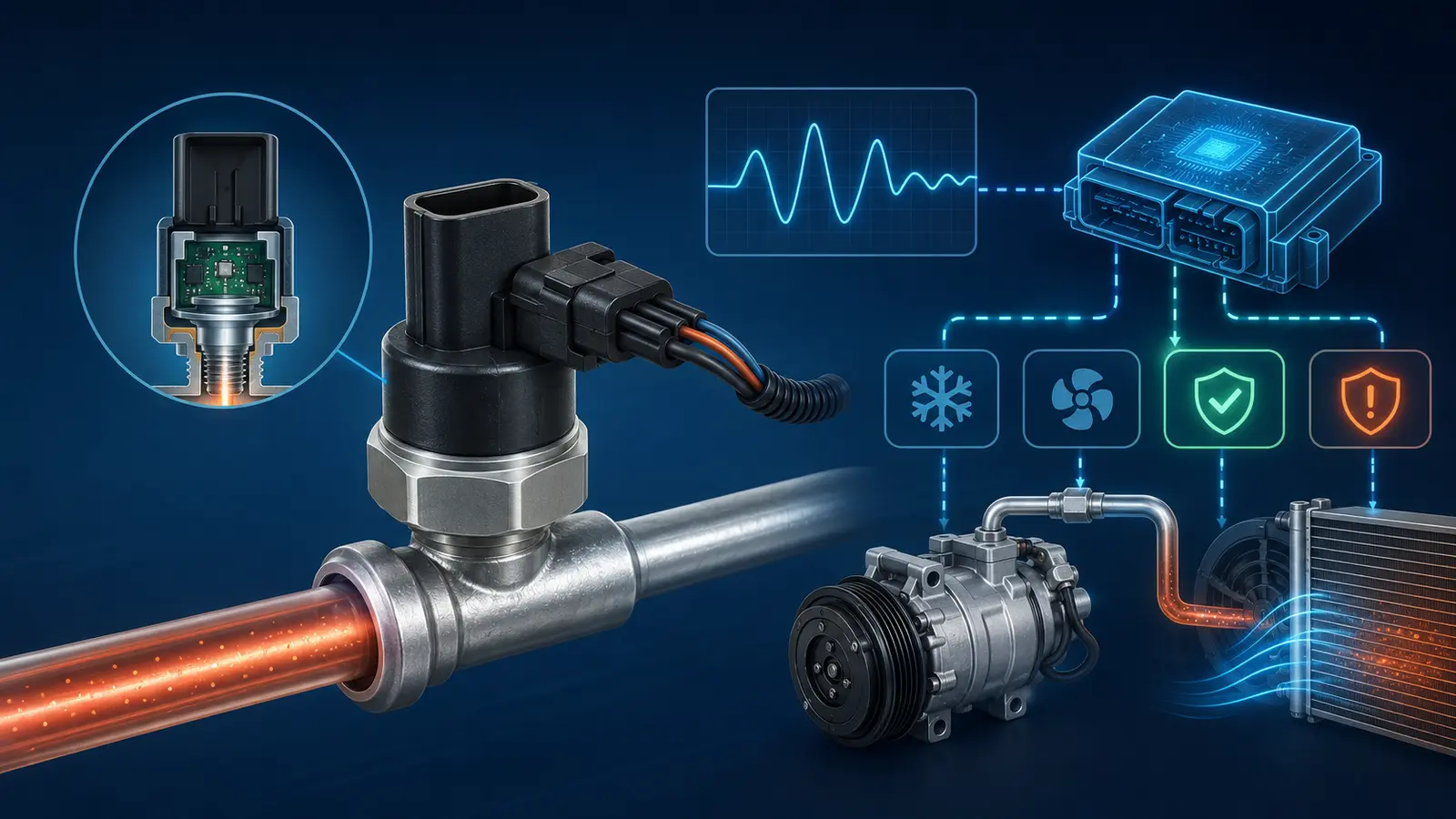
Modern climate systems use pressure, evaporator and ambient sensors to decide whether the compressor and fans should operate. A mechanical gauge reads physical port pressure; a scan tool shows the pressure value seen by the module and the commands the module is sending.
If mechanical pressure is safe but scan data reports an implausible value, the control unit may reduce or disable compressor operation to protect the system. Replacing the compressor would not correct the false input. The pressure sensor or AC pressure switch circuit must be tested according to the vehicle design.
Live recording is particularly useful for intermittent faults because it can show whether compressor command disappeared first or whether the physical pressure changed first. A full AC system diagnostic should include this electrical layer when the vehicle supports it.
First-party workshop evidence
What we actually record before turning readings into a repair decision
At the Car AC Heroes workshop route through AMF Auto Services in Al Quoz 4, the useful evidence is not a photograph of two gauges. The diagnostic record is built around the customer’s exact complaint, the condition in which it occurs and the measurements that change with that condition.
Vehicle-specific PSI figures should come from a documented job and identified service data. The useful repeatable workshop logic is that the complaint, test condition, changing measurements and confirmation must agree.
Recurring workshop patterns
Four symptom patterns that change the next test
Cold while moving, warm at traffic lights
We compare stationary high-side behaviour, fan command and actual condenser airflow before considering refrigerant or compressor work.
Cold at first, then gradually fades
We keep the system operating until the failure appears and compare evaporator airflow, icing, sensor behaviour and compressor response at that moment.
Cooling returned after gas, then became weak again
We do not assume another refill is the answer. Charge history and leak evidence move ahead of repeated topping-up. If loss is supported, the next branch is AC leak detection and repair.
Pressures look plausible but one side stays warm
Vent mapping and HVAC actuator or sensor data are checked before the sealed refrigerant circuit is opened.
These are recurring diagnostic patterns from the workshop workflow, not fabricated customer case studies. Their value is that each pattern tells the technician what has to be measured next.
Questions about gauge results
Car AC pressure reading questions
What pressure should my car AC show in Dubai
There is no responsible universal target. Expected readings depend on refrigerant, ambient temperature, heat load, compressor design, airflow, operating speed and manufacturer data. Compare readings only under a defined test condition.
Can correct-looking pressures still produce weak cooling
Yes. Air-mix doors, filters, blower delivery, heater influence, vent routing and sensor calibration can reduce cabin comfort while the refrigerant circuit appears plausible.
Can gauges confirm that refrigerant charge is correct
Not by themselves. Correct charge is established from the vehicle specification and appropriate recovery, evacuation and charge-by-mass procedures when service is required.
Why do pressure readings change when the car moves
Road speed changes condenser airflow, while engine speed and control strategy can also change compressor operation. A large idle-versus-road difference is useful evidence, especially for Dubai traffic complaints.
Should I use a DIY recharge can with a gauge
A single low-side gauge cannot identify refrigerant purity, specified charge mass, high-side behaviour or the reason refrigerant was lost. Incorrect refrigerant or overcharge can make the problem worse.
Get readings that lead to a repair decision
A no-cost first assessment can establish whether the complaint needs a complete pressure, temperature and control-system diagnostic.
Related Car AC Guides