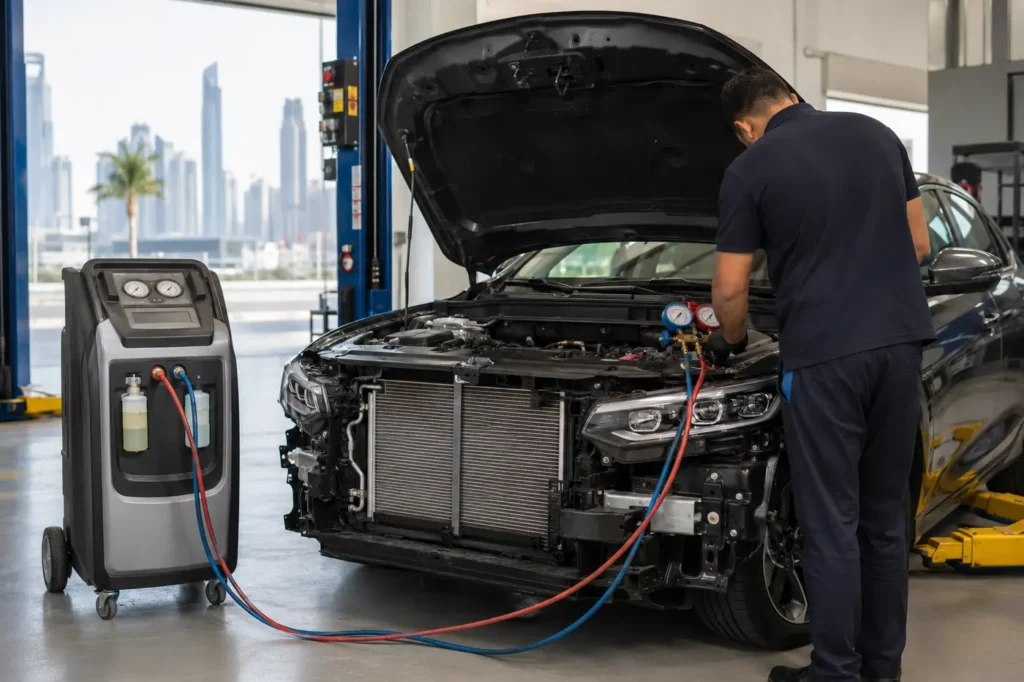
Car AC system guide
Every Car AC Part Explained and What It Does
A vehicle air-conditioning system is a chain of connected refrigerant, airflow and electronic components. A fault in one part can create symptoms that look like failure somewhere else: weak condenser airflow can imitate a compressor problem, while a blocked cabin filter can make a cold evaporator feel ineffective. This guide explains where every major car AC part sits, what it does, how it commonly fails and whether it is normally repaired, cleaned or replaced.
Car AC system at a glance
Two connected paths make the cabin comfortable
The refrigerant circuit moves heat out of the cabin. The airflow path moves cabin air across the cold evaporator and through the vents. Sensors and control electronics coordinate both paths. A useful diagnosis checks all three instead of choosing a spare part from one symptom.
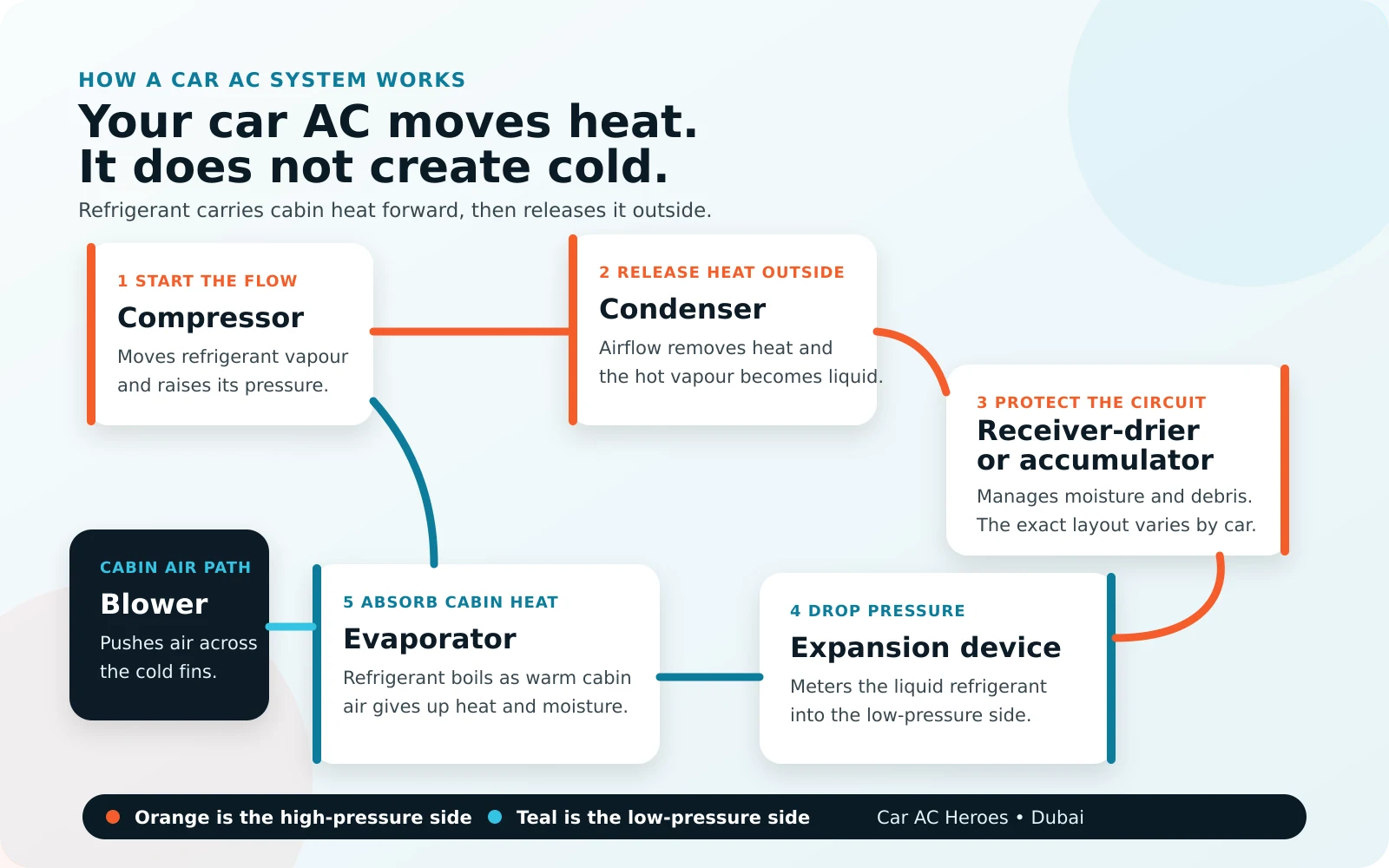
- CompressorDraws in low-pressure vapour, raises its pressure and keeps refrigerant circulating.
- CondenserReleases heat to outside air and turns hot vapour into high-pressure liquid.
- Receiver-drier or accumulatorManages moisture, debris and refrigerant condition according to the system design.
- Expansion valve or orifice tubeMeters refrigerant and creates the pressure drop needed for cooling.
- EvaporatorAbsorbs heat from cabin air as refrigerant boils, then returns vapour to the compressor.
A compressor does not blow cold air into the cabin, and refrigerant does not pass through the vents. Refrigerant carries heat inside sealed pipes. The blower moves separate cabin air across the evaporator. Read the full guide to how a car AC system works for a step-by-step view of the cycle.
Every major car AC part
What each component does, and what failure looks like
These are functional clues, not a remote diagnosis. Pressure behaviour, temperature, airflow, electrical command and the vehicle’s exact system design must be checked together before a part is condemned.
Refrigerant circuit
AC compressor
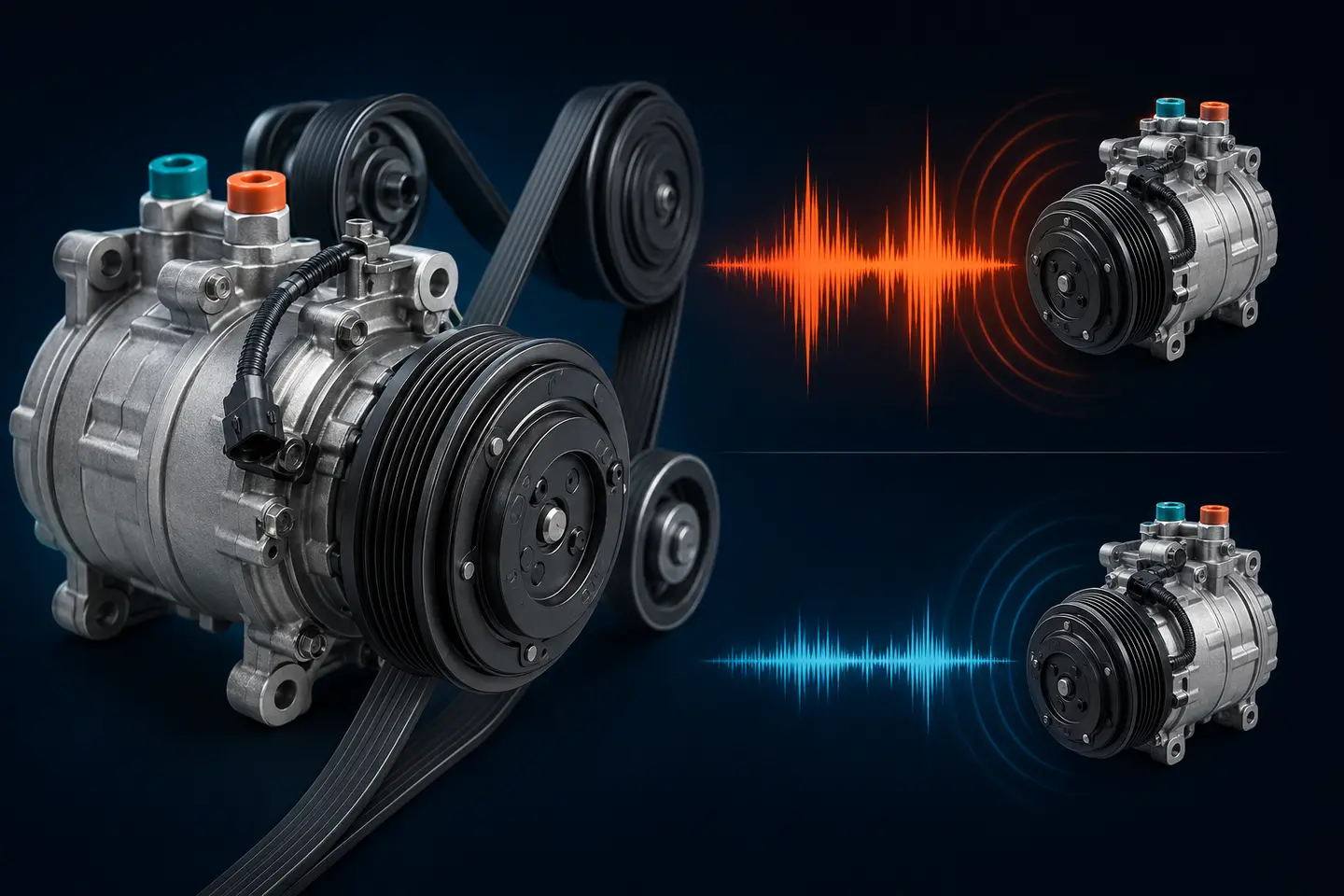
The compressor sits in the engine bay on conventional vehicles, usually driven by the engine belt. It raises refrigerant pressure and keeps it moving. Some units engage through an electromagnetic clutch; variable-displacement compressors alter output without obvious cycling. EVs and many hybrids use a high-voltage electric compressor. Correct oil quantity and grade protect its internal surfaces.
See AC compressor repair and replacement, compressor engagement faults and compressor noise diagnosis.
Heat rejection
AC condenser
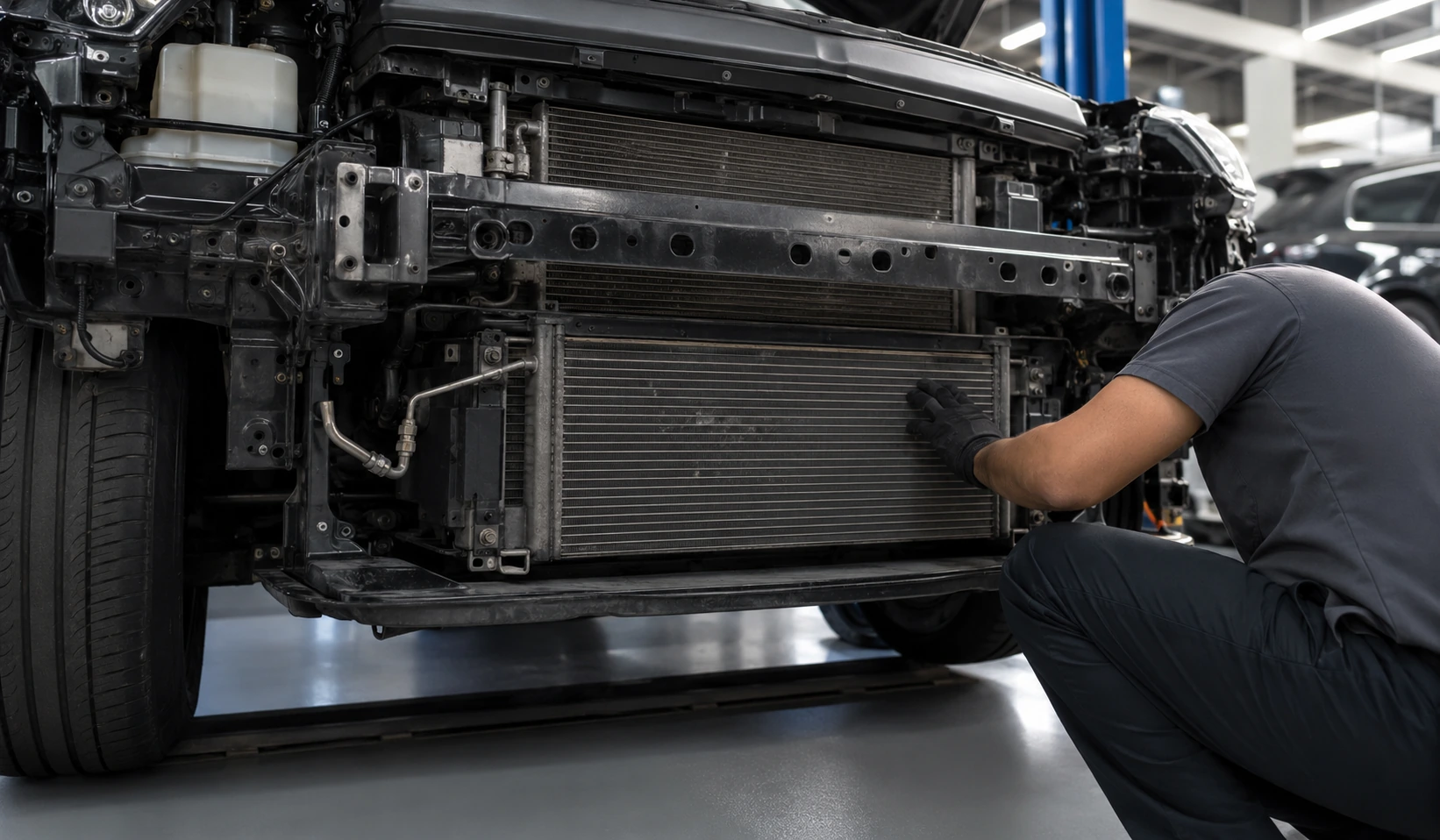
The condenser is the heat exchanger near the front of the car, commonly positioned in front of the engine radiator. Hot, high-pressure refrigerant releases heat through its tubes and fins, then condenses into liquid. It depends on road speed or the cooling fan for airflow. Dust, bent fins, impact damage and internal debris can reduce performance or raise pressure.
Is the car AC condenser the same as the AC radiator? No. People often say car AC radiator, air conditioning radiator or AC condenser radiator, but the correct AC part is the condenser. It sits beside the engine radiator and performs a similar heat-exchange job for a different circuit.
Learn about car AC condenser testing and repair, or see when condenser cleaning can help.
Cabin heat absorption
Evaporator or cooling coil
The evaporator is hidden inside the HVAC housing behind the dashboard. Low-pressure refrigerant boils inside it and absorbs heat from the air passing across its fins. Moisture also condenses on the cold surface and should drain under the car. The evaporator normally operates above freezing; a sensor or airflow fault can allow ice to form and restrict airflow.
See evaporator and cooling-coil repair or AC cleaning and odour treatment.
Pressure control
Expansion valve or metering device
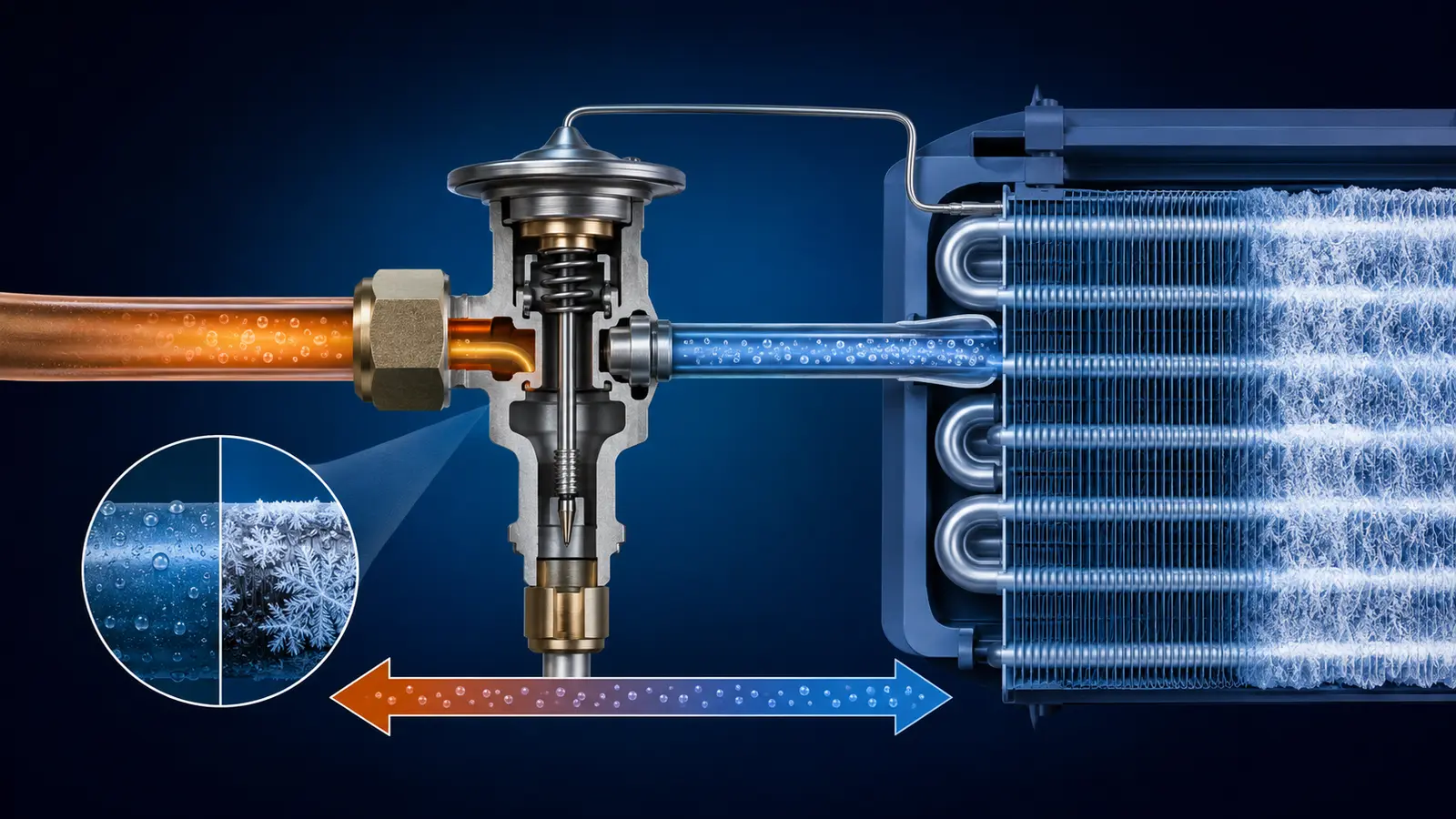
The expansion valve sits at the evaporator inlet, often at the firewall. An orifice tube is fitted in the liquid line on systems designed around a fixed restriction. Both meter refrigerant and separate the high-pressure side from the low-pressure side. A thermostatic or electronic valve adjusts flow; an orifice tube relies on other system controls.
Read about car AC expansion-valve diagnosis.
Moisture and debris control
Receiver-drier or accumulator
A receiver-drier is generally on the high-pressure liquid side of an expansion-valve system. An accumulator is on the low-pressure side of many orifice-tube systems and helps keep liquid refrigerant away from the compressor. Both may contain desiccant and filtering material, but their functions and locations are not interchangeable.
A complete AC diagnostic identifies the system architecture and whether replacement belongs in the repair scope.
Refrigerant connections
AC hoses, pipes, seals and O-rings
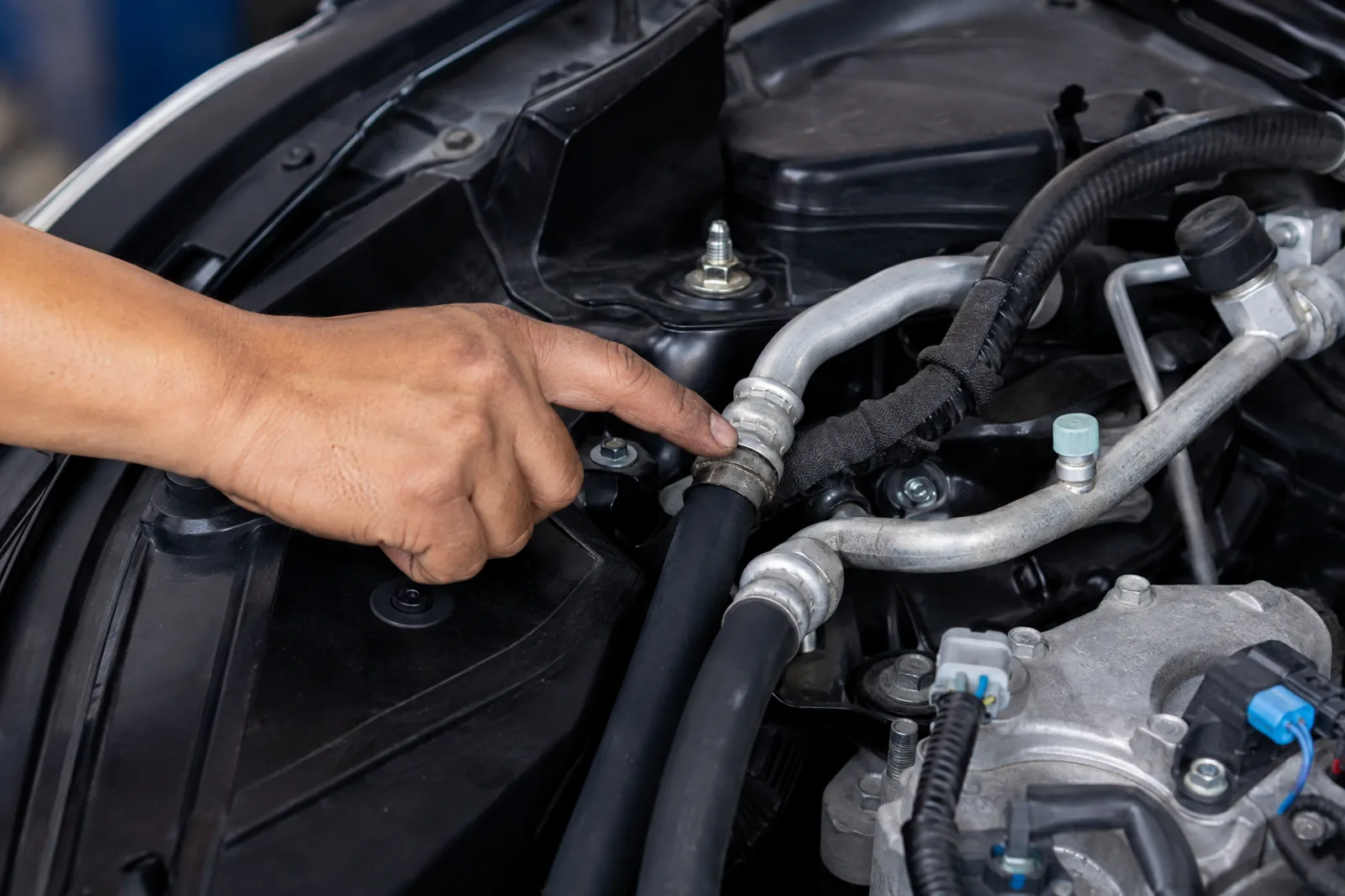
High-pressure and low-pressure lines connect the major components. Flexible rubber sections absorb engine movement; aluminium pipes carry refrigerant through tight spaces; crimped joints and O-rings seal the connections. The low side is usually larger in diameter because it carries lower-density vapour back to the compressor.
Cabin airflow
Blower motor and speed controller
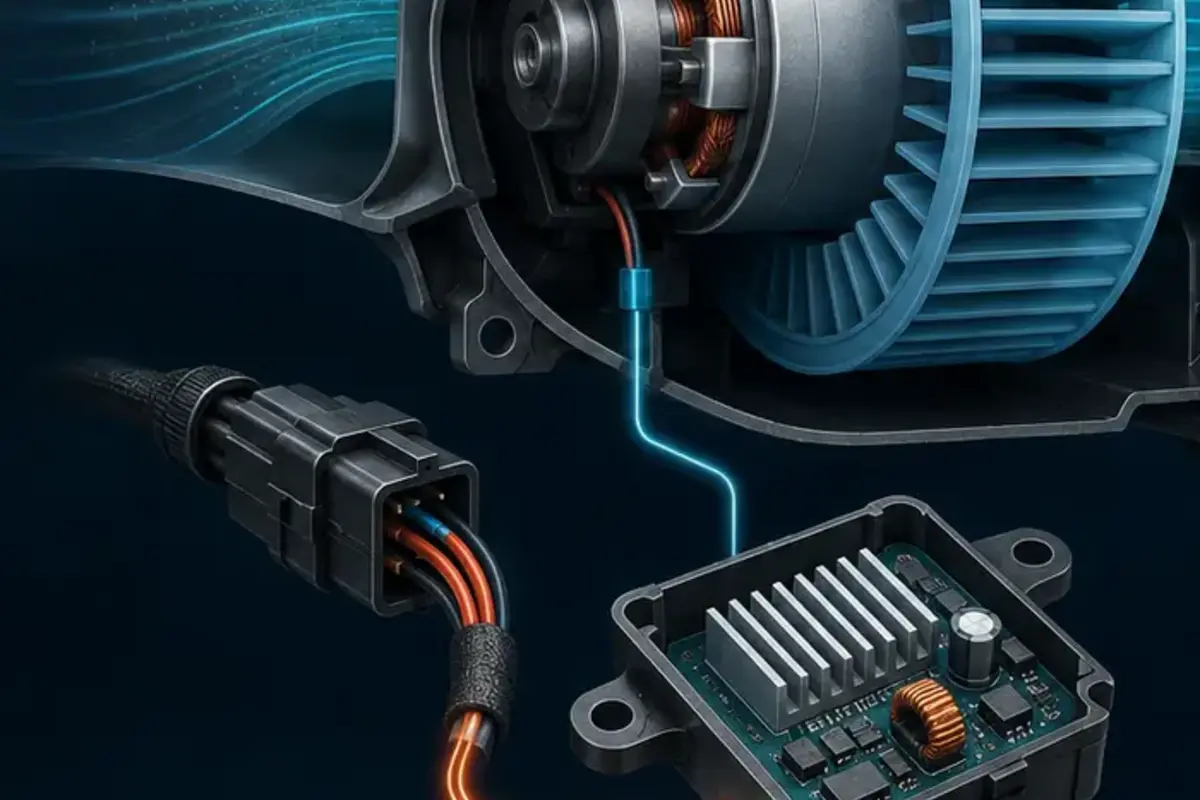
The blower motor is the fan that pushes air through the cabin filter, across the evaporator and into the ducts. Older vehicles often use a resistor pack for stepped speeds; newer systems may use an electronic power module for smooth control. It is separate from the condenser or radiator fan at the front of the car.
Visit blower motor and fan repair or troubleshoot weak airflow from the vents.
Air quality and flow
Cabin air filter
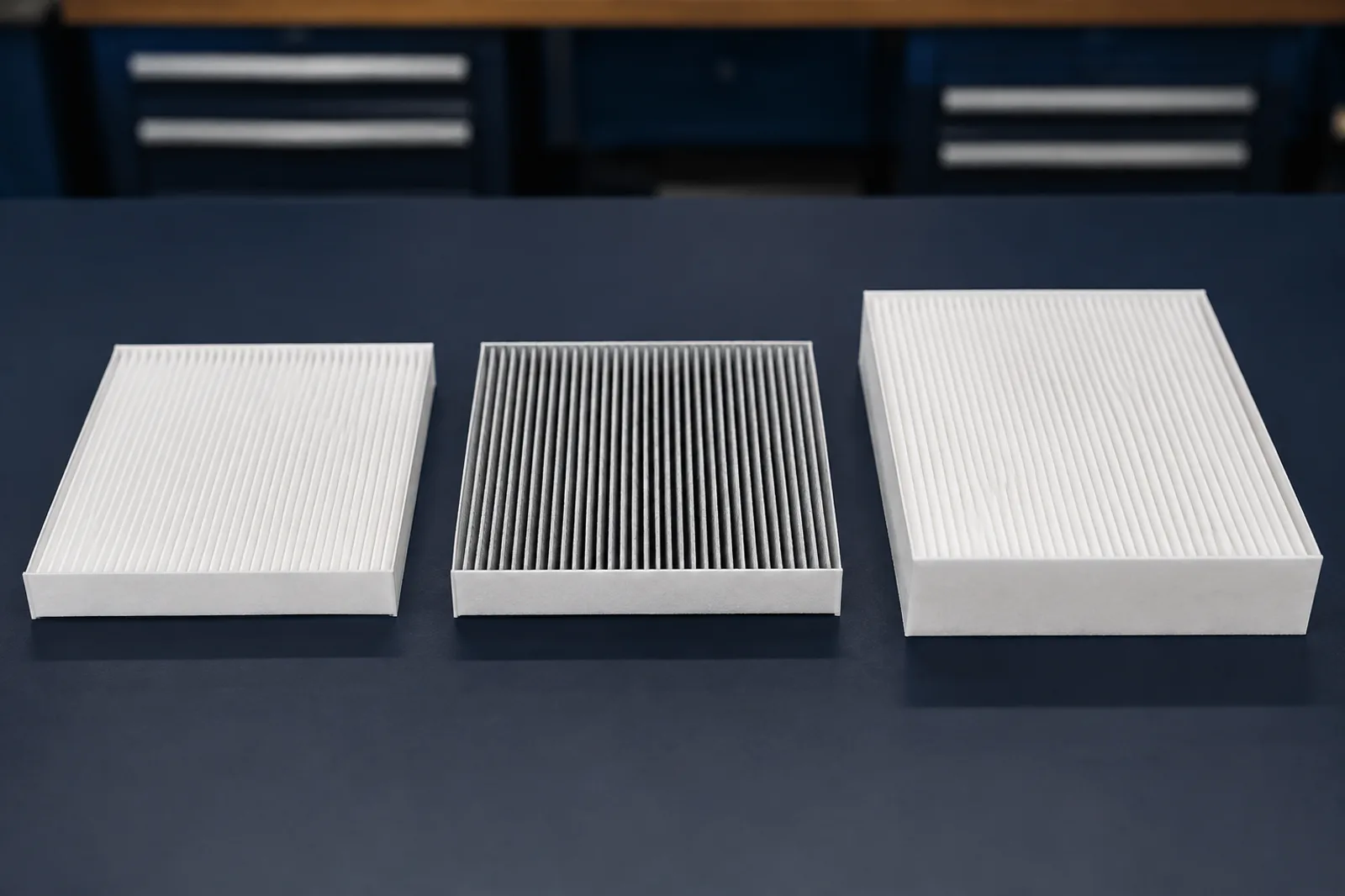
The cabin filter usually sits behind the glovebox, below the dashboard or near the fresh-air intake. It traps dust, pollen and debris before air reaches the blower and evaporator. Dubai dust can load the filter quickly, especially when the car is parked or driven near construction, desert tracks or heavy roadside dust.
Learn about cabin filter inspection and replacement.
System protection
Pressure switches and sensors
Pressure protection devices are fitted in the refrigerant circuit, often on a line or receiver. A simple switch opens or closes at defined thresholds. Newer cars commonly use an electronic pressure transducer that sends a changing signal to a control unit. That data can influence compressor output, fan speed and protective shutdown.
Freeze protection
AC thermostat or evaporator temperature sensor
The evaporator temperature sensor measures the cooling-coil temperature. Older systems may use a mechanical thermostat or cycling logic; newer climate-control systems use sensor data to adjust compressor request or displacement. Its protective purpose is to keep the evaporator cold without allowing it to freeze into a block of ice.
Read about car AC thermostat and temperature-sensor faults.
Electronic coordination
Climate control module and HVAC panel
The climate-control module interprets the driver’s temperature request and inputs from cabin, ambient, sunload, pressure and evaporator sensors. It may command the compressor, blower, cooling fans and air-door actuators. In modern vehicles it also exchanges information over the CAN network with engine, body and high-voltage control units.
Temperature and direction
Blend doors and air-distribution actuators
Doors inside the HVAC case mix cooled and heated air, select recirculation, and route airflow to the face, feet or windscreen. Small electric actuators move them. Dual-zone systems use separate doors or control paths so the driver and passenger can request different temperatures.
Use the guides for AC cold on one side only and clicking when the AC is on.
Low-speed heat rejection
Condenser or radiator cooling fan
The electric fan pulls or pushes outside air through the condenser when the car is stationary or moving slowly. Many cars share one fan assembly between the condenser and engine radiator. Control can involve relays, resistors, electronic fan modules, variable-speed commands and temperature or pressure inputs.
See why car AC can become warm at idle and how the condenser depends on airflow.
Heat-carrying fluid
Refrigerant
Refrigerant is not a mechanical part, but the system cannot move heat without the correct type and measured charge. R134a and R1234yf have different equipment, service and safety requirements. The label under the bonnet identifies the specified refrigerant and charge. They should never be casually mixed or substituted.
Compare R134a and R1234yf, see car AC gas refill or visit the R1234yf service guide.
Internal lubrication
Compressor oil
Specialised oil lubricates compressor bearings, pistons, scrolls or other internal surfaces. A controlled amount circulates with refrigerant and returns through the circuit. The vehicle and compressor specify the oil chemistry and quantity. Hybrid and EV electric compressors may require oil with particular electrical-insulation properties.
For a system-level assessment, book car AC diagnostics before authorising compressor work.
Typical UAE part prices
What car AC parts commonly cost before installation
These ranges are a useful starting point for standard passenger vehicles. The exact price depends on the VIN, brand, genuine or aftermarket choice, refrigerant, electrical design and current UAE stock. Luxury, rare and high-voltage components can cost considerably more.
| Car AC part | Typical AED range | What changes the price | Compatibility check |
|---|---|---|---|
| AC compressor | AED 450 to 1,800 | Drive type, control valve, clutch, genuine or aftermarket choice and contamination scope. | Check exact price |
| AC condenser | AED 300 to 1,000 | Vehicle size, integrated drier, sensor ports, heat-exchange design and brand. | Check exact price |
| Evaporator or cooling coil | AED 250 to 2,500 | Genuine versus aftermarket supply, HVAC-case design and premium-vehicle application. | Check exact price |
| Expansion valve | AED 80 to 250 | Mechanical or electronic control, port arrangement and manufacturer. | Check exact price |
| Receiver-drier or accumulator | AED 50 to 300 | Separate canister versus integrated design, capacity, ports and desiccant specification. | Check exact price |
| AC hose or aluminium pipe | AED 100 to 400 | Length, pressure side, sensor fittings, mufflers, crimp type and genuine assembly availability. | Check exact price |
| Blower motor | AED 160 to 750 | Motor only versus housing assembly, integrated controller and premium-brand application. | Check exact price |
| Cabin air filter | AED 60 to 350 | Standard, activated-carbon or fine-particle media and genuine-brand packaging. | Check exact price |
| Pressure switch or sensor | AED 50 to 200 | Switch versus electronic transducer, pressure range, connector and OE supplier. | Check exact price |
| Evaporator temperature sensor | AED 60 to 250 | Sensor design, harness inclusion, access position and manufacturer. | Check exact price |
| Blend-door actuator | AED 200 to 450 | Number of zones, actuator position, calibration needs and genuine or aftermarket supply. | Check exact price |
| Condenser cooling fan | AED 200 to 900 | Motor only versus complete shroud, single or twin fan and integrated control module. | Check exact price |
| Climate-control module or panel | AED 400 to 2,800 | New, used or remanufactured condition, display and button assembly, programming and vehicle options. | Check exact price |
| Compressor oil | AED 50 to 450 | PAG or POE chemistry, viscosity, electrical requirements, brand and container size. | Check exact price |
R134a and R1234yf service requires the correct vehicle specification, measured charge and appropriate handling equipment. A low charge should trigger leak assessment rather than an unmeasured top-up. Use the car AC gas refill guide or compare R134a and R1234yf.
Market reference points were checked against current UAE supplier and retailer listings from Yellow Pages UAE, Parts7 UAE, European Auto Spares and Partfinder UAE. These are indicative market bands, not a quotation or stock promise.
Which car AC part is faulty?
Symptoms by component path
Use the pattern to decide what deserves testing. No single row confirms a failed part, because several components can produce the same cabin symptom.
| What you notice | Possible component paths | Useful next guide |
|---|---|---|
| No cold air | Low refrigerant, compressor or command fault, poor condenser airflow, expansion restriction, sensor or blend-door problem. | Run the free symptom checker or see full diagnostics. |
| Weak airflow | Loaded cabin filter, blower motor or controller, evaporator contamination or icing, duct or air-door restriction. | Weak airflow causes |
| Cold while driving, warm at idle | Condenser fan, restricted condenser face, high system pressure or a charge/control fault exposed by low airflow. | AC warm at idle |
| Cold on one side only | Blend-door actuator, zone-temperature sensor, calibration or low refrigerant causing uneven evaporator performance on some systems. | One-side cooling guide |
| Hissing sound | Normal pressure equalisation after shutdown, expansion-device noise, a restriction or an active leak. | Leak detection |
| Water inside the cabin | Blocked evaporator drain, disconnected drain, damaged housing seal or water entering from another body drain. | Evaporator and drain checks |
| Vinegar or musty smell | Microbial contamination on the evaporator, a damp cabin filter, retained moisture or a drainage problem. | AC cleaning and smell removal |
| Clicking behind the dashboard | Blend or distribution actuator gears, a door obstruction, lost calibration or another dashboard mechanism. | Clicking-noise guide |
Diagnose Your Car AC Online for Free
The guided tool asks for your vehicle, year and symptoms, then narrows the likely diagnostic paths and prepares a useful summary before a workshop test. It does not pretend to confirm a part remotely.
Repair or replace?
The failure mode matters more than the part name
Diagnosis should identify the failed component, the reason it failed and any connected contamination or control problem before replacement. Otherwise a new part can be fitted into the same condition that damaged the old one.
Sometimes repairable
Repair can be sensible when the failed area is accessible, the original assembly remains structurally sound and a tested repair restores proper specification.
- AC hoses and some aluminium pipes
- Wiring, terminals, grounds and connectors
- Compressor clutch or coil on serviceable designs
- Some climate-control modules and panels
- Dirty condenser fins, evaporator surfaces or drains
Often replaced after confirmation
Sealed, contaminated, internally worn or calibration-critical components are commonly replaced because a local repair would not reliably restore function.
- Stuck or contaminated expansion valves
- Badly damaged or internally blocked condensers
- Moisture-saturated or contaminated receiver-driers
- Failed pressure or temperature sensors
- Severely leaking evaporators
- Compressors with major internal wear or seizure
Before choosing a unit, compare repairing versus replacing an AC compressor. If replacement is confirmed, the OEM versus aftermarket compressor guide explains the quality and labour-risk decision.
OEM vs aftermarket AC parts
Choose by specification, supplier and labour risk
Aftermarket does not automatically mean poor quality, and a manufacturer logo does not remove the need to verify the exact part number. The best auto AC parts in Dubai are the parts that match the vehicle, pressure rating, refrigerant, electrical design and installation requirements.
Compatibility goes beyond dimensions. A condenser needs correct ports and heat-exchange capacity. Hoses and seals need the right materials and pressure tolerance. A compressor must match mounting, pulley or high-voltage design, control valve, oil and refrigerant. On dashboard-intensive work, saving a small amount on a questionable evaporator can expose the owner to the same large labour cost again. Ask what brand and part number are quoted, whether seals and related drier work are included, what warranty applies to parts and labour, and what caused the original failure.

EV and hybrid AC parts
Electric compressors change the safety and lubrication rules
Many hybrid and electric vehicles use an electrically driven compressor instead of a belt-driven unit. This allows cabin or battery cooling while the combustion engine is off, but it also introduces high-voltage isolation requirements. The specified compressor oil may need carefully controlled electrical properties; contamination with a conventional oil can be unsafe or damaging.
Some vehicles use the refrigerant circuit to cool a battery chiller as well as the cabin. Others use a reversible heat-pump system for heating and cooling. Valves, sensors and control software can therefore manage several thermal demands. Diagnosis needs the correct isolation procedure, equipment, refrigerant and model information.
- High-voltage electric compressor
- Vehicle-specific insulating oil
- Battery or power-electronics chiller on some platforms
- Heat-pump valves and controls on some EVs
Dubai-specific failure factors
Heat and dust remove the system’s spare capacity
Dubai does not change the refrigeration cycle, but local conditions make marginal car air conditioning parts more obvious. The most useful test reproduces the complaint at the temperature, traffic and fan conditions where it occurs.
Car AC parts FAQ
Short answers to common component questions
These answers explain the system without turning a symptom into a guessed parts order.
What are the main parts of a car AC system?
The core refrigerant parts are the compressor, condenser, receiver-drier or accumulator, expansion valve or orifice tube, evaporator, hoses and refrigerant. The blower motor, cabin filter, vents, doors, fans, sensors and climate-control electronics manage airflow and operation.
What is the most expensive car AC part?
The compressor is often one of the costliest individual parts. However, total repair cost also depends on labour and related work. A hidden evaporator may cost more overall because dashboard access is extensive, while compressor contamination may require several connected components to be cleaned or replaced.
Is the AC condenser the same as the radiator?
No. The condenser carries AC refrigerant and rejects cabin heat. The engine radiator carries engine coolant. They often sit together at the front and may share cooling fans, which is why the condenser is informally called a car AC radiator.
What part makes air blow through the vents?
The blower motor creates cabin airflow. The cabin filter, evaporator condition, ducts and air doors determine how much of that airflow reaches each vent. The front cooling fan does not blow air into the cabin.
What part actually makes the air cold?
No single part works alone. Heat is absorbed from cabin air at the evaporator, while the compressor creates circulation and pressure difference, the expansion device meters flow, and the condenser releases heat outside.
Can one bad AC part damage another?
Yes. A failed condenser fan can raise pressure and compressor load. Internal compressor debris can contaminate the condenser and expansion device. Low refrigerant can reduce oil return. Burnt blower connectors can damage a new motor if the underlying current problem is ignored.
Can a compressor be repaired instead of replaced?
Sometimes. A serviceable clutch, coil, control valve, bearing or external seal may allow a targeted repair on certain designs. Internal wear, seizure or widespread contamination usually makes replacement the more reliable decision. Testing must identify the failure first.
Why does car AC gas keep getting low?
Refrigerant circulates in a sealed system and is not normally consumed. Repeated low charge usually means a leak or an earlier incorrect service. Leak location and repair need to be confirmed before another measured refill.
How do I know which AC part is faulty?
Start with the exact pattern: airflow strength, vent temperature, idle versus road speed, time until failure, one side versus both, sounds, smells, water and recent refill history. Then compare airflow, pressures, temperatures, commands and electrical response. The free online symptom checker can organise those clues before workshop diagnosis.
Are car AC parts different for R134a and R1234yf systems?
Many component designs look similar, but seals, service ports, labels, equipment, oil and certification requirements can differ. Parts and procedures must be matched to the vehicle’s specified refrigerant. The gases should not be mixed.
Are EV AC parts different from petrol cars?
Some are. EVs and hybrids commonly use high-voltage electric compressors, specific oils and additional thermal-management parts for batteries or power electronics. Some also use heat pumps. Safe diagnosis requires the exact vehicle procedure and electrical isolation controls.
Related Car AC Guides