Dubai climate field guide
Why Car ACs Fail Faster in Dubai’s Heat
Extreme ambient heat does not invent faults. It removes the spare cooling capacity that lets a weak fan, dirty condenser, low refrigerant charge or restricted filter stay unnoticed in milder weather.
That difference matters. “Dubai heat damaged my compressor” is often too simple. The compressor may be worn, but the confirming story could involve a condenser fan that is slow at idle, an incorrect refrigerant charge, contamination, a sensor input, or a cabin filter that leaves too little air crossing the evaporator. Replacing the loudest or most expensive component without testing the complete operating condition can miss the reason it struggled.
The most useful question is not whether the AC feels cold at one moment. It is whether the system can pull down a hot-soaked cabin, hold cooling at idle, maintain airflow through a longer drive, remove moisture, and do all of that without abnormal pressure, cycling, noise or warnings.

The National Center of Meteorology recorded and forecast temperatures in the mid-to-high 40s during the current UAE summer period. An SAE study of high-ambient vehicle air conditioning also notes that conventional systems can lose performance above 45°C, with outcomes affected by vehicle speed, duct design, compressor performance and refrigerant flow. That does not mean every car should cool identically at 45°C. It means test conditions have to be recorded.
Dubai does not create one problem. It stacks several loads
The AC cycle has one central job: absorb cabin heat at the evaporator and reject it outside at the condenser. Dubai makes both sides more demanding at once. The evaporator sees hotter incoming air and hotter cabin surfaces. The condenser has to release heat into hotter ambient air. When airflow, charge quantity or control is only slightly wrong, the available margin disappears.
Glass admits solar energy and interior materials store it. Opening the door does not instantly remove heat held by the dashboard, seats, roof lining and glass. Those surfaces continue warming the air after the first burst of trapped heat escapes.
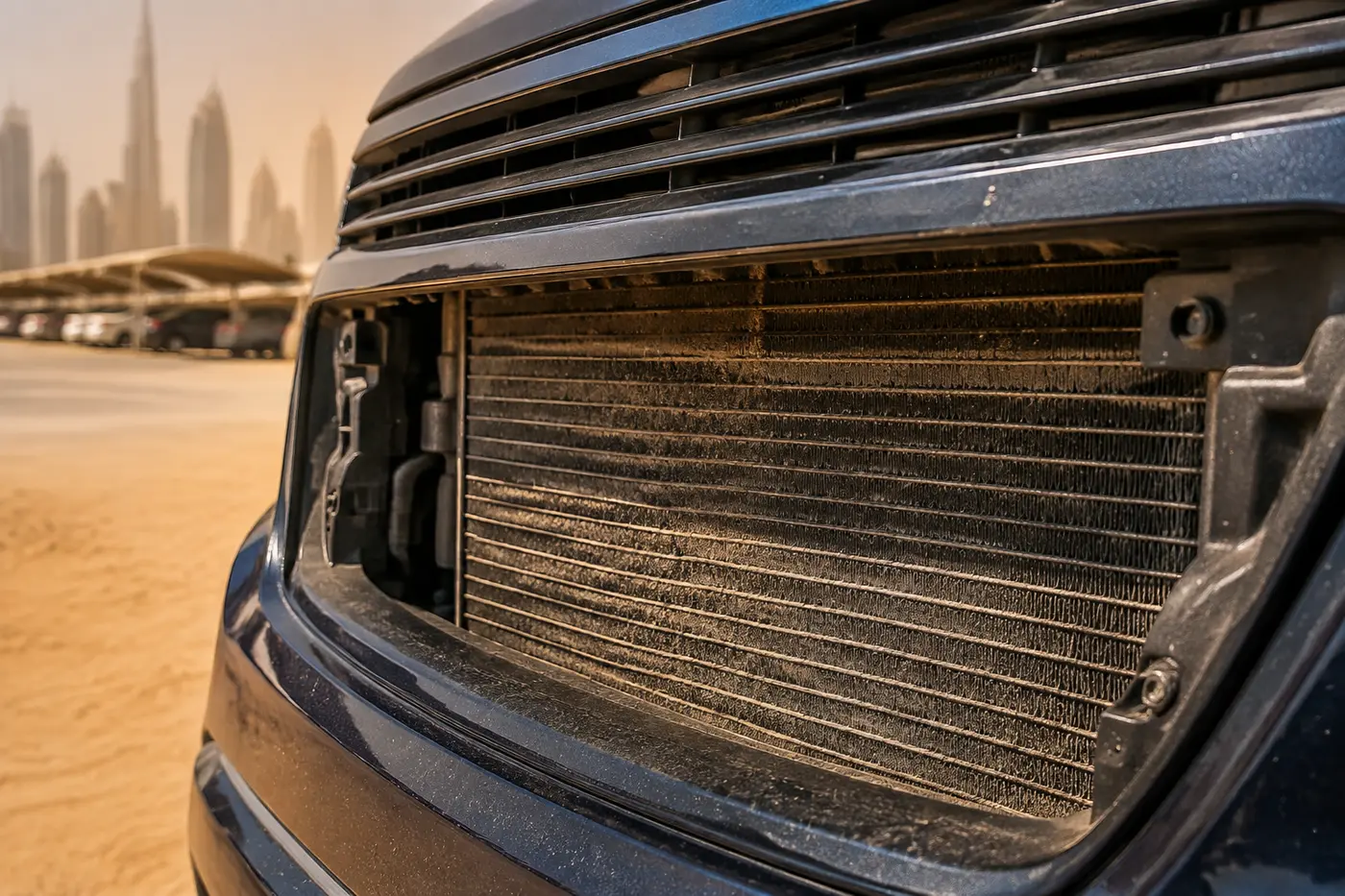
The condenser rejects refrigerant heat to outside air. The hotter that air becomes, the more demanding heat rejection is. Correct fan operation, clean fins and an accurate refrigerant charge become especially important.
At road speed, moving air crosses the condenser naturally. At idle and in congestion, electric fans must create much of that airflow. A marginal fan, control circuit or obstructed heat exchanger can therefore look acceptable on Sheikh Zayed Road and weak in a queue.
Fine material loads the cabin filter and settles on exposed heat exchangers. A restricted filter reduces the air that reaches the cabin. Contaminated condenser fins reduce the outside heat-transfer path. The symptoms feel similar, but the confirming checks are different.
Water condenses on a cold evaporator. More moisture means more condensate to manage, and a clear drain becomes important. Retained moisture, a dirty surface or a drainage issue can contribute to damp smells, but odour alone does not identify mould or justify a chemical treatment.
Every parked start repeats the high-load pull-down stage. A ten-minute journey may end just as the cabin surfaces and ductwork approach a stable condition. The driver experiences the hardest part again at the next stop.
Which parts lose their margin first
There is no universal Dubai failure order. Vehicle design, age, previous work, refrigerant type, driving pattern and storage conditions all matter. The useful approach separates the complaint from the possible system area and then names the test that would confirm it.
| What changes in the heat | Possible system areas | What should be checked |
|---|---|---|
| Cold while moving, warmer at idle | Condenser airflow, fan speed or direction, debris, charge, pressure control | Compare pressures, fan command and actual fan operation under the same ambient condition. |
| Strong air but it never becomes properly cool | Refrigerant charge, leak, compressor output, condenser heat rejection, expansion control, blend door | Confirm refrigerant specification and mass, system pressures, temperatures, command data and leak evidence. |
| Airflow starts strong then fades | Evaporator icing, cabin filter, blower control, temperature sensor plausibility | Track airflow and evaporator temperature over time, then inspect the filter and control response. |
| Cooling returns after a restart | Control protection, sensor input, clutch or variable-compressor command, icing | Read fault memory and live data before the restart erases the useful operating state. |
| Damp smell on humid starts | Cabin filter, evaporator surface, drain, intake contamination, retained moisture | Inspect the actual source and drainage path instead of masking the smell with fragrance. |
| Noise grows in the hottest conditions | Compressor load, high pressure, fan or bearing, belt drive, incorrect charge or contamination | Stop guessing from sound alone. Record when it occurs and inspect before secondary damage becomes possible. |
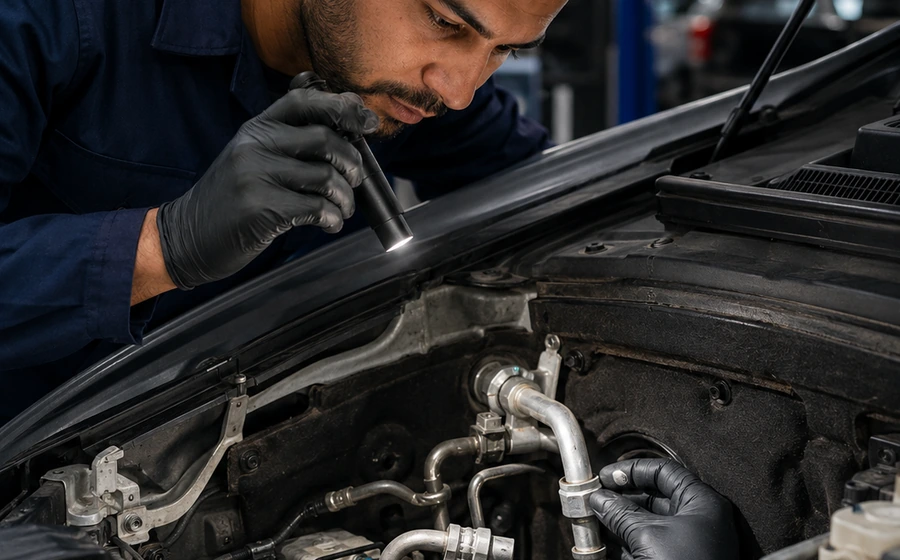
Manufacturer technical guidance supports this system view. HELLA lists contaminated condensers, defective fans and incorrect fan direction among the causes of high pressure and warm vent temperatures. MAHLE also notes that insufficient condenser airflow can prevent refrigerant from condensing properly and push high-side pressure upward. For a focused inspection of that heat-rejection path, see our car AC condenser service.
Locate your cooling pattern
Select the moment when the problem is easiest to reproduce. This is a triage aid, not a remote diagnosis.
Road speed may be hiding an airflow fault
When cooling improves as the car moves, condenser airflow deserves attention. The fan, fan command, fin condition and pressure response matter. Low charge or control faults can produce a similar pattern, so improvement on the road is a clue rather than proof.
Separate normal pull-down from lost capacity
A sun-soaked cabin will not feel cold immediately because the surfaces remain hot. Compare today with the same vehicle’s previous performance under similar parking and traffic conditions. A clear decline, uneven vent temperature or failure to stabilize deserves testing.
Time is part of the test
Cooling that fades after twenty or forty minutes can point toward icing, a changing sensor signal, pressure protection or compressor control. Record blower strength and whether a restart restores cooling. That timeline is more useful than checking only at startup.
Do not confuse airflow with refrigerant cooling
A restricted cabin air filter, blower problem, iced evaporator or air-door restriction can leave the vents weak even when the refrigeration circuit is producing a cold surface. Check the air path before assuming the gas is low.
Moisture reveals drainage and cleanliness problems
Odour after a humid start can involve the filter, evaporator surface, intake or drain. Note whether the smell fades, whether water appears in the cabin, and whether normal condensate drains under the car. Perfume does not confirm or remove the source.

Why short trips make the AC feel older than it is
The beginning of a trip is the steepest cooling challenge. The system is removing heat from the air while every hot interior surface is adding more. Recirculation can reduce the amount of hot outside air entering after the cabin is ventilated, but it cannot instantly cool the dashboard, seats and glass.

Now repeat that process several times. Park at school, restart for a short errand, stop for coffee, then sit in traffic. The vehicle may spend much of the day in pull-down rather than stable cooling. A driver can experience constant disappointment even if a longer uninterrupted road test eventually becomes comfortable.
This does not excuse a clear decline. It explains why a fair comparison uses the same mode, fan setting, number of passengers, sun exposure and driving condition. If last summer the vehicle held cooling at idle and this summer it only works while moving, weather alone is not a complete answer.
High load that may be normal
The cabin is initially very hot, cooling improves progressively, airflow stays strong, no warning appears, and the vehicle reaches a stable comfortable condition during a continuous drive.
Pattern that deserves diagnosis
Cooling has declined compared with the same car, becomes warm at idle, fades after time, produces abnormal noise, loses airflow, cycles unusually or requires repeated refrigerant additions.
The problems that topping up cannot solve
Car AC problems in Dubai heat are often blamed on “gas” because refrigerant level affects performance and is easy to discuss. But refrigerant is not routine fuel. A sealed system does not use it up during normal cooling. If the measured charge is low, the system needs a reasoned leak assessment rather than an automatic refill habit.
A pressure gauge alone cannot determine how much refrigerant is present. Gauge readings shift with outside temperature, air passing through the condenser, compressor strategy and the circuit design. Adding an unknown quantity can overcharge the system, raise pressure and make hot-weather performance worse. The correct process identifies the specified refrigerant, recovers and measures what is present when appropriate, repairs confirmed leakage, evacuates correctly, and charges by the manufacturer’s specified mass.
If cooling returns after a refill and then weakens again, document the time between changes. A slow leak may require a different method from a large active leak. Our car AC leak repair guide explains why visible dye, an electronic detector and pressure testing answer different questions.
Five useful habits that do not pretend to repair the car
Open doors or windows briefly when practical, then use the AC and recirculation according to the vehicle instructions. Reducing the initial cabin air temperature gives the system a more reasonable start.
Compare idle with road speed, first start with a long drive, and dry conditions with humid ones. Record the point at which cooling or airflow changes.
Follow the vehicle maker’s cabin-filter guidance and shorten inspection intervals when local dust loading justifies it. Do not attack delicate condenser fins with aggressive pressure washing.
Use the label and manufacturer specification. Avoid mixed refrigerants, stop-leak products and unknown oils, especially on hybrid and electric compressors where oil compatibility can be safety-critical.
A pre-summer comparison can find marginal airflow, control or charge conditions before they become impossible to ignore in peak heat.
A good Dubai AC test records the conditions
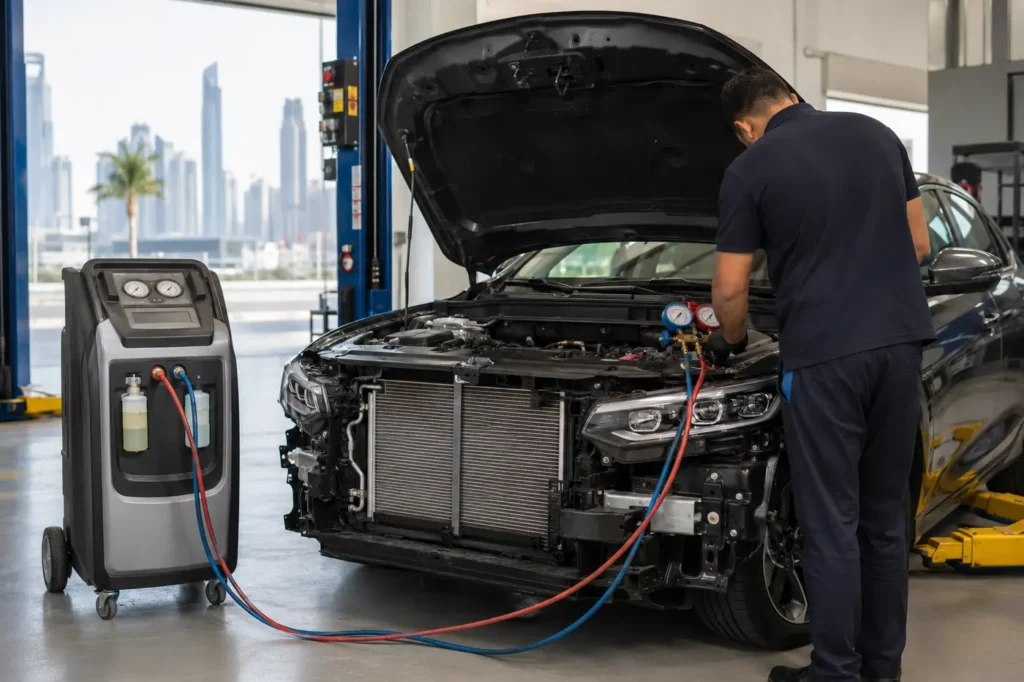
A single vent temperature without context can mislead. A meaningful check records ambient temperature, cabin starting condition, engine speed, recirculation mode, blower setting, doors and windows, vent selection and enough operating time to observe the pattern. The technician then compares pressures, line temperatures, fan command, actual fan operation, compressor command, airflow and relevant sensor data.
That process is why a proper car AC diagnostic can separate heat load from a fault. It also protects against replacing a compressor when the underlying problem is condenser airflow, a control input, incorrect charge or contamination. Car AC problems in Dubai heat deserve a system test under Dubai-like conditions, not a part guess made in a cool workshop bay.
Build a useful AC check-in note
Select what you have actually observed. The tool prepares text you can copy. It does not send information or diagnose the vehicle.
Let us reproduce the condition before recommending a part
Book the no-charge preliminary AC assessment offered by Car AC Heroes in Al Quoz 4. Bring the note above, your vehicle details, any warning messages, and the history of recent refills or repairs. Further diagnostic work may be necessary before a fault or price can be confirmed.
Request a free initial AC checkTechnical and UAE climate references
- UAE National Center of Meteorology weather observations and forecasts
- UAE National Air Quality Index Manual on dust and particulate conditions
- Federal Competitiveness and Statistics Centre humidity indicators by weather station
- HELLA Tech World automotive air-conditioning diagnosis guidance
- MAHLE automotive air-conditioning technical guide
Related Car AC Guides