Car AC fundamentals
How a Car AC System Works
Your air conditioner does not manufacture cold air. It collects heat from the cabin, carries that heat through a sealed refrigerant circuit, and releases it outside the car.
This sounds like one process, but two loops are working together. A simple way to understand how car AC works is to track them separately. Refrigerant travels through sealed pipes and components. Cabin air follows a separate route through a filter, blower, evaporator and dashboard ducts. They meet at the evaporator without mixing.
That distinction explains many confusing symptoms. Strong airflow can still be warm if the refrigerant loop is not moving enough heat. The refrigerant side can be working while a blocked filter, tired blower or air door prevents the cooled air from reaching you. A good diagnosis therefore checks both loops, plus the controls that coordinate them.
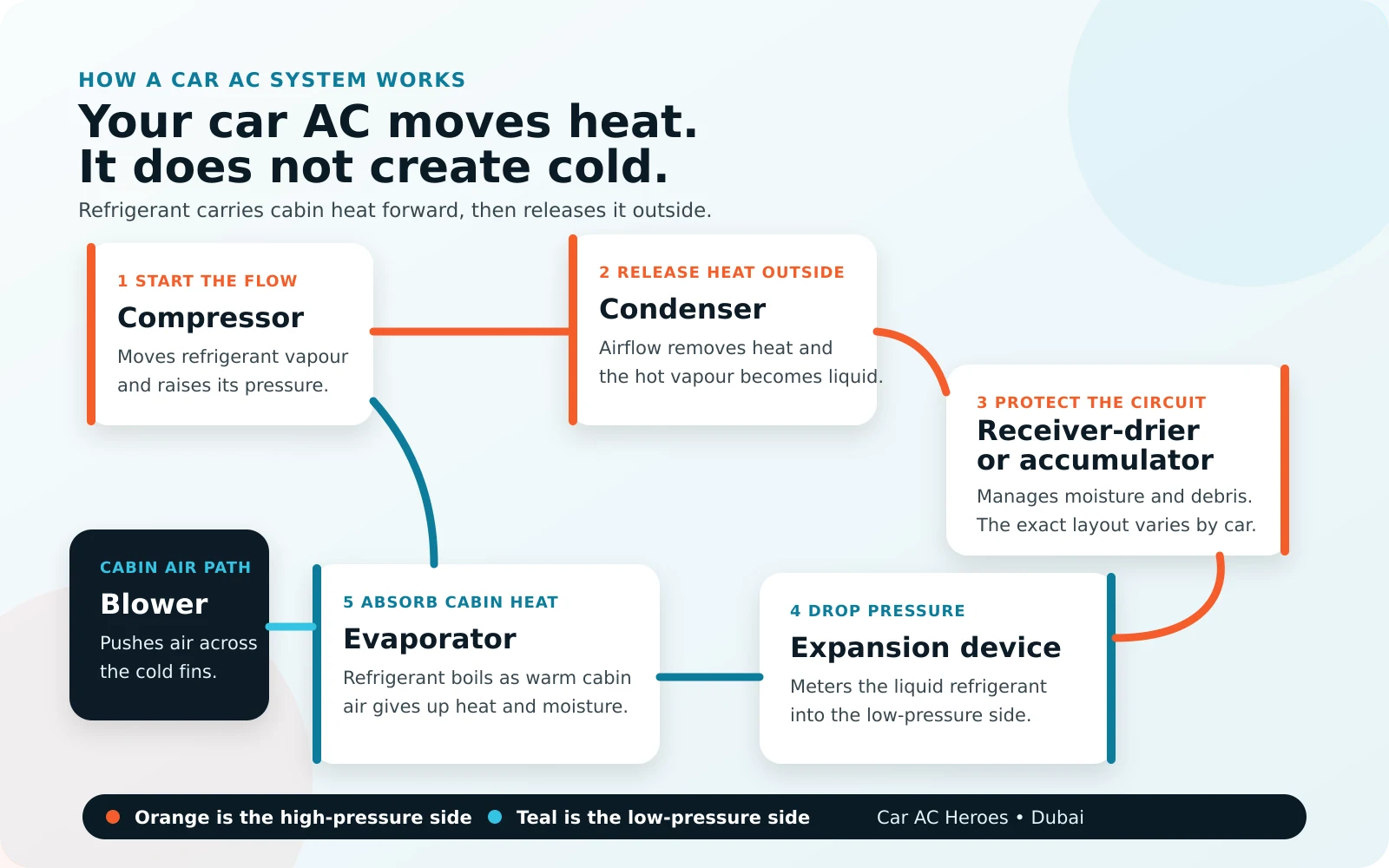
A closed circuit changes refrigerant pressure and physical state so it can absorb heat inside and reject heat outside.
A blower pulls fresh or recirculated air through the filter, across the evaporator and through doors that feed the vents.
The useful idea is heat transfer, not cold production
A parked car in Dubai can contain a remarkable amount of stored heat. Sunlight warms the glass, seats, dashboard, roof and trim. Even after the air itself begins to cool, those surfaces continue passing heat back into the cabin. That is why an AC system needs time to pull the whole cabin down after a hot soak.
Refrigerant is useful because its boiling and condensing temperatures change with pressure. On the low-pressure side, it can boil at a temperature low enough to absorb heat at the evaporator. On the high-pressure side, it can condense at a temperature high enough to release heat through the condenser. The compressor and expansion device create those different pressure conditions. For the practical gauge side of this, see our car AC pressure readings and gauge-pattern guide.
The refrigerant is not consumed as fuel. In a healthy sealed system it keeps circulating. If the charge is low, refrigerant has usually escaped somewhere, even when the leak is slow or difficult to see. That is why repeated topping up is not the same as finding and repairing the cause. Our guide to car AC leak detection explains how test choice depends on the fault and system condition.
One complete trip around the refrigerant circuit
The exact hardware varies by model. Some cars use a thermal expansion valve and receiver-drier. Others use a fixed orifice tube and accumulator. Many newer vehicles use variable-displacement compressors, electronic valves or electric compressors. The central heat-moving cycle remains recognisable. For a function, location, symptom and repair decision for each unit, use our complete car AC parts guide.
The compressor raises pressure and keeps refrigerant moving
The compressor receives low-pressure refrigerant vapour from the evaporator side. It pumps that vapour onward at a much higher pressure. Compression also raises its temperature, so the refrigerant arriving at the condenser is hotter than the outside air and can release heat to it.
Older belt-driven compressors may cycle through an electromagnetic clutch. Variable-displacement designs can keep turning while changing output, and hybrid or electric vehicles may use a high-voltage electric compressor. This is why the absence of a familiar clutch click does not prove the compressor has failed.
Leaves as hot, high-pressure vapourThe condenser releases the heat in front of the car
The condenser is a heat exchanger, commonly mounted in front of the engine radiator. Outside air flows across its thin fins. As the refrigerant gives up heat, it changes from a high-pressure vapour into a high-pressure liquid.
Vehicle speed pushes air through the condenser on the road. At idle or in slow traffic, electric cooling fans have to create that airflow. This is why cooling that becomes weaker in traffic but improves while moving can point toward a condenser-airflow or fan problem, although pressure, charge and control faults can produce similar behaviour. One symptom is a clue, not a verdict.
Leaves mainly as high-pressure liquidThe receiver-drier or accumulator protects the circuit
These components are not interchangeable, but both help manage refrigerant condition. A receiver-drier belongs on the high-pressure liquid side of many expansion-valve systems. It can store a small amount of liquid refrigerant, filter particles and use desiccant to capture limited moisture.
An accumulator sits on the low-pressure side of many orifice-tube systems. It helps prevent liquid refrigerant from reaching a compressor that is intended to receive vapour. The vehicle’s design determines which arrangement it uses. Neither component is a substitute for correct recovery, evacuation, measured charging and contamination control during service.
System-dependent componentThe expansion device meters flow and drops pressure
The expansion valve or orifice tube creates a restriction between the high-pressure and low-pressure sides. As refrigerant passes through, its pressure falls sharply. The colder low-pressure mixture entering the evaporator is now ready to absorb heat.
An electronically controlled or thermostatic valve can change flow according to operating conditions. A fixed orifice has no moving valve mechanism, so the system controls capacity in other ways. Frost near this point can be meaningful, but it does not by itself prove the valve is blocked. Incorrect charge, moisture, airflow and temperature-control problems can also change where ice appears.
Becomes a cold, low-pressure mixtureThe evaporator absorbs cabin heat and removes moisture
The evaporator is another heat exchanger, hidden inside the dashboard or HVAC housing. Warm air passes over its fins. Heat moves from that air into the cold refrigerant, which boils and returns toward the compressor as a low-pressure vapour.
Moisture in the air also condenses on the cold fins, much like water on the outside of a chilled bottle. That water should flow into a tray and leave through a drain under the vehicle. A puddle of clear water after AC use is therefore often normal. A blocked drain, dirty evaporator surface or retained moisture can contribute to damp odours and water where it should not be.
Cabin heat enters the refrigerantThe blower and air doors deliver the result
The blower is the fan you feel through the vents. It draws outside air or recirculated cabin air, usually through a cabin filter, then pushes it across the evaporator. Temperature-blend doors may route some air through the heater core before distribution doors send it toward the face, feet or windscreen vents.
Automatic climate control adds sensors and control logic. Depending on the vehicle, the system may consider cabin temperature, outside temperature, sunlight, evaporator temperature, refrigerant pressure, engine load and requested temperature. A weak blower, restricted filter or stuck door can therefore imitate a refrigeration fault even when the evaporator is cold.
Air and refrigerant remain separateWhy the air feels cooler and drier
The system changes two things you can feel. First, it lowers the air temperature by moving heat into the refrigerant at the evaporator. Second, it lowers humidity because water condenses on the evaporator fins and drains away. Drier air makes the cabin feel more comfortable and helps demist glass.
This is also why the AC may operate during demisting even when the weather is not hot. The vehicle can dry the incoming air, then add some heat to deliver warm but dehumidified air to the windscreen. The AC button is not simply an instruction to produce maximum cold.
Recirculation changes where the blower draws air. After the hottest trapped air has been expelled, recirculating already-cooled cabin air can reduce the load compared with continuously pulling in hotter outside air. Some climate-control systems switch recirculation automatically, while others limit it in demist modes to manage visibility.
What Dubai heat changes
The physics does not change in the UAE, but the operating load does. A useful assessment records the conditions instead of judging the whole system from one vent reading.
What common symptoms suggest about the two loops
A symptom narrows the search, but it does not identify a part with certainty. The same complaint can have refrigerant, airflow, electrical or control causes. Testing should reproduce the condition and then separate observation from confirmation.
| What you notice | Which path deserves attention | Why it is not a diagnosis yet |
|---|---|---|
| Strong airflow but warm air | Refrigerant flow, compressor command, condenser heat rejection, blend position | Several faults can leave the blower working while the evaporator stays too warm. |
| Weak airflow at every temperature | Cabin filter, blower, controller, evaporator icing, duct or door restriction | A cold evaporator cannot cool the cabin effectively if too little air crosses it. |
| Cold on the road, warmer in traffic | Condenser fan and airflow first, then pressures, charge and control behaviour | Road speed masks some airflow faults, but an incorrect charge can also change idle performance. |
| Cold for a while, then weak or warm | Evaporator icing, sensor plausibility, pressure protection, compressor control | A restart may temporarily reset a control state or allow ice to melt. |
| One side warmer than the other | Zone doors, actuators, sensors and control data, with refrigerant checks where relevant | Multi-zone layouts vary, and a low charge can create uneven evaporator performance in some systems. |
| Damp or musty smell | Cabin filter, evaporator surface, intake, drain and retained moisture | Spraying fragrance into vents can hide the odour without removing its source. |
If the complaint changes between idle, road speed, first start, afternoon heat or a long drive, record that pattern. It gives a technician much more value than saying only that the AC is not cold. For a measured inspection across airflow, refrigerant and electronic control, see our full car AC diagnostic service.
Four myths that cause expensive wrong turns
Knowing how car AC works makes four popular shortcuts much easier to challenge before they turn into the wrong repair.
Low refrigerant is one possibility, but a failed fan, compressor-control fault, blocked condenser, air-door problem or sensor input can also leave the vents warm. A measured car AC gas refill should use the refrigerant type and charge quantity specified for the vehicle, not pressure alone.
Refrigerant circulates in a sealed system. A very slow leak may take time to become obvious, but adding refrigerant repeatedly does not repair the escape path. Overcharging can also reduce performance and raise pressure.
The compressor creates circulation and the pressure difference that makes heat transfer possible. Cabin air becomes cooler at the evaporator, while heat leaves through the condenser. A compressor should not be condemned until the system has checked command, pressure, charge, airflow, electrical supply and contamination risk as relevant.
The temperature request is an instruction to the climate-control system. Depending on the car, it may alter compressor output, fan speed, recirculation and blend-door position. Setting the display lower does not bypass a mechanical fault or instantly cool hot interior surfaces.
Why DIY recharge cans can create more uncertainty
A single low-side pressure reading does not reveal the correct refrigerant mass. Pressure changes with ambient temperature, airflow, compressor control, system architecture and current operating state. A can may add an unknown amount to a system that is already correctly charged or has another fault.
Vehicles also differ in refrigerant and oil specification. R134a and R1234yf are not casual substitutes for one another. Hybrid and electric compressors may require oils with specific electrical-insulation properties, and the high-voltage system introduces hazards beyond ordinary DIY work.
A better way to describe an AC problem
Before booking, note when the symptom appears, which vents are affected, the blower strength, whether recirculation changes it, and whether cooling improves with vehicle speed. Include the make, model, year, refrigerant label if safely visible, and any warning messages. This does not replace testing, but it helps reproduce the fault.
How car AC works in Dubai is the same cycle used elsewhere, but our Dubai heat failure guide explains how solar load, high ambient temperature, dust and slow traffic remove operating margin. The most useful test is therefore not a race to produce the lowest vent number. It is a comparison under recorded conditions that explains whether the refrigeration path, airflow path and control path are working together.
Not sure which part of the cycle is letting you down?
Ask Car AC Heroes about a free initial AC check in Al Quoz 4. Tell us when the cooling changes, your vehicle details and any recent refill or repair history. A confirmed diagnosis or quotation may require additional testing.
Request an AC checkTechnical references
This guide uses manufacturer and regulator material for the core refrigeration cycle and responsible service context.
Related Car AC Guides