
Car AC Heroes knowledge centre
Car AC guides for Dubai drivers
Clear, useful explanations for the moments when your cooling changes, the cabin feels wrong or a repair decision is not yet obvious. Start with what you notice, then go as deep as you need.
Find your route
Start with the symptom, not the part name
You do not need to guess whether the problem is the compressor, gas or a sensor. These paths help you identify the most useful next guide or service page without pretending to diagnose the car remotely.
Latest knowledge
Read the newest guide first
Every new post in Car AC Guides appears here automatically. The newest story leads the page, while the rest stay easy to browse.
 Guide Car AC Guides
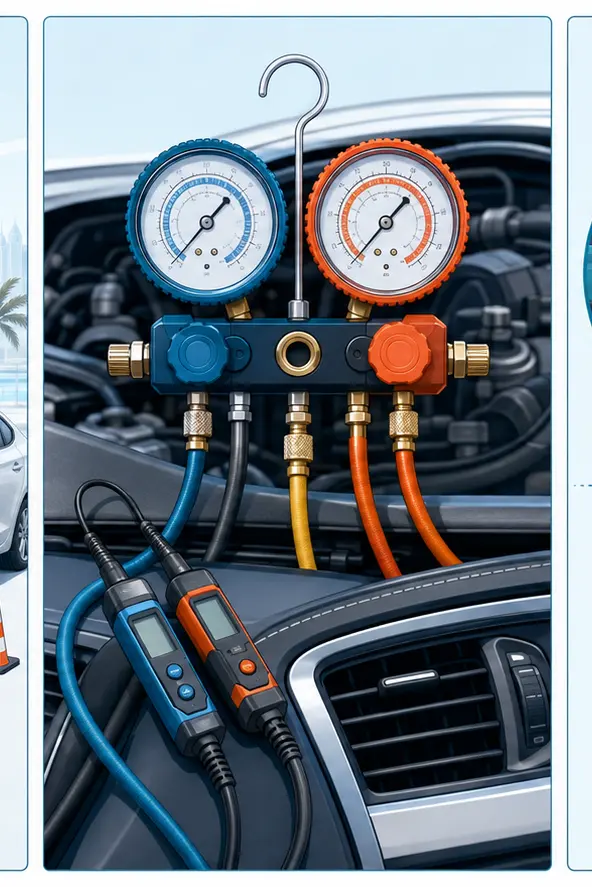
What a Proper AC Diagnostic Includes and What Pressures Mean
Understand car AC pressure readings, test conditions and supporting checks before approving refrigerant or component repairs. Read the guide
 Guide Car AC Guides
Ozone Treatment for Cars and Whether It Actually Works
Learn when car ozone treatment may reduce residual odour, when it cannot work, and why cleaning and ventilation come first. Read the guide
- Guide Car AC Guides
R134a vs R1234yf Which Gas Does Your Car Use
Find out whether your car uses R134a or R1234yf. Learn how to read the under-bonnet refrigerant sticker, why brands and years are only clues, and why the gases cannot… Read the guide
 Guide Car AC Guides
Why Car ACs Fail Faster in Dubai’s Heat
Dubai heat, sand, humidity and short trips expose weak car AC systems. Learn the real failure patterns and when a free AC check makes sense. Read the guide
 Guide Car AC Guides
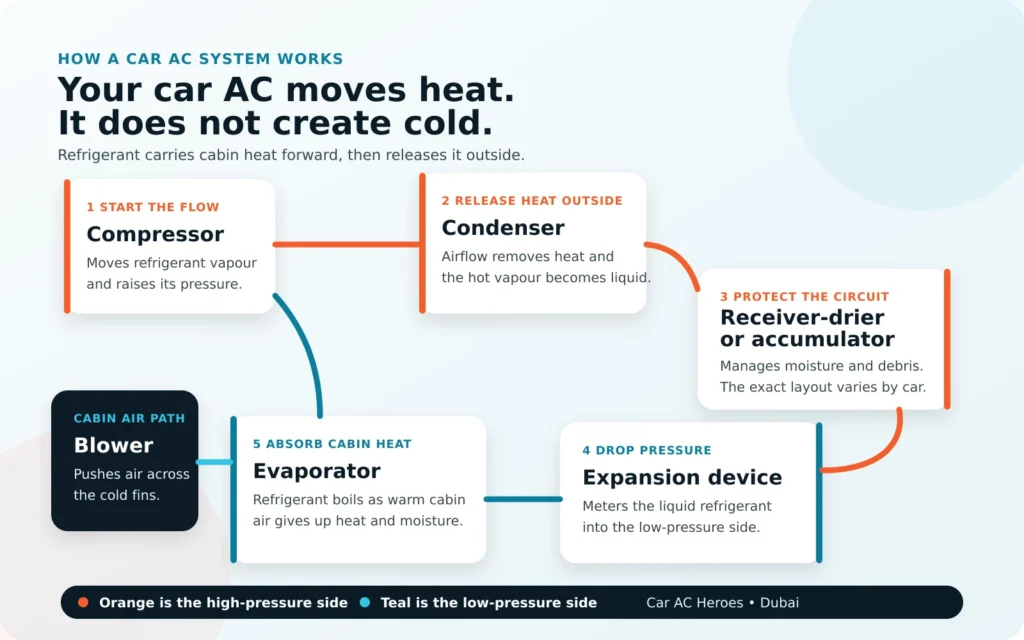
How a Car AC System Works
Learn how a car AC system works through the refrigerant loop, airflow path and electronic controls, with Dubai-specific examples and symptom clues. Read the guide



When reading is not enough
Use the guide to describe the pattern, not to choose a part
If your car is still not cooling properly, note whether it changes in traffic, after a hot soak, with recirculation on, or at a particular fan speed. Then book a full AC diagnostic with the vehicle make, model and year. That pattern is useful evidence. It is not a reason to replace a part without testing.
Choose by symptom
Find the right guide by what the car is doing
A useful AC diagnosis starts with the pattern, not with a guessed part. Tell us what changes, when it changes and whether the problem depends on traffic, engine speed, fan speed or time in the sun. These routes help you narrow down the right information before deciding what should be tested.
Dubai driving conditions
Why the same AC fault can feel different in Dubai
Dubai heat does not create a completely different air-conditioning system, but it exposes weak systems faster. A car that feels acceptable early in the morning may struggle after sitting in direct sun, and a system that cools properly at road speed may lose performance in slow traffic. Those differences are useful diagnostic clues because they show how the system behaves under higher heat load and lower condenser airflow.
Dust also changes what should be checked. Restricted condenser fins or a heavily loaded cabin filter can reduce performance without creating the same symptoms as low refrigerant. Humidity matters too: condensation, evaporator moisture and drain problems can contribute to musty smells or water inside the cabin. That is why our guides keep airflow, refrigerant, electrical control and moisture-related faults separate instead of treating every weak AC complaint as a gas-refill problem.
If the fault changes after a hot soak, during idling, with recirculation on, or after twenty to thirty minutes of driving, note it. Those details are often more useful than simply saying the AC is “not cold.”
Diagnosis before parts
What a proper AC check should separate
Pressure readings, vent temperature and refrigerant quantity can be useful, but none of them should be interpreted in isolation. A good check asks whether the system has enough airflow, whether the condenser can reject heat, whether the compressor is being commanded and working correctly, whether the refrigerant type and charge are correct, and whether a leak or control fault is present.
Use the library well
Use these guides to ask better questions, not to guess a repair
These guides are designed to help Dubai drivers understand symptoms, common failure patterns and the logic behind testing. They are not a substitute for checking the vehicle. Two cars can produce the same warm-air complaint for completely different reasons, and replacing a compressor, valve or sensor based only on a symptom can turn a small fault into an expensive mistake.
When you contact the workshop, send the make, model, year and the exact pattern you noticed. Mention whether the AC is colder while moving, whether one side is different from the other, whether the problem appears only after the car has been parked in the sun, and whether there are smells, noises or water inside the cabin. That gives the technician a much better starting point and helps us choose the right diagnostic path before parts are discussed.